

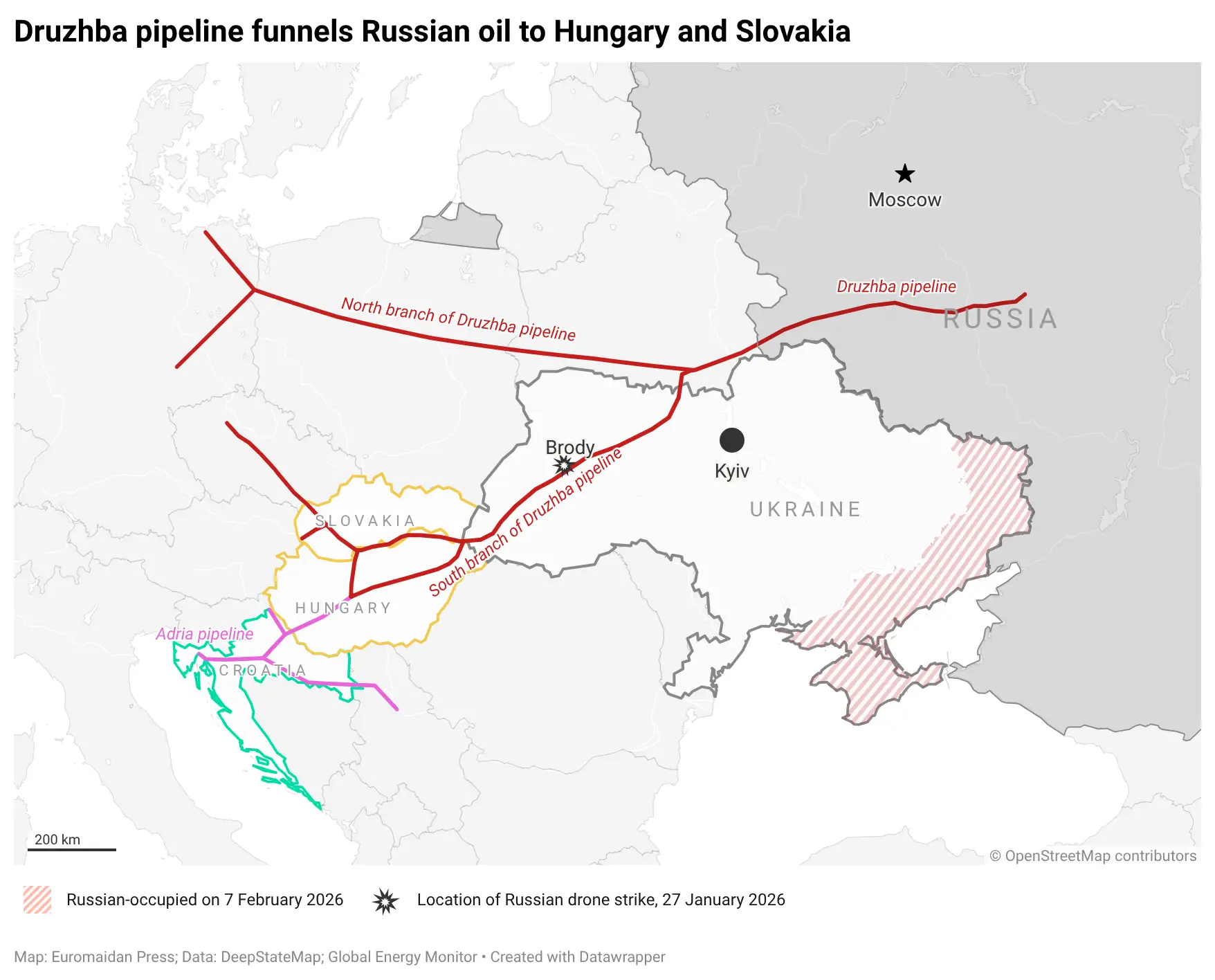
Hungary’s oil company MOL imported about 35,000 tonnes of Ukrainian crude oil through the Druzhba pipeline at Kyiv’s request after a strike and fire damaged pumping installations in western Ukraine on 27 January, MOL executive chairman Zsolt Hernadi told Hungarian commercial television station ATV on Monday.
The same government that deployed troops to “protect” Hungarian energy infrastructure from a supposed Ukrainian blockade was already receiving Ukrainian oil.
The admission contradicts what Budapest has claimed for five weeks: that Ukraine is keeping the pipeline shut for political reasons. In reality, Ukrainian operators pumped their own crude into Druzhba to prevent the post-strike fire from spreading—and Orbán’s state-aligned refiner took every barrel.
Although MOL is publicly listed, three foundations linked to Orbán control 30.49% of the company, according to the Center for the Study of Democracy, making it an instrument of his energy policy.
The same government that deployed troops to “protect” Hungarian energy infrastructure from a supposed Ukrainian blockade was already receiving Ukrainian oil through the pipeline in question.
What MOL’s chairman said
Hernadi told ATV that when the fire broke out at the Brody pumping station in Lviv Oblast, Ukrainian operators began pumping crude from other storage facilities into the pipeline to prevent the blaze from escalating. Ukraine then asked MOL to accept the oil.
“And we took 35,000 tons of Ukrainian crude, which arrived on the Druzhba pipeline over 2-3 days.”
“When the fire broke out… from other storages they started to pump Ukrainian crude into the pipeline. The Ukrainian colleagues asked us… to take over this oil to prevent the problem and fire escalating further,” Hernadi said. “And we took 35,000 tons of Ukrainian crude, which arrived on the Druzhba pipeline over 2-3 days.”
Hernadi added that MOL believes the pipeline itself suffered no damage. If the pipe is intact, Ukraine’s difficulties are localized to the pumping infrastructure that Russia struck.
“He is doing this to help the Tisza Party come to power.”
The shutdown also costs Ukraine. Before the 27 January strike, Ukraine was injecting approximately 40,000 metric tonnes of its own crude into Druzhba monthly for export, Reuters reported on 27 February, citing three industry sources.
After Russia destroyed Ukraine’s last domestic refining capacity in mid-2025, the pipeline was the only available export route. Kyiv has no financial motive to keep it closed.
Within hours of the ATV broadcast, Orbán posted on Facebook that the interview proved the opposite of what it showed—claiming it confirmed Ukraine’s blockade was political. “He is doing this to help the Tisza Party come to power,” Orbán wrote. He did not address the 35,000 tonnes of Ukrainian crude his own refiner accepted.
“Maybe he’s a magician”
Ukrainian President Volodymyr Zelenskyy responded to Orbán’s satellite photos.
“You can see the technical tanks from satellite, and that one large tank is ruptured. But you can’t see the control panel or the underground pipe,” Zelenskyy told media in comments published by Liga.net. “Maybe he’s a magician, Orbán, and can see underground what’s happening with the pipe?”
Trending Now
“Has anyone heard from Orbán or Fico—‘we are very grateful to Ukraine,’ or ‘we’re so sorry for the families, the relatives, the loved ones who were hurt’?”
In an exclusive interview with Italy’s Corriere della Sera, Zelenskyy laid out the human cost Budapest and Bratislava have not acknowledged. After the first Russian strike on Druzhba, Ukraine repaired the damage. During that repair, another attack hit—and workers were injured.
“Has anyone heard from Orbán or Fico—‘we are very grateful to Ukraine,’ or ‘we’re so sorry for the families, the relatives, the loved ones who were hurt’? Not a single word,” Zelenskyy told Corriere. “Only that we owe them again.”
Nobody in Ukraine wants to restore Russian oil transit so Moscow can earn money and spend it on war.
He told the Italian newspaper he had explained to Slovak Prime Minister Robert Fico directly: nobody in Ukraine wants to restore Russian oil transit so Moscow can earn money and spend it on war. “If European leaders ask us to do this, we need to understand—what is the price? People must die? What do you want?”

The leverage behind the blockade claim
The Druzhba shutdown has given Budapest a pretext for a far broader campaign. Zelenskyy told Liga.net that Hungary is currently blocking a 90 billion euro preferential loan for Ukraine, the EU’s 20th sanctions package against Russia, and the opening of EU accession negotiating clusters. “There is no feedback at all,” the president said.
Since Russia’s full-scale invasion in 2022, Hungary has increased its dependency on Russian crude from 61% to 92%—turning a temporary EU sanctions exemption into a permanent loophole, according to the Center for the Study of Democracy.
Fidesz billboards across Hungary depict Zelenskyy demanding money.
MOL’s main Hungarian refinery is still operating at 40% below capacity due to a fire last year, Hernadi said in the same ATV interview—meaning Hungary needs less oil than usual.
Orbán, trailing opposition leader Péter Magyar by 20 points in polls ahead of Hungary’s 12 April election, has built his campaign around the pipeline crisis. Fidesz billboards across Hungary depict Zelenskyy demanding money.
Kyiv has offered Budapest and Bratislava alternative non-Russian supply routes. MOL itself admitted in November it can meet 80% of its crude needs through Croatia’s Adriatic pipeline. The EU Commission will submit legislation on 15 April—three days after Hungary votes—to ban all Russian oil imports permanently by the end of 2027.
Ukraine’s embassy in Budapest stated Monday that the possibility and timing of repairs “was solely dependent on security circumstances” as Russia continues its attacks.
Read also
-
“Now it’s your turn”: US envoys planned to show Moscow a refinery pause and a diesel deal, then ask for something back, a source tells Reuters
-
“A warning to companies that remain”: Russia takes control of Nestlé and Auchan’s assets – companies that stayed in Russia following the full-scale invasion of Ukraine
-
“I can travel back to Finland and be safe. That is a luxury”: Sanna Marin on the Russian strike that stopped her train from Kyiv


