

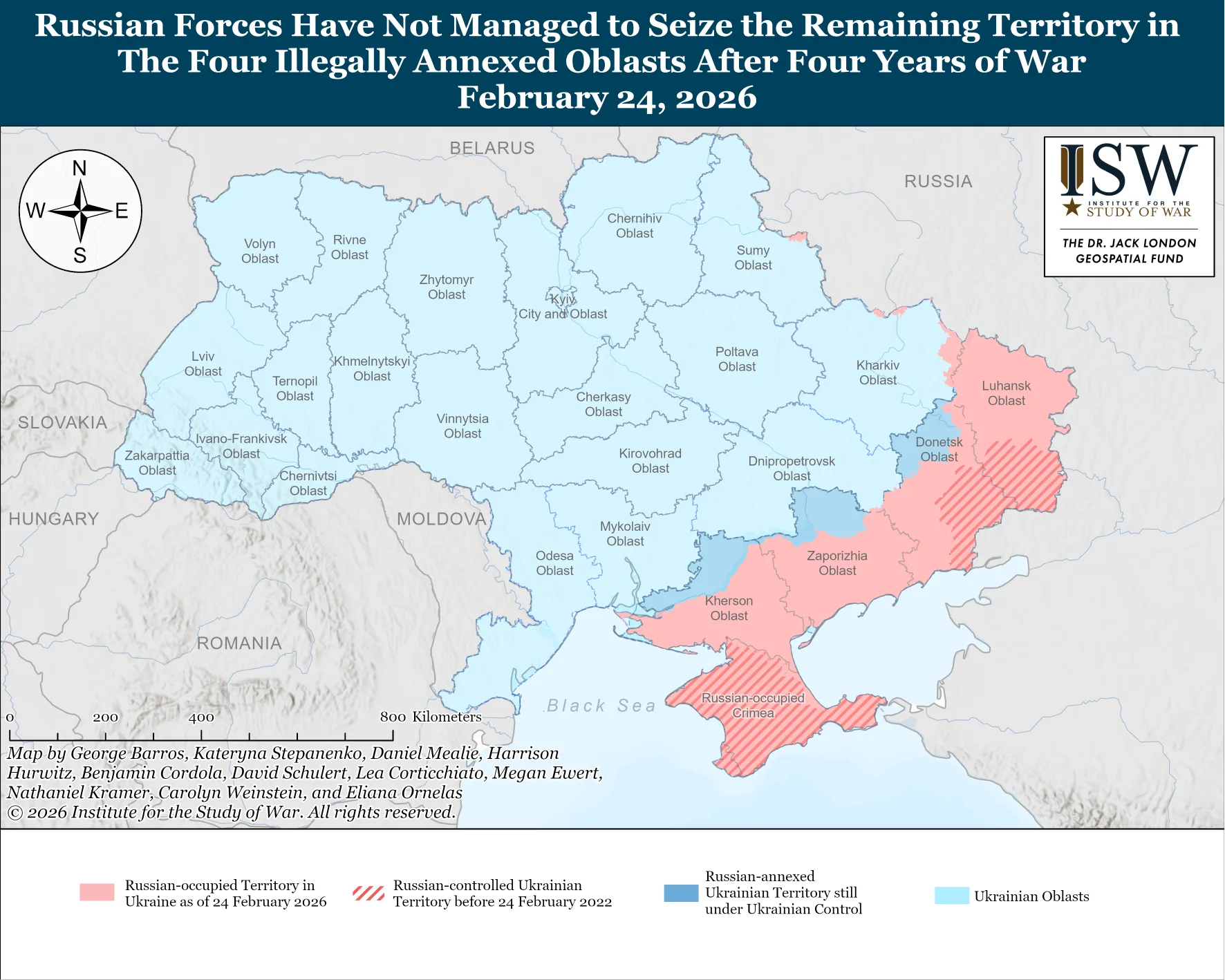
ISW reported on 24 February that "the fifth year of Russia's invasion is not beginning well for Moscow," with recent Ukrainian battlefield successes Russian claims that things can only get worse for Ukraine the longer Kyiv delays surrendering.
The assessment, published on the fourth anniversary of the full-scale invasion, concluded that Russia "has not secured a permanent edge" and has failed to achieve any of its original war aims.
Ukrainian counterattacks produce largest gains since Kursk incursion
Ukrainian forces retook at least 183 km² near Kupiansk between 11 and 25 December and a net 165 km² in the Novopavlivka, Oleksandrivka, and Huliaipole directions in February — the most significant gains since Ukraine's incursion into Kursk Oblast in August 2024, ISW reported.
"Battlefield realities as of late February 2026 show that continued significant Russian battlefield gains, let alone total victory, are not inevitable," the think tank wrote.
Near Kupiansk, Ukrainian forces severed fragile Russian ground lines of communication that overstretched troops had advanced on without consolidating. In the south, counterattacks took advantage of Russian command-and-control failures caused by two simultaneous disruptions: Elon Musk's cooperation with Ukraine's Defense Ministry to block illegal Russian Starlink use, and the Kremlin's decision to throttle Telegram — a platform Russian soldiers relied on for essential battlefield communications.

Ukraine’s Air Assault Forces officially reveal southern “operation” that reclaimed 300+ km² and eight settlements
ISW noted that the Kremlin was likely unaware "of the degree to which Russian forces continued to rely on that platform" and "prioritized securing control of the information space over the conduct of military operations even once they were made aware of that reliance."
"Putin’s invasion of Ukraine enters its fifth year with Russia having failed to achieve any of its original war aims and facing setbacks on the battlefield amid mounting casualties," ISW wrote.
Counterattacks disrupting Russia's spring offensive preparations
ISW cautioned that the localized counterattacks are unlikely to grow into a large-scale counteroffensive and that Russian forces "will very likely stabilize their positions and even begin advancing again." But the gains carry lasting operational consequences:
Russian troops planned for the spring-summer 2026 offensive must now first fight to reestablish defensive positions, then regain lost ground — only then can they launch planned operations, "with troops already attrited and worn down rather than fresh."
"Events on the battlefield refute Moscow's claims that a Russian battlefield victory is inevitable and that Ukraine should surrender to Russia's demands before its position deteriorates further," ISW says.


