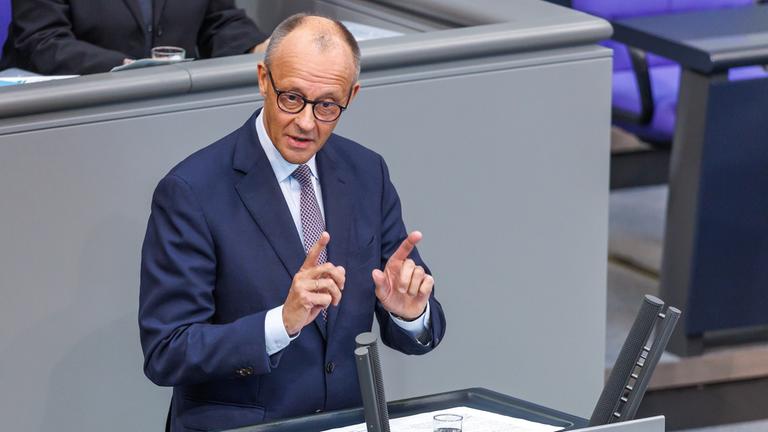
German Chancellor Friedrich Merz declared that Europe must learn to "speak the language of power politics" during his address to the Bundestag on 29 January, calling for massive investments in European defense capabilities.
The speech comes amid heightened tensions in US-European relations following President Donald Trump's threats to impose tariffs on countries not supporting his Greenland plans, though Trump later backed away from those threats. Ukrainian President Volodymyr Zelenskyy recently suggested at the Davos economic forum that Europe should create joint armed forces under current circumstances rather than rely entirely on NATO guarantees.
"We will only be able to use this attractiveness and this self-confidence, and we will only be able to partially assert our ideas in the world if we ourselves learn to speak the language of power politics. If we ourselves become a European power," Merz said in his speech.
The chancellor outlined three key requirements for Europe: taking security into its own hands, making the economy competitive again, and maintaining unity. "We must massively invest in our own European defense capability," he emphasized.
Merz reminded parliament that Germany and the Bundestag majority decided last year to increase national defense spending to up to 5% of GDP. "This had a significant impact for many European neighbors. We took the lead and others in Europe followed us," he said.
Addressing economic challenges, the chancellor noted that the EU's growth gap compared to the US and China has been widening for over a decade. "If we are serious about shaping global politics, then the ability to shape global politics depends above all on economic strength," Merz added.
On transatlantic relations, Merz struck a balance between partnership and sovereignty. "The transatlantic alliance, the transatlantic trust is still a value in itself for us in Germany," he said, while adding: "As democracies, we are partners and allies, not subordinates."
The chancellor firmly rejected what he described as attempts to intimidate Europe with tariff threats. "Anyone in the world who thinks they need to use tariffs to make policy against Europe must know, and they now know, that we are ready and able to defend ourselves against this if necessary," Merz declared.
Merz announced that EU heads of state and government will hold a special summit in Belgium on 12 February, at his initiative, dedicated exclusively to making the European economy competitive again. He referenced reports by former Italian Prime Ministers Enrico Letta and Mario Draghi, stating: "The reports and proposals from both must not disappear into the filing cabinets of the European Commission."
The chancellor also addressed Germany's military contributions to NATO, defending the country's deployment to Afghanistan following 11 September 2001. "59 Bundeswehr soldiers lost their lives during the almost 20-year mission in Afghanistan. Well over 100 were injured, some seriously, in combat and attacks. We will not allow this mission, which we also carried out in the interest of our alliance partner, the United States of America, to be disdainfully disparaged today," he said.
On trade policy, Merz expressed support for the Mercosur agreement and called for a free trade agreement with India. "With 1.4 billion inhabitants, the largest democracy in the world, together with Europe's over 2 million inhabitants, consumers - we would form the largest contiguous internal market in the world after Mercosur, with around a quarter of today's world population," he explained.
Domestically, the chancellor reported early signs of economic recovery. "For the first time in years, private sector investments in Germany are again larger than capital outflows from Germany. These are the first indications that our economy is beginning to recover," Merz noted.