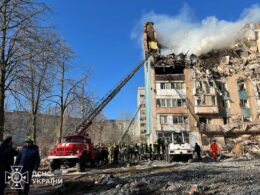

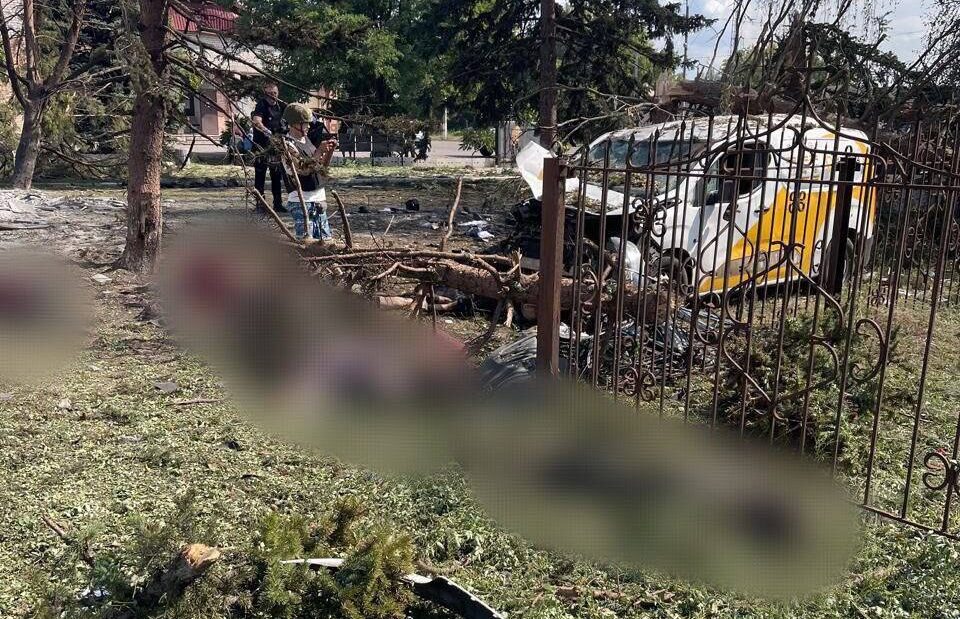
Russian attacks killed 2,514 civilians in Ukraine in 2025, with another 12,142 wounded, according to the UN Human Rights Monitoring Mission (HRMMU). The death toll represents a 31% increase from 2024 and marks the highest civilian casualty figure since the full-scale invasion began.
The mission's monthly report found that 97% of confirmed deaths from Russian attacks occurred on Ukrainian-controlled territory. HRMMU attributes the rising casualties to intensified fighting along the front line and Russia's expanded use of long-range weapons.
"63% of Ukrainian deaths in 2025 occurred in front-line districts," the report states. Intensified Russian attempts to capture territory led to civilian deaths and injuries, destruction of critical infrastructure, suspension of essential services, and new waves of displacement.
Elderly Ukrainians bore a disproportionate burden of the war's impact. Though they comprise only 25% of Ukraine's population, they represent a significant share of those still living in front-line communities.
Drone warfare transforms front-line areas
Drone attacks by Russian forces surged dramatically in 2025, killing 577 civilians and wounding more than 3,000 — a 120% increase compared to the previous year.
"The expanded use of short-range drones has made many areas near the front line essentially uninhabitable," said HRMMU head Danielle Bell. "As essential services cease operations and infrastructure is destroyed, in some communities it has become too dangerous even to provide emergency medical care or evacuate civilians. In 2025, many people who survived years of fighting were finally forced to leave their homes."
Long-range weapon strikes increased significantly from June 2025 onward, the UN recorded. These attacks across the country killed 682 people and wounded nearly 4,500 — a 65% increase from 2024.
Russia escalates with "Oreshnik" missile after Paris talks
On 8 January, Russia deployed the medium-range "Oreshnik" missile with a kinetic warhead against Ukraine, according to Defense Express. The strike targeted Lviv Oblast, which borders Poland, and came just two days after Western partners formalized security guarantees for Ukraine in the Paris Declaration.
This marked the second use of the nuclear-capable missile against Ukraine since 2022. Moscow stated that any military contingent in Ukraine would be regarded as foreign intervention, indicating the Kremlin's continued view of Ukrainian territory as within its sphere of influence.
The day after the Paris talks, Kremlin envoy Kirill Dmitriev met with Steve Witkoff, Axios reports. A plan was conveyed to Russian President Vladimir Putin, with the White House expecting a clear response. The "Oreshnik" launch followed shortly after.
Defense Express notes that despite the political signal, the combat effectiveness of the missile in this configuration raises questions. Russia used a non-nuclear kinetic warhead — essentially a solid projectile without explosives that relies solely on speed to damage targets.
The "Oreshnik" warhead consists of six independently guided reentry vehicles, each weighing about 150 kg, according to analysts. Calculations suggest the kinetic impact of one unit is roughly equivalent to 50 kg of TNT. For comparison, Russia's Kh-22 missile has a nearly 1,000 kg warhead, while the Iskander-M has one of nearly 500 kg.
Kinetic warheads lack blast and fragmentation effects typical of high-explosive munitions, the experts emphasize. As a result, the effectiveness of a single "Oreshnik" warhead is lower than that of a standard FAB-100 aerial bomb.
Accuracy presents another concern. Guidance occurs in space at an altitude of several hundred kilometers, where accuracy is around 100 meters at best. Given the Soviet-era technologies underlying the system, real accuracy may reach 300–500 meters, Defense Express notes.
Deadliest strikes of 2025
The deadliest Russian strike hit Ternopil on November 19, when a missile struck an apartment building and killed at least 38 people, including eight children. At least 99 residents were wounded, among them 17 children. Ten families lost at least two family members that day, the UN established.
On 31 July, Kyiv experienced its highest single-day death toll since the full-scale invasion began. The massive strike killed 32 civilians, including five children, and wounded 170 Kyiv residents.
Energy infrastructure under renewed assault
In October 2025, Russia resumed large-scale coordinated strikes on energy facilities, the UN noted. Odesa Oblast was among the regions hit hardest by such attacks in December.
"The sharp increase in long-range attacks and strikes on energy infrastructure means that civilians feel the consequences of war far beyond the front line," HRMMU stated. "With temperatures dropping to -15°C, power outages, water supply disruptions and heating failures, the civilian population faces increased risk across the country."
Russia claims that Ukrainian Defense Forces attacks killed 253 Russian civilians in 2025, with another 1,872 wounded. However, the UN could not verify these figures.