

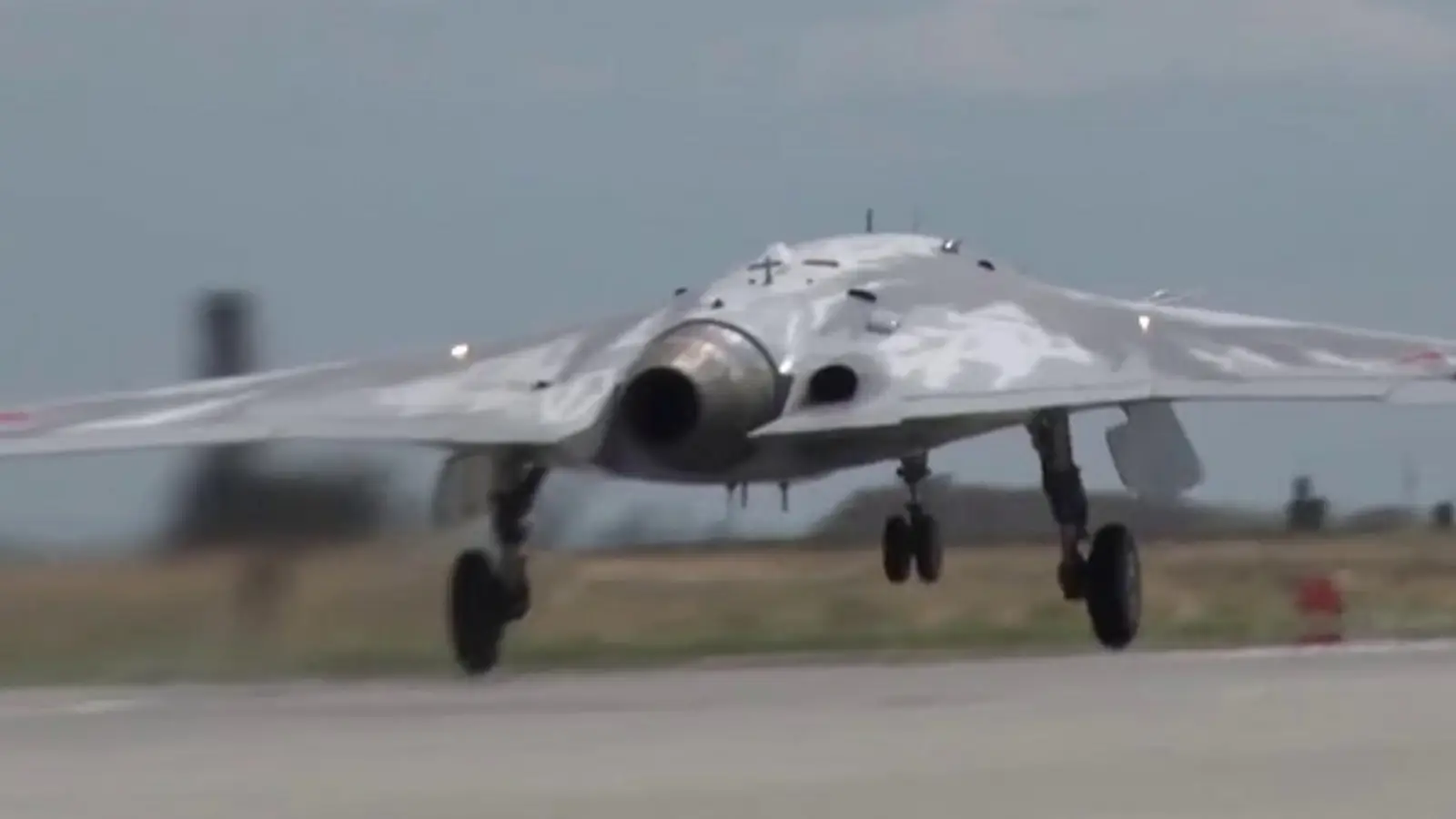
- 15 months after losing one of their rare Okhotnik stealth drones in Ukraine, the Russians have resumed testing the type
- The Okhotnik might be Russia's most sophisticated large drone
- But development of the type suffered a major setback when one of two prototypes wandered off course over Donetsk Oblast
- Now the Okhotnik apparently sticks to flights inside Russia
More than a year after Russia's rare Okhotnik stealth drone wandered off course over Ukraine, the Russians are still trying to get the type to work. But they're clearly not willing to risk the second, and now only, Okhotnik prototype in dangerous Ukrainian skies.
The loss exposed both Russia's dependence on Western microchips—found throughout the wreckage—and weaknesses in its "stealth" design. Fifteen months later, Moscow is trying again, but keeping the lone surviving prototype safely inside Russian airspace.
Scrutinizing commercial satellite imagery, analysis team AviVector spotted the 65-foot-wingspan, jet-powered drone at the 929th State Flight Test Center southeast of Moscow no fewer than three times in 2025: on 22 April, 27 August, and 14 October.
It's clear testing is ongoing as Russia tries to keep pace with the latest US and Chinese drones. Where both Ukraine and Russia deploy a large number of drones in combat, including tiny first-person-view drones and larger one-way attack drones, the Okhotnik and drones like it are in a whole other class.
They're as big as manned warplanes and, in many ways, just as capable—with heavy payloads and enough range to strike deep inside enemy territory. And in stark contrast to most Ukrainian and Russian drones, they're expensive at tens of millions of dollars apiece ... and meant to be reusable.
The United States and China are moving quickly to field these large, high-performance fighter drones. And Russia was, too—at least until it suffered a major setback on 5 October 2024.
That's when one of just two flyable Okhotnik prototypes that Russian plane-maker Sukhoi had built went astray during combat trials near Chasiv Yar in eastern Ukraine's Donetsk Oblast. Exactly what happened is a closely held secret in Moscow.
Shootdown over Donetsk

Maybe the drone malfunctioned. Maybe Ukrainian electronic jamming interfered with the Okhotnik's navigation system or its radio link to its operators on the ground. In any event, the drone was flying at hundreds of kilometers per hour toward Ukrainian-controlled territory.
A similarly rare Russian warplane, a Sukhoi Su-57 manned stealth fighter, chased after the Okhotnik and shot it down. Obviously, the Russians were trying to prevent the drone from falling into Ukrainian and allied hands.
But they failed. The Okhotnik crashed just inside Ukrainian lines near Kostiantynivka. The Ukrainians and their allies "will disassemble it down to the last screw and, of course, familiarize themselves with its rich internal contents," moaned Fighterbomber, the unofficial Telegram channel of the Russian air force.
Russia reportedly targeted the crash site with an Iskander ballistic missile to destroy evidence — but Ukrainian forces had already recovered the wreckage.

Trending Now
What is the Okhotnik?
| Type | S-70 Okhotnik-B heavy stealth UCAV |
| Size | 19m wingspan, 20+ tons, ~$15mn per unit |
| Performance | 1,000 km/h, up to 6,000 km range (claimed) |
| Payload | 2.8 tons internal weapons bay |
| Status | ~4 prototypes built; 1 flyable after October 2024 loss |
What Ukraine learned
The wreckage proved valuable. Ukrainian intelligence found dozens of Western-made microelectronics from American companies Analog Devices, Texas Instruments, and Xilinx-AMD, as well as Germany's Infineon Technologies and Switzerland's STMicroelectronics — evidence that sanctions haven't stopped Russia from sourcing critical components.
Ukrainian analysts also noted the drone's stealth credentials appeared weaker than advertised: round engine nozzles and visible aluminum rivets would show up on radar.
If Russia ever moves from prototypes to serial production, it will need continued access to those same Western chips — something it has managed to do for Oreshnik missiles and Sukhoi fighters alike.

Ukraine finds US, German, Swiss parts in Russian new stealth drone Okhotnik despite sanctions
Testing resumes — cautiously
The shootdown didn't stop the Russians from resuming work on the Okhotnik. The second prototype's appearances at that testing site near Moscow are proof of that.
The Russians haven't sent the second Okhotnik on trial runs over Ukraine, however. Clearly, they've decided the airspace over the front line is too dangerous for valuable prototypes. If the radar-evading drone ever flies back into action over Ukraine, it may be after it has completed development — and there's more than one copy.
That doesn't mean the second Okhotnik is safe at home. On 8 June 2024, long-range drones operated by Ukrainian military intelligence struck the 929th State Flight Test Center — home of the Okhotnik as well as the bulk of the small Su-57 fleet — and damaged at least two of the Su-57s.
If Ukrainian intelligence ever determines the Okhotnik represents a serious danger to Ukrainian troops or civilians, the Russian base could get a second visit from Ukrainian drones.


