
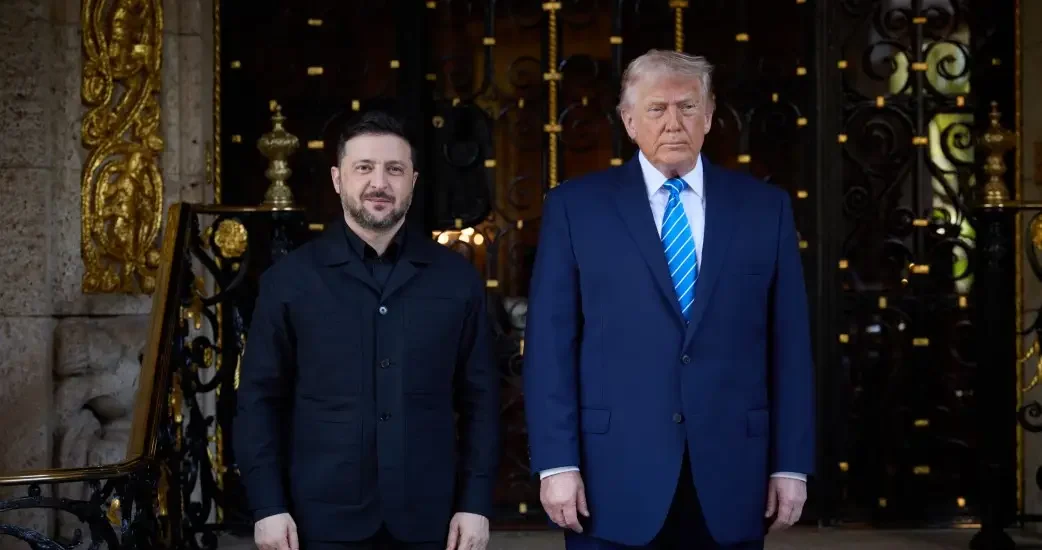

"Russia wants to see Ukraine succeed," President Trump stated after his 28 December meeting with Zelenskyy, claiming negotiations had covered "95%" of the issues needed to end the war. He said Putin offered help with post-war reconstruction, including energy supplies and infrastructure development.
This is the same president who claims he has "ended eight wars" — unsupported by any objective measure — and who alleges that "Biden gave away $350 billion" in aid to Ukraine, a figure bearing no relationship to reality. He has called Zelenskyy a "dictator without elections," suggested Ukraine started the war, and pushed a "peace plan" whose original 28-point draft gave Russia terms more favorable than what Moscow sought at the 2022 Istanbul talks.
Within 24 hours, Trump's claim was tested.
The kill switch activated
On 29 December, Russian Foreign Minister Sergei Lavrov alleged that Ukraine had tried to attack Putin's presidential residence in the Novgorod region with 91 long-range drones, forcing Moscow to reconsider its negotiating position. "Such reckless actions will not go unanswered," Lavrov said, calling it "state terrorism."
This matters because Trump's 20-point "peace plan" contains a fall-back clause: if Russia claims Ukraine launched an unprovoked attack, and Washington believes the allegation, the security guarantees are voided. The mechanism Russia will use to escape any agreement is now operational.
Zelenskyy called the allegation "another Russian lie" and warned it was a pretext for escalation.
"It's clear that yesterday we had a meeting with Trump. And it's clear that for the Russians, if there's no scandal between us and America, if we have progress — that's a failure for them. Because they don't want to end this war," Zelenskyy told journalists.
He warned that Russia is "preparing the ground to strike the capital, probably government buildings," noting that Russia struck Ukraine's Cabinet of Ministers building in September using similar justification. "Everyone needs to be vigilant right now."

The numbers tell a different story
If Russia wants Ukraine to succeed, it has a strange way of showing it.
In 2025 alone — while these "peace talks" have been underway — Russia has launched 54,327 long-range strike drones, 1,925 ballistic and cruise missiles, and 1,255,569 short-range kamikaze drones against Ukraine. The latter includes multiple documented cases of FPV drone operators hunting and killing civilians — what Ukrainians call "human safari."
On 27 December — the day before the Mar-a-Lago meeting — Russia conducted its 46th large-scale air strike since Trump's inauguration.
Since January, Russia has occupied an additional 3,800–4,400 km² of Ukrainian territory. According to the latest estimates, Russia has caused damage in Ukraine totaling around $800 billion. The destruction continues daily.
Trump is portraying a war criminal as compassionate and generous.

Zelenskyy unveils 20-point peace draft including “Article 5-like guarantees”; territorial status still unresolved
Trump is solving the wrong war
The 20-point plan fails to acknowledge that the Kremlin is demanding all of Ukraine, a zone of influence over parts of NATO, and the withdrawal and dismantling of the Alliance. Putin's aims remain unchanged: "denazification" (regime change), "demilitarization" (rendering Ukraine's military vulnerable), Ukrainian withdrawal from illegally annexed regions, and neutrality without effective security guarantees. Russia has repeatedly stated publicly it has no intention of dropping these demands.
If implemented, the plan gives Russia a golden opportunity to refocus its efforts from Ukraine to what it sees as its "historical lands" in Eastern Europe. It brings a wider war closer to NATO.
The security guarantee problem
While little is known about the details of US and European security guarantees, several problems remain unresolved.
- The ”fall-back” clause. The clause is still in place in the 20-point plan, fundamentally undermining the credibility of the “security guarantees.” When Russia claims that Ukraine has launched a strike against it – and when the USA decides to believe the allegation – the security guarantees are no longer valid. America’s fear of a war with Russia and its national interests will continue to define its foreign policy towards the aggressor.
- The 15-year limit. The US has offered Ukraine security guarantees limited to 15 years. It is not clear when the clock starts. President Zelenskyy hopes the guarantees begin when Ukraine signs a peace deal. "Without security guarantees, this war cannot be considered truly over," Zelenskyy explained. He stresses that Ukraine's martial law will only end once credible guarantees are in place.
- The referendum problem. Knowing that Ukrainians would vote against ceding territory in a referendum, Putin has signaled he will not provide security guarantees—a ceasefire—that allows one to be held.
- No US troops. It is highly unlikely the US will offer troops on the ground—this has been long-standing policy. The Trump administration is adamant that Europe is responsible for its own security. On Sunday, Trump said he expected European allies to "take over a big part" of the effort.
- Article 5 ambiguity. Offering "NATO Article 5"-style protection introduces the exact kind of ambiguity that NATO's European members already experience. If they don't expect the US to honor its NATO commitment, there is no reason for Ukraine to expect it. The US has already failed Ukraine three times: the Budapest Memorandum, halting defense aid, and presenting a "peace plan" that undermines Ukrainian security.
- Russian rejection. Russia has repeatedly stated that any presence of European forces in Ukraine is completely unacceptable. "Military contingents of the so-called European coalition of the willing, if deployed to Ukraine, would become legitimate targets for Russian forces," Foreign Minister Lavrov said.
Both Europe and the US are extremely fearful of military confrontation with Russia — a decision that ultimately rests with the aggressor. Suggesting security guarantees that Russia has already "shot down" is pointless if the West is unwilling to use military force to impose peace.

European security is being undermined
The so-called "peace plan" rewards the aggressor without seeking accountability for Russia's war crimes. Ukraine is being pressured to make territorial concessions, including giving up crucial defensive terrain. The plan does not address Russia's ongoing hybrid war against European NATO members, nor Russia's demand for NATO to withdraw to its 1997 borders.
Trump's plan sets conditions for future Russian aggression—with Russia battle-hardened, better armed, and better prepared.
Since the US aims to rebuild Russia's economy as part of the reset, the Trump administration is signaling an intent to economically strengthen an aggressor seeking Great Power status and European hegemony. The plan sets conditions for future Russian aggression—with Russia battle-hardened, better armed, and better prepared.
Europe now faces two strategic adversaries: Russia and the United States.

Time to disconnect the US from negotiations
A peace plan that reads like a business deal, pressures the victim, and contains built-in escape clauses for the aggressor will not bring a just and lasting peace. Nor will it end the actual war Russia is fighting—not for Ukrainian territory, but for Great Power status, strategic parity with the US, and European hegemony.
Trump's statement that "Russia wants Ukraine to succeed" illustrates how disconnected the current peace process is from reality. It is not seeking peace. It is seeking to fulfill US short-term national interests without regard for Ukraine or Europe.
Ukraine is seeking peace. Russia is seeking peace only on its terms: Ukrainian capitulation and the withdrawal of NATO to its 1997 borders.
A Coalition of Like-Minded European countries — with Ukraine as a founding member — can effectively counter the joint US-Russian effort to undermine, divide, and weaken Europe.
Europe must take charge of its own destiny.

Editor's note. The opinions expressed in our Opinion section belong to their authors. Euromaidan Press' editorial team may or may not share them.
Submit an opinion to Euromaidan Press


