

Today, there are important updates from the Dnipropetrovsk direction.
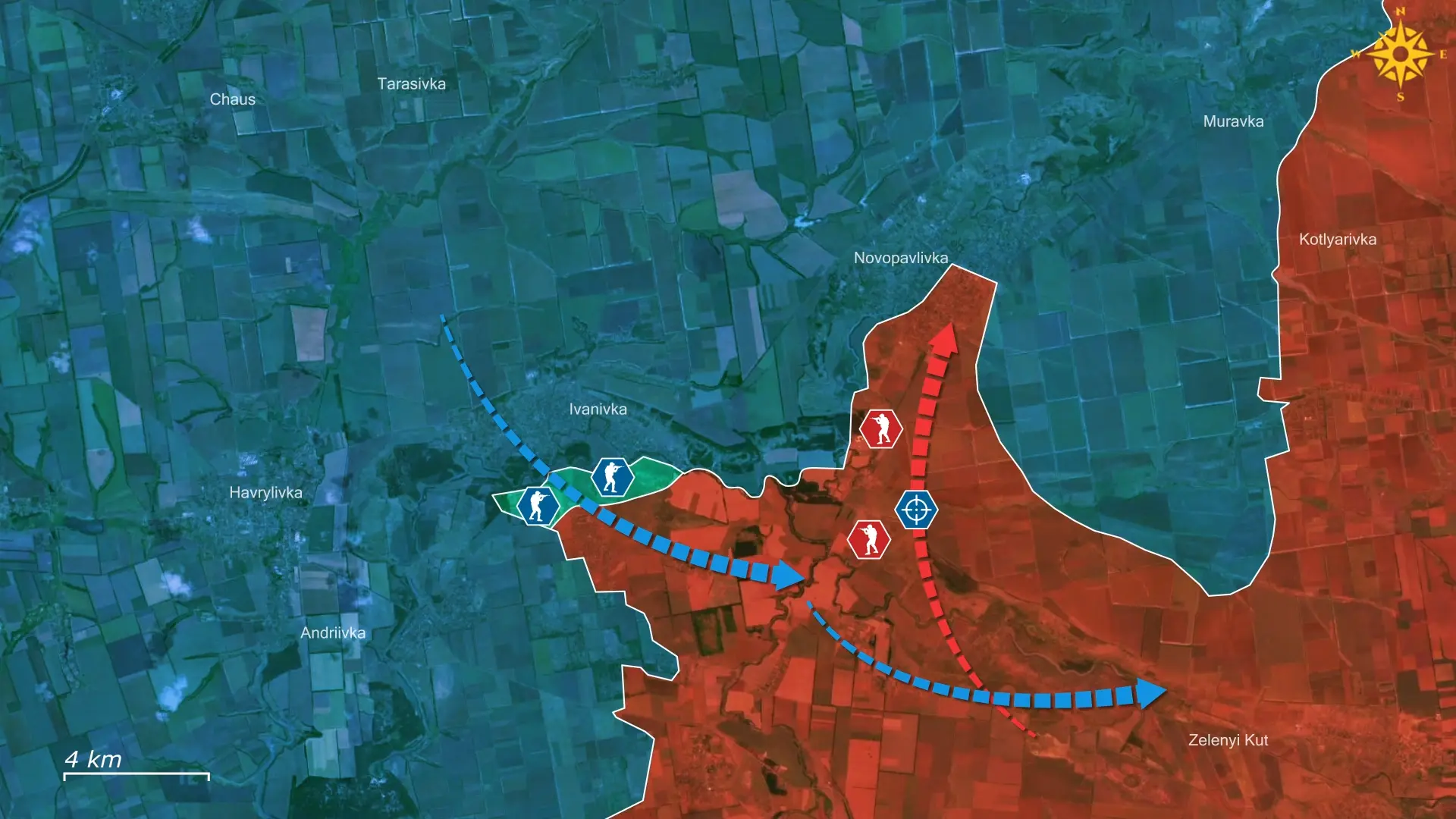
Here, after a successful clearing operation on the northern bank of the river, Ukrainian forces are starting their next operation to push forward. Despite the Russians anticipating such a move, the Ukrainian command is spearheading the assault using marines and tanks to penetrate the Russian flank deeper.

Ukraine’s main objective in this sector is to advance into the Russian-held area and create a credible threat on the flank of the Russian offensive directed toward Novopavlivka. The Ukrainians need to escalate pressure in this sector to further erode the Russian effort exactly when the Russian assault has stalled, and Ukrainian units have the chance to turn the tide. In doing so, the Ukrainian command seeks not only to interrupt the tempo of the Russian advance but also to force Russian commanders to reallocate personnel and resources to secure their vulnerable flank, consequently undermining their broader operational posture.

Why Novopavlivka matters
Novopavlivka holds strategic significance because the settlement is located on both banks of the river. If Russian forces capture even one side, the opposing bank will become considerably more difficult for Ukraine to defend, and, similar to the situation in Ivanivka, any captured ground could provide Russia with an improved crossing point for further offensive operations.

Ivanivka as a staging ground
The main Ukrainian advantage is that now they have full control over Ivanivka, which facilitates the creation of a staging ground for further operations. As the settlement is secured, Ukrainian forces can use it as a crossing point over the Vovcha River and start attacking to the east, conducting disruptive operations against enemy troops and infiltrating their forward positions. Bad weather conditions, such as fog, would also help them get behind enemy lines, as the Russian reconnaissance drones wouldn’t be able to spot them.

Terrain cuts both ways
If we take a look at the topographic map, we can see that the Ukrainian positions on the high ground can also be used to support further Ukrainian counteroffensive operations, providing excellent mortar positions and starting positions for drones. However, Ivanivka is on the same level as the Russian positions east of the river, which means that Ukrainian forces will need to assault on even ground, despite enjoying fire support from the elevation behind the village.

After being pushed behind the river, Russia now has the advantage of using the river as a natural defensive barrier, protecting its forces against prospective Ukrainian counterattacks by complicating Ukraine’s capacity to reliably sustain its advancing forces.

Tanks soften, marines storm
Geolocated footage shows how Ukrainian Leopard 1A5 tanks are softening up Russian fortifications by firing their cannons directly into them to destroy the enemy personnel and pin them down while the Ukrainian marines arrive. After the initial raid, the tanks pulled back to the rear to avoid the Russian drones, while the Ukrainian troops started clearing the trenches.

Trending Now

Their efforts were supported by a reconnaissance drone, which enabled commanders to monitor the operation in real time and guide the soldiers on the ground, helping them avoid potential ambushes and identify threats not visible from their vantage point.

Into the tunnels
The soldiers maneuvered carefully because the roof of the fortification partially collapsed due to the firepower of the tanks. As the Ukrainian forces descended into the tunnels, they conducted a systematic sweep.


As a result of the Ukrainian operation, five Russian soldiers were eliminated, and ten more surrendered, as they realized that no one would help them and they were surrounded. The Russian prisoners of war were subsequently interrogated and escorted to the Ukrainian rear to further increase the exchange fund.

Shaping the next phase
Overall, the Ukrainian counteroffensive efforts appear to be building on the momentum generated by the liberation of Ivanivka, applying sustained pressure on the exposed Russian flank and complicating further Russian attempts to advance toward Novopavlivka. By consolidating more gains and compelling Russian forces to defend a widening front, Ukrainian marines are not only stabilizing the sector but also shaping conditions that will force the Russian command to divert reserves. As the situation evolves, follow-on Ukrainian actions will be influenced by Russia’s ability to reinforce and maintain cohesion. If Russia’s response remains slow, the current Ukrainian posture could open opportunities for deeper tactical exploitation and more advances in this sector.
In our regular frontline report, we pair up with the military blogger Reporting from Ukraine to keep you informed about what is happening on the battlefield in the Russo-Ukrainian war.


