

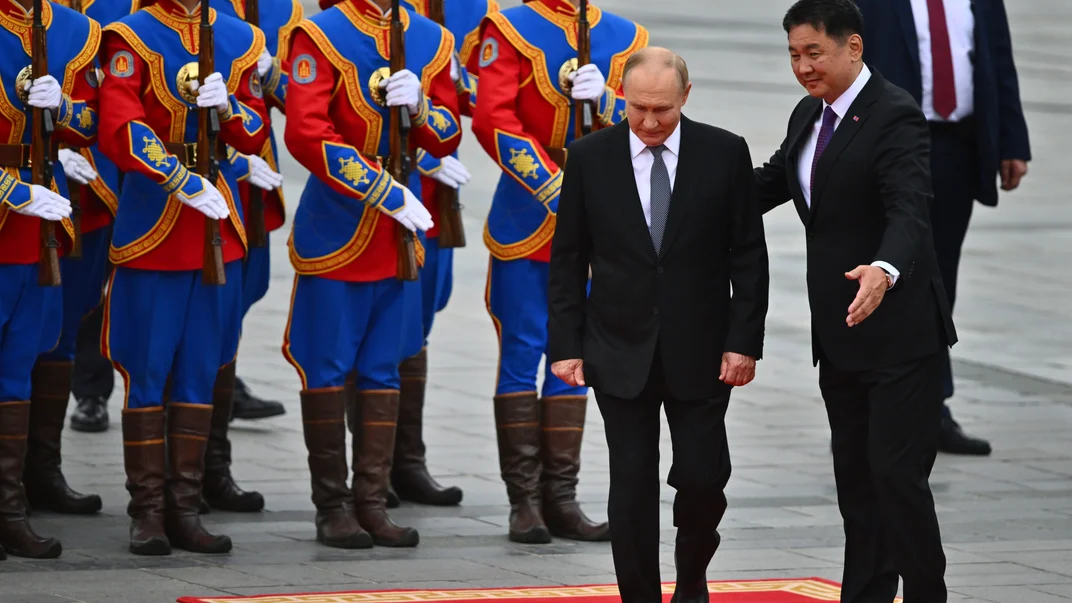
This week, Russia and Mongolia held their first-ever Forum of Regions in Irkutsk, with over 300 participants signing agreements on trade, energy, and transport. Russia’s state-aligned outlet celebrated the event as “the institutionalization of a new phase” in bilateral ties.
The forum caps a year of accelerating integration. In June, Mongolia signed a free trade deal with Russia’s economic bloc. In September, it exited its observer status at the Shanghai Cooperation Organization to focus on “trilateral cooperation” with Russia and China.
Throughout, Mongolian business groups have warned their government is walking into a trap—one the war in Ukraine made possible.
For Western policymakers, Mongolia offers a case study in unintended consequences. When sanctions closed Russia’s European transit routes, they also closed Mongolia’s path to Western markets—and handed Moscow new leverage over a democracy that had spent decades trying to balance its giant neighbors.
Landlocked, locked in
Before February 2022, Mongolia balanced between Russia and China while using Russian rail routes to reach European markets. The start of the full-scale invasion of Ukraine changed everything.
Transit through Russia to Europe is now effectively dead.
The same Western sanctions designed to punish Russia for invading Ukraine cut Mongolia off from its customers. Western logistics firms refuse to route containers through Russian territory, insurance costs have skyrocketed, and some cargo is being blocked at borders.
Mongolia’s path to European customers—gone.
Fuel dependency became acute. Mongolia imports 95% of its petroleum from Russia, according to Politico. When Moscow imposed temporary export restrictions in 2023 and 2024, Mongolia faced immediate shortage anxiety, particularly in its mining sector. With no access to deep-water ports, the country cannot reach alternative suppliers.
Petroleum products remain Mongolia’s largest single import category, accounting for 18.3% of total imports, as reported by the Mongolian English-language newspaper UB Post in September 2025.
The dubious deal with EAEU
The forum celebrated the Interim Free Trade Agreement between Mongolia and the Eurasian Economic Union (EAEU)—Russia’s economic bloc comprising five former Soviet states—signed in June 2025.
The three-year deal covers 367 product categories, offering Mongolian exporters duty-free access to 200 million consumers.
Russia frames this as opportunity. Mongolian businesses see a trap.
Domestic opposition
When the deal was announced in December 2024, it triggered immediate backlash. Mongolia’s National Chamber of Commerce and Industry warned the agreement “will undermine national security by killing off local food production and creating dependence on other countries for food supplies.”
The Chamber added that trading with Russia and Belarus—two states under unprecedented sanctions—“poses reputational and financial risks that may scare away potential investors and result in secondary sanctions,” Global Voices reported.
T. Monkhtor, Director of Food Evolution, predicted that “Russian food products, such as dairy, wheat, and flour, which are cheaper and higher quality, will flood the Mongolian market and bankrupt local companies.”
His estimate: it would take “only one year for this grim scenario to take place.”
A coalition of professional associations—including the Food Producers’ Union, the National Association of Veterinarians and Breeders, and the Farmers’ Union—opposed the deal. The government postponed negotiations in December 2024, but signed anyway in June 2025.
A political chaos
By June 2025, Mongolia was consumed by a different crisis. Social media posts showing the prime minister’s son’s lavish lifestyle triggered youth protests. 80,000 people signed petitions demanding Prime Minister Oyun-Erdene’s resignation.
He lost a parliamentary confidence vote and stepped down in early June.
The EAEU deal was signed in the same month. Another prime minister was ousted in October 2025. The business groups’ warnings about the EAEU deal have been drowned out by successive governance crises.
Trending Now
The numbers Moscow doesn’t mention
A study by Mongolia’s National University Business School, cited by The Diplomat, projects the agreement could cause a 6.1% decline in Mongolia’s GDP growth by 2028, a 117% surge in imports, and a 3.2% reduction in government revenue. Key sectors, such as food production and textiles, could face “heightened competition from cheaper, better-subsidized imports from Russia and Kazakhstan.”
Mongolian critics point to the 2015 free trade agreement with Japan as a warning.
Japan’s exports to Mongolia doubled from $300 million to $600 million by 2023. Mongolia’s exports to Japan grew by just $3 million—from $15 million to $18 million, according to Global Voices.
Meanwhile, the Ulaanbaatar Railway—Mongolia’s economic spine carrying over 90% of freight—remains a 50/50 joint venture with Russia. Moscow holds half of the country’s logistics infrastructure.
Putin walks free
The dependency was already visible in September 2024, when Putin visited Ulaanbaatar. Mongolia, an ICC member state, refused to execute the arrest warrant against him for war crimes, including the deportation of Ukrainian children.
A government spokesperson told Politico that “energy dependence” made arrest impossible.
President Zelenskyy was blunt: Mongolia’s behavior “indicates a lack of independent decision-making.”

Diversification attempts
Mongolia’s government recognizes the trap. India’s JSW Steel and SAIL are in negotiations to purchase Mongolian coking coal. South Korea has signed agreements on critical minerals and technology. An Indian-backed oil refinery aims to reduce petroleum dependence.
But geography is stubborn.
Every route crosses Russian or Chinese soil. And increasingly, Russia and China appear coordinated rather than competitive. At a September 2025 trilateral summit in Beijing, President Khurelsukh explicitly aligned Mongolia’s “Steppe Road” infrastructure plan with both China’s Belt and Road Initiative and Russia’s EAEU. Presidents Putin and Xi both praised Mongolia’s “deeper engagement.”
Who’s next
For countries designing sanctions against Russia, Mongolia demonstrates the collateral capture they must anticipate. The pattern is replicating: Serbia navigates similar pressure over transit, Kazakhstan faces the same trade-offs, and Armenia is being pulled closer as alternatives narrow.
In each case, the war didn’t just isolate Russia—it created new dependencies Moscow is now institutionalizing.
And this week in Irkutsk, the trap closed a little tighter.


