


Ukrainian forces continue to halt Russian advances in Donetsk Oblast, with no indication that Moscow can rapidly overrun the remaining territory, according to the Institute for the Study of War (ISW). ISW assesses that Russia’s recent gains are limited, weather-driven, and not indicative of an impending breakthrough, while Ukrainian troops continue to effectively contain Russian operations and launch successful counteractions when properly manned and supplied.
Russia makes slow progress despite major effort in Pokrovsk
ISW says Russian gains show that a Russian military victory "is not inevitable” and that a rapid seizure of the rest of Donetsk Oblast “is not imminent.” Russian troops have made only limited progress in the town of Pokrovsk, where they first entered on 31 July. Over the course of 118 days, Russian forces advanced just 0.12 kilometers per day on average, despite committing elements of at least two combined arms armies. Pokrovsk spans just 11.5 square miles, but ISW has only observed confirmed Russian control over 66% of it as of 26 November, according to ISW.
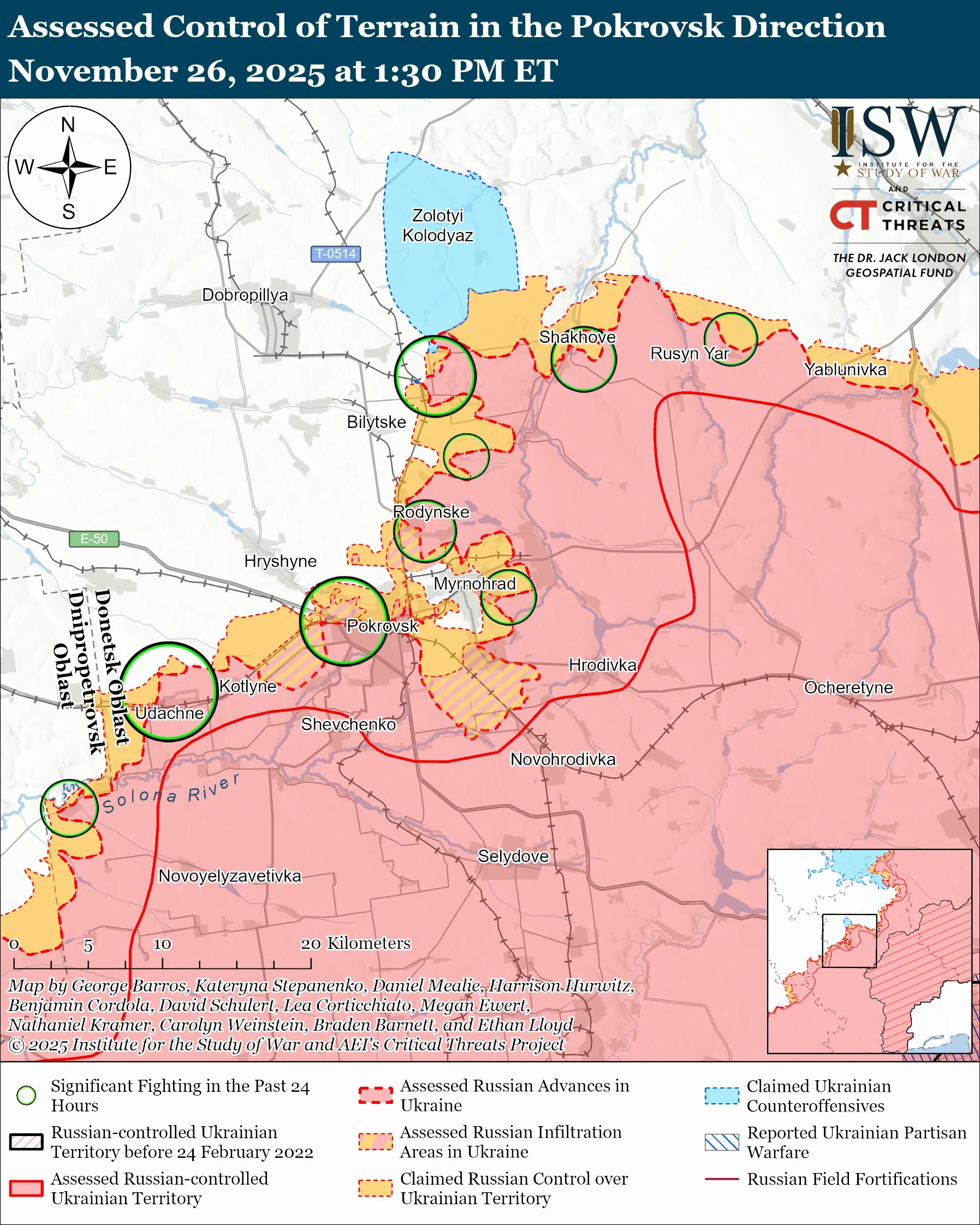
Russian commanders have portrayed themselves as capable of rapidly seizing Donetsk Oblast. However, ISW data contradicts that narrative. The Kremlin's messaging around an “inevitable” Russian victory — especially after the emergence of a US-Russian 28-point peace proposal — appears aimed at pressuring Ukraine and the West to accept Moscow’s terms.
Gains elsewhere are opportunistic, not systemic
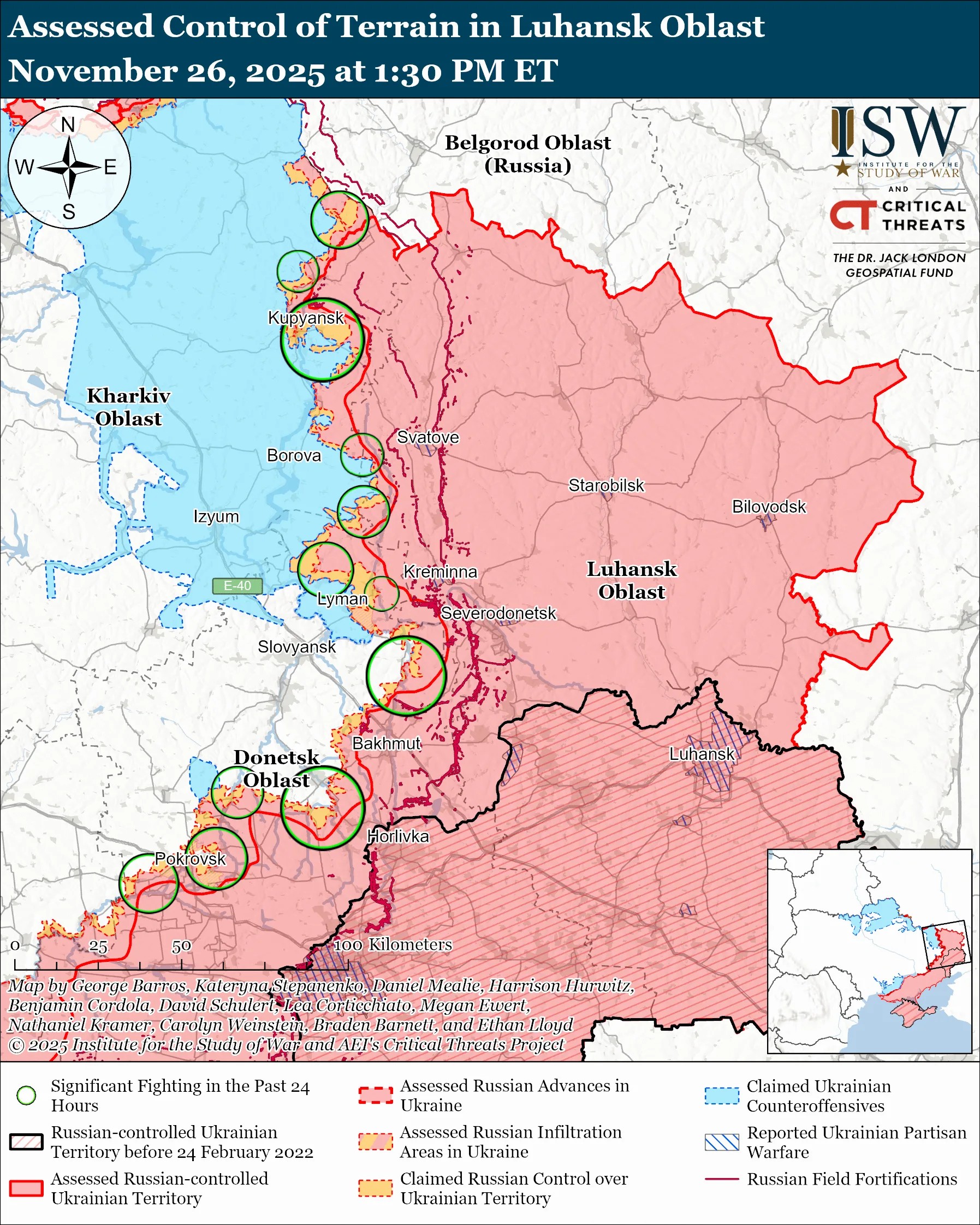
While the overall rate of Russian advances increased after the Alaska summit on 15 August, the pace remains slow. Between 15 August and 20 November, Russian forces gained an average of 9.3 square kilometers per day across the entire frontline, the think tank notes. These numbers, however, are distorted by recent limited advances in eastern Dnipropetrovsk and Zaporizhzhia oblasts, where Russian forces took advantage of local weather conditions and less fortified positions.
In areas such as Zaporizhzhia's Huliaipole, Russian troops leveraged a porous frontline and used infiltration missions alongside battlefield air interdiction efforts to gain ground from the northeast and east. Even these gains remain "constrained to footpace."
Attempts to replicate similar progress in the Kharkiv's Vovchansk and Kupiansk directions have fallen short. Russian forces were unable to achieve breakthroughs and instead became mired in urban combat with only minimal territorial changes, suffering high manpower losses in the process.
Ukrainian resistance remains effective and proven
ISW emphasized that Ukraine has repeatedly demonstrated the ability to repel Russian forces and regain lost ground. Ukrainian troops forced Russia to withdraw from Kyiv Oblast and northern Ukraine in April 2022, liberated much of Kharkiv Oblast in September and October 2022, and drove Russian forces out of the west bank of Kherson Oblast in November 2022 following a successful interdiction campaign.
Ukraine also blocked Russian offensives into northern Kharkiv and Sumy oblasts in spring 2024 and again in January 2025. These actions have prevented Russia from regaining operational maneuver and forced Moscow into a positional war.
ISW continues to assess that with timely and sufficient Western military assistance and arms supplies — along with strong economic pressure on Russia — Ukraine can halt Russian advances entirely. This is especially possible if Ukrainian troops make full use of their fortifications in Donetsk Oblast.


