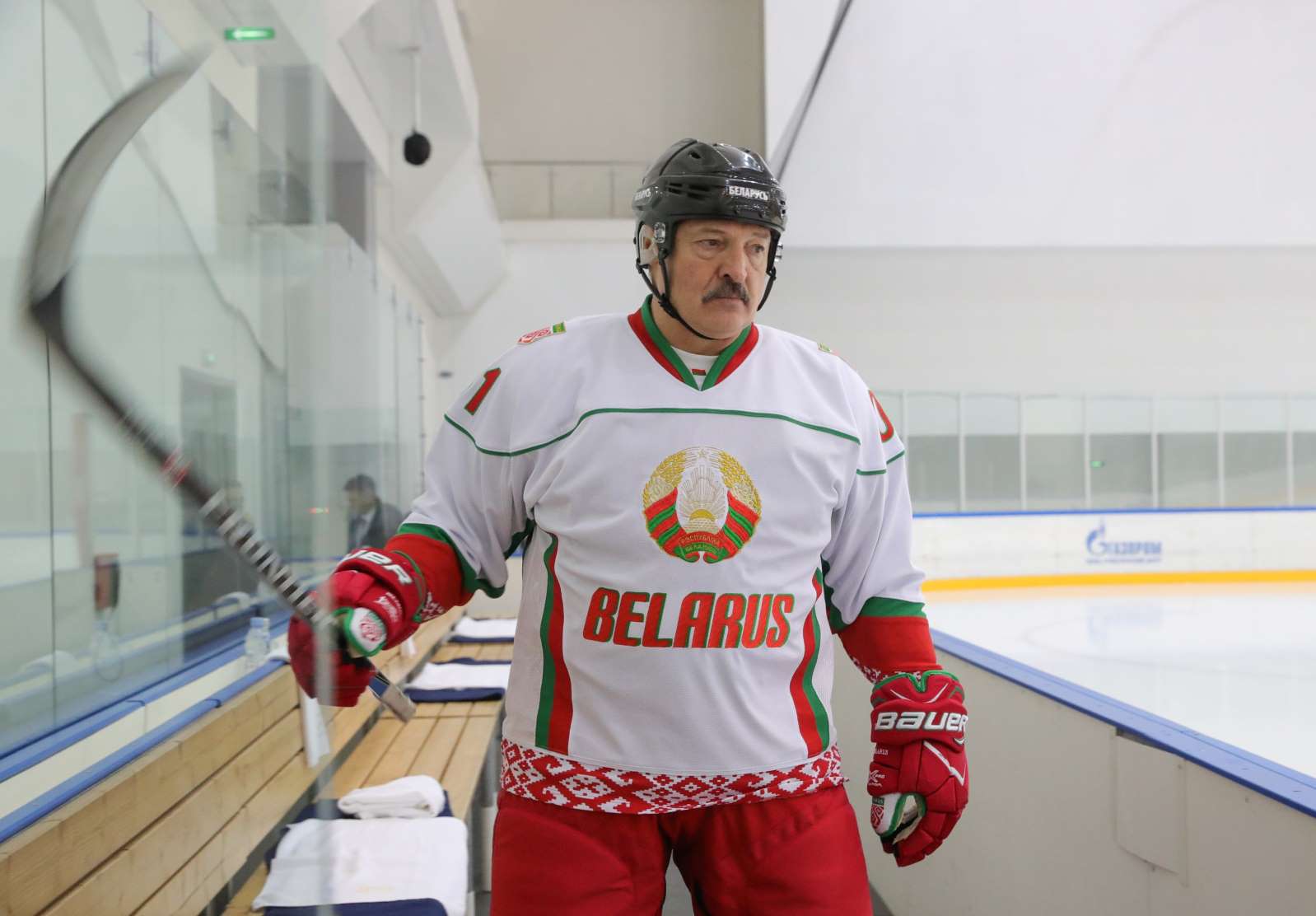
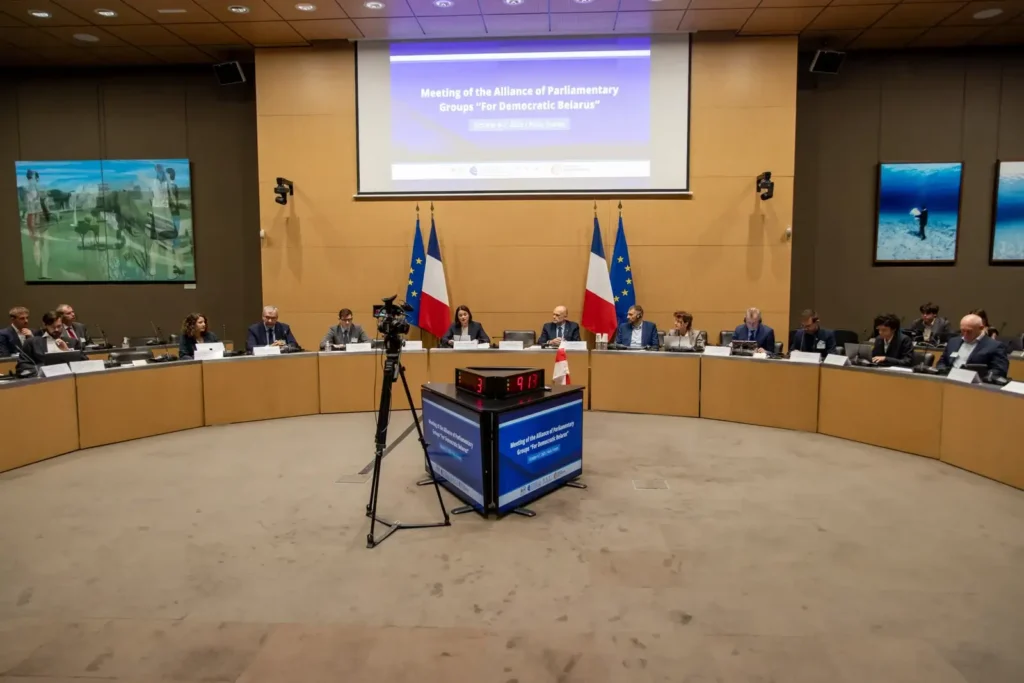
In Paris this October, two Belarusian delegations competed for Europe's attention. While fourteen parliamentary groups gathered at the French National Assembly to sign a cooperation pact with Belarus's democratic opposition, a senior diplomat from Lukashenka's regime was across town meeting Western ambassadors to discuss sanctions relief.
Five years after Aliaksandr Lukashenka's rigged election sparked the largest protests in Belarusian history, the question facing Europe is simple: which Belarus to engage with?
The "Paris Memorandum," adopted 7 October, represents the opposition's answer—a formal cooperation framework between European parliaments and Belarus's government-in-exile. But it arrives at a precarious moment.
Trump's rapprochement with Minsk is giving Lukashenka new leverage through prisoner releases, while the opposition's five-year exile has raised uncomfortable questions about legitimacy, resources, and whether patient institution-building can outlast transactional diplomacy.
At the gathering, former Belarusian journalist Kseniya Lutskina stood to speak. "In my previous life, I was a Belarusian journalist on Belarusian state television," she said with a slight smile, both ironic and weary.
Before 2020, she worked for public television in Minsk, believing it was possible to do her job despite the censorship. After Lukashenka's disputed election, she joined the strike of state employees and resigned, then attempted to create an independent YouTube channel with colleagues. Their ambition: to tell the country's story differently, to give a voice to those silenced.

On 22 December 2020, she was arrested while shopping in downtown Minsk. Initially charged with tax fraud, she was later accused of "conspiracy to seize state power." The Minsk court sentenced her to eight years.
For more than three years, Kseniya endured the women's prison colony in Homieĺ—cold, sleepless nights, confiscated letters, deteriorating health. Pardoned in August 2024, she managed to leave Belarus in March 2025.
She paused, tucking a strand of hair behind her ear. Next to her, a former activist with Viasna—the human rights organization founded by Ales Bialiatski—bowed her head. "Ales is still there," Kseniya whispered. "I hope we can see him as soon as possible."
The meeting brought together representatives from fourteen countries, diplomats, members of international organizations, and leaders of the Unified Cabinet and Coordination Council—the two political structures created in Vilnius to embody a democratic Belarus. The initiative is led by French MP Frédéric Petit and Sviatlana Tsikhanouskaya, the opposition's leader in exile.
The text calls for increased support for Belarusian civil society, political recognition of the Unified Cabinet, and strengthened cooperation with Ukraine.
"This is not just a symbolic gesture," insists Petit. "European security architecture and the liberation of Belarus are intrinsically connected."
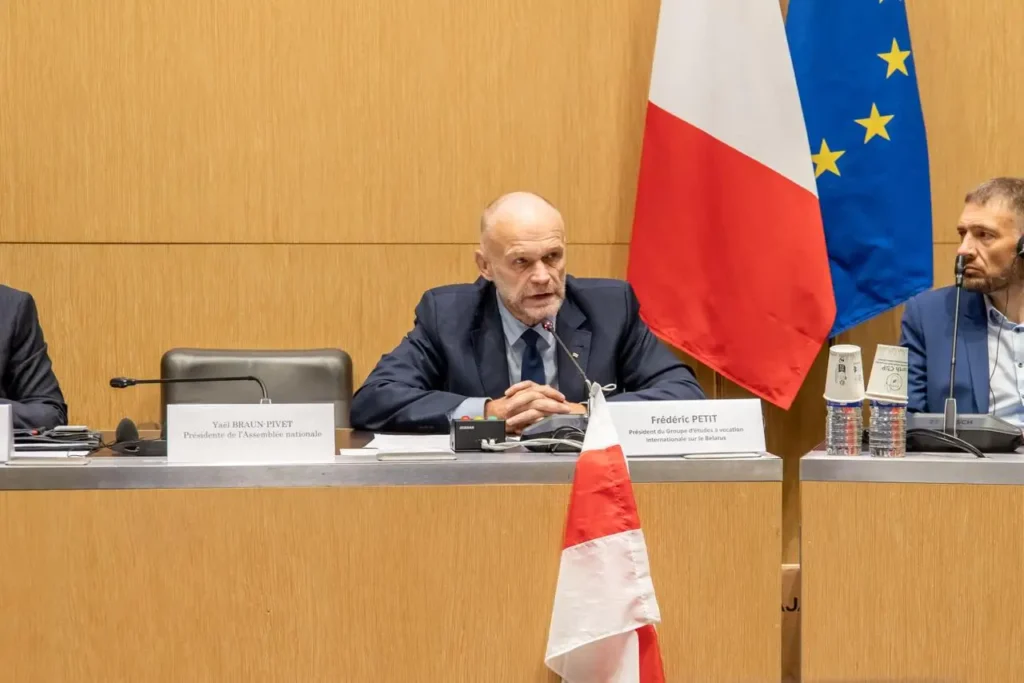
The memorandum calls for national parliaments to establish formal cooperation channels with Belarusian democratic forces—including the creation of parliamentary friendship groups and institutionalized dialogue mechanisms. Whether this translates into tangible support or remains another well-intentioned document depends on how individual parliaments choose to implement it.
Since the outbreak of war in Ukraine, Minsk has become a logistical hub for the Russian army. In Moscow's shadow, Aliaksandr Lukashenka remains an indispensable link in Vladimir Putin's power structure. For opponents in exile, the balance remains fragile: maintaining a credible political structure without territory, without a stable budget, and without electoral legitimacy.
“But we have a society, people who continue to fight, both inside and outside the country,” Sviatlana Tsikhanouskaya said in an interview with Euromaidan Press. A former presidential candidate, she has been the face of the Belarusian opposition in exile for the past five years.

“Belarusian regime gave our country as a launchpad”
Sviatlana Tsikhanouskaya speaks in clear, straightforward English. She almost never searches for words.
"After the war began, it became clear that the Belarusian regime and the Belarusian people are two completely different things. While the regime offered our country as a launch pad for missiles, the Belarusian people opposed this from the very beginning."
Since February 2022, Belarusian territory has served as a rear base for Russian troops. The economy, now militarized, fuels the war effort. "About 300 Belarusian companies produce military equipment for the Russian army," Tsikhanouskaya says.
This makes Belarus a critical node in Russia's defense industrial base at a time when Western sanctions have constrained Moscow's domestic production.
Faced with this total dependence on Moscow, the opposition in exile is trying to keep its voice heard. Without access to territory or stable resources, it strives to maintain recognized political representation.
From Vilnius to Brussels, Tsikhanouskaya steps up diplomatic meetings, pleading for Belarus not to be forgotten in the wake of the war in Ukraine. "We are a European nation that wants Ukraine to win this war. Because their fate and that of Belarus are linked," she emphasizes.
This link with Kyiv is not merely symbolic. Since 2020, several hundred Belarusian volunteers have joined Ukrainian brigades, including the Kastous Kalinouski regiment, made up of former protesters forced into exile.
On the other side, the Minsk regime has sealed its loyalty to Moscow, hosting Russian tactical nuclear warheads on its soil—the first such deployment outside Russia since the Soviet collapse, positioning them within 300 kilometers of Warsaw and within strike range of NATO infrastructure across Eastern Europe.

An opposition without territory
Five years after the disputed election of August 2020, which sparked the largest protest movement in the country's history, the question of democratic legitimacy still haunts the Belarusian opposition.
"We don't have to forget that in 2020 we won elections," insists Sviatlana Tsikhanouskaya. "It gave us legitimacy that can be changed only by new free and fair elections in Belarus."
In exile since then, the candidate defeated by Aliaksandr Lukashenka has gradually built a political structure without territory.
From Vilnius to Warsaw, parallel institutions have emerged:
- a Unified Cabinet, acting as a symbolic government;
- a Coordination Council, designed as a parliament;
- and an Office of the President-elect, which Tsikhanouskaya herself heads.
"We are building a system that can ruin the dictatorship system," she summarizes. "We formalize the relationship with Western countries. We rediscovered Belarus to the world."
But this architecture faces a fundamental challenge: maintaining legitimacy for five years without controlling territory, raising taxes, or holding elections.

She is patiently cultivating recognition through initiatives like the Paris Memorandum. The text, supported by several European parliamentary groups, proposes the creation of channels for institutional cooperation between Belarusian democratic forces and national parliaments.
The document calls for the formation of parliamentary friendship groups within NATO, the OSCE, and national parliaments where such networks do not yet exist.
In Minsk, any contact with so-called “terrorist” structures abroad—including democratic opposition organizations—is punishable by law. Independent media outlets broadcasting from abroad have become the main lever for opposition action.
“Everything we are doing is in the media space,” says Tsikhanouskaya. “Alternative media are mostly broadcasting from exile,” she explains. “Yet we manage to cover 60-70% of the adult population in Belarus.”
She cites this figure cautiously, but if accurate, it means the opposition has maintained an information space outside Lukashenka's control that reaches more Belarusians than state television.
Despite repression and forced exile, the Belarusian opposition still carries weight—that of a civil society which, even when silenced, has not disappeared.

Fear, horror, anger, despair, solidarity, apathy, and glee. 100 days of Belarus protests in photos
Trending Now
“We are not abandoned”
For many exiles, the hardest thing is not the distance, but the feeling of being forgotten.
Sviatlana Tsikhanouskaya often repeats: "Belarusians need to feel that they are not abandoned, that they are not alone. For 30 years, Belarus has been a gray spot on the map of Europe.”
The memory of those early days still stings.
"In 2020, Putin said clearly, 'I am on the side of Lukashenka,'" Tsikhanouskaya recalls. "And nobody from the European, from the democratic world told, 'And we are on the side of Belarusians.'"
Not in those first crucial months after the election, when the demonstrations were at their peak and the violence was most intense. Sanctions and condemnation came later, but at the beginning, Belarusians saw Lukashenka backed by Putin—and themselves alone.
"These five years of hard work showed Europeans that we are the same as you," she says.
In the corridors of the Palais Bourbon, these words resonate with particular gravity. Several French MPs acknowledge the difficulty of maintaining international attention on a country now relegated to the periphery of the conflict. Since the invasion of Ukraine, Belarus has disappeared from European diplomatic priorities, perceived above all as a mere satellite of Moscow.
"Everyone is talking about Ukraine now, which is essential, and we fully support that. But don't neglect Belarus. Just look at the map,“ Tsikhanouskaya argues. She adds: ”But if Belarus remains under Russian control, no border in Eastern Europe will be safe."
If Belarus remains under Russian control, no border in Eastern Europe will be safe.
Sviatlana Tsikhanouskaya, Belarusian opposition leader in exile
The Paris Memorandum attempts to prove the opposite. It comes amid growing tensions between Minsk and Western capitals. Since mid-September, large-scale Russian-Belarusian military maneuvers, dubbed Zapad-2025, prompted Poland to temporarily close its border with Belarus.

Belarusian “unfinished revolution” resists from the shadows, awaiting window of opportunity
Competing for Europe's attention
The Paris Memorandum came at a moment when both Belarus's opposition and Lukashenka's regime were making simultaneous plays for European engagement. Just as MPs were signing the cooperation framework on 7 October, a senior Belarusian diplomat was requesting meetings with Western ambassadors in the same city.
According to diplomatic sources reported by Reuters, Yury Ambrazevich, Belarus's representative to UNESCO, had sent invitations in late September to European embassies for meetings in Paris on October 6, 8, or 9—the exact dates bracketing the opposition's parliamentary gathering.
The regime's outreach, leveraging Trump's warming relations with Minsk, sought sanctions relief and diplomatic normalization. Some European countries agreed to the meetings, European diplomats confirmed to Reuters.
The parallel diplomatic tracks reveal the strategic challenge facing European capitals: which Belarus to engage with—the democratic forces building institutional frameworks in exile, or the regime controlling territory while offering transactional concessions through prisoner releases?
Et pendant ce temps ... L'Assemblée nationale accueillait hier le 1er Forum Interparlementaire des Amis de la Biélorussie démocratique, en présence de Mme Sviatlana @Tsihanouskaya , leader de l'opposition bélarusse démocratique. Merci à mon collègue @fpetitAN , engagé depuis des… pic.twitter.com/7Yj5xAAGLb
— Constance Le Grip (@ConstanceLeGrip) October 8, 2025
For Tsikhanouskaya, the choice should be obvious. "The regime will always try to deceive the world," she said at the Paris Peace Forum weeks later. "When speaking about Belarus, we see Lukashenka and fail to see what is most precious—its nation."
The timing underscores why the Paris Memorandum matters beyond symbolism. As Lukashenka uses Trump-brokered prisoner releases to extract legitimacy, the opposition is building institutional infrastructure designed to outlast individual diplomatic transactions.
The question is whether European parliaments will invest in this longer game—or whether, five years after the 2020 protests, fatigue and pragmatism will win out.
1,187 people still in prison for political reasons

In this climate of isolation and mistrust, the opposition in exile is trying to maintain its visibility and influence. Its representatives know that their political survival depends as much on external support as on the discreet but tenacious loyalty of those who have remained in the country and continue to believe in a European Belarus.
To date, 1,187 people are still being held for political reasons, according to the Belarusian human rights NGO Viasna. Among them is its leader, the 2022 Nobel Peace Prize laureate, Ales Bialiatski, who has been imprisoned for three years.
In the afternoon, the French parliamentarians attending the meeting each sponsored a Belarusian political prisoner as part of a symbolic initiative aimed at maintaining international pressure on the Minsk regime.
Political prisoners are Lukashenka's most valuable asset in his attempts to bring his country out of isolation and secure sanctions relief. He regularly organizes waves of releases to extract concessions, while continuing fierce repression and new arbitrary detentions.

In June, Lukashenka's regime released 14 political prisoners, including prominent opposition figure Siarhei Tsikhanovski, Tsikhanouskaya's husband. These releases came hours after a visit to Minsk by Keith Kellogg, the Trump administration's special envoy for Russia and Ukraine.
It was the first meeting in more than five years between a senior White House official and Lukashenka—a sign that some are still willing to use the Belarusian regime to engage in dialogue, legitimizing it in the process.

Democracy to defend
When asked what message she would send to European citizens, Sviatlana Tsikhanouskaya pauses, weighing each word. "Through Belarus, it is very easy to show democratic countries that they must cherish what they have. We see how easy it is to lose democracy—and how much blood it costs to regain it."
For five years, her fight has been waged in European capitals where she tirelessly pleads for Belarus not to sink into oblivion. "Belarus is under Russia's influence and will be a constant threat to Ukraine, Poland, and the entire NATO alliance," she says. "It is Russia that is testing NATO's strength through Belarus."
Behind the exiles and speeches, Tsikhanouskaya defends a simple idea: Belarusian freedom is being decided at the very heart of Europe. "This is no longer just about Ukraine or Belarus. It's about democracy itself," she concludes.
Et pendant ce temps ... L'Assemblée nationale accueillait hier le 1er Forum Interparlementaire des Amis de la Biélorussie démocratique, en présence de Mme Sviatlana @Tsihanouskaya , leader de l'opposition bélarusse démocratique. Merci à mon collègue @fpetitAN , engagé depuis des… pic.twitter.com/7Yj5xAAGLb
— Constance Le Grip (@ConstanceLeGrip) October 8, 2025