

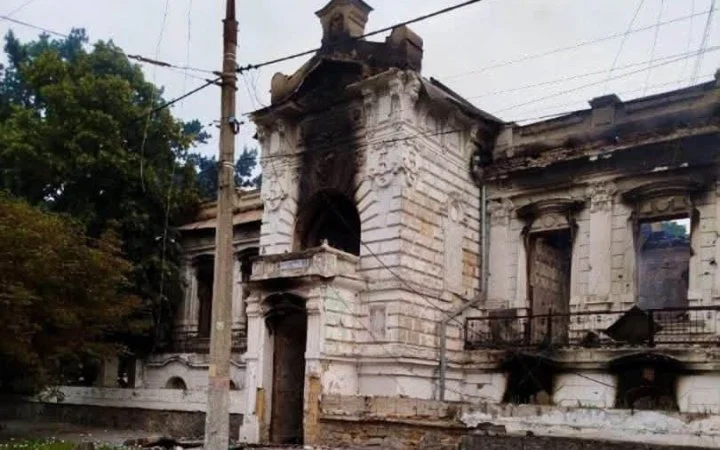
Russia has fired more than 925,000 shells at Ukraine’s Kherson Oblast since late 2022 and now sends up to 6,500 drone attacks against it every week. Oleksandr Prokudin, head of the Kherson regional military administration, set out the toll at the Council of Europe’s Congress of Local and Regional Authorities in Strasbourg.
Approximately 70% of Kherson Oblast remains under Russian military occupation, primarily across the left (east) bank of the Dnipro River, while Ukrainian forces control and have liberated the right bank, including the regional center of Kherson city.
“Everything except nuclear weapons”: the toll Kherson carried to Strasbourg
Prokudin told European partners that his region has spent nearly five years at the epicenter of the war, a few kilometers from Russian positions.
“It used everything except nuclear weapons. A separate danger is the ‘drone safari,’ today up to 6,500 drone attacks a week. This is deliberate, targeted terror against civilians, children, medics and rescuers. But we stayed, adapted and learned to counter this terror,” Prokudin said.
What nine European countries are now coming to learn
The region has answers that are already keeping 140,000 residents alive, he said: coordination among local authorities, the military, emergency services and volunteers; underground schools and hospitals; the pace of demining in deoccupied areas; and anti-drone defenses that let Ukraine’s forces bring down most of the incoming UAVs.
“We paid an extremely high price for this knowledge. That is why our unique experience of civil-military administration is already being studied by nine European countries, from the Baltics and Scandinavia to Germany and Poland,” he stressed.
His central message, he added, was that a large-scale crisis leaves no time to prepare, and that Europe must ready its communities, energy, medicine and local government, not only its armies, while it still holds the one thing Ukrainians lacked in February 2022, which is time.
“Our pain must gain meaning, and our lessons must save thousands of lives,” Prokudin added.
He thanked the Council of Europe and international partners for their solidarity with the region.
Read also
-
Detectives say the darkest part is still hidden. Ukraine’s president is already rushing to open security officers’ wealth to checks
-
Russia aims to split Ukraine along the Dnipro, Ukraine says. Moscow’s strikes cut power in Dnipro and Kamianske
-
Ukraine asked 1,616 soldiers what breaks them on front line. Top answer has nothing to do with Russian fire


