

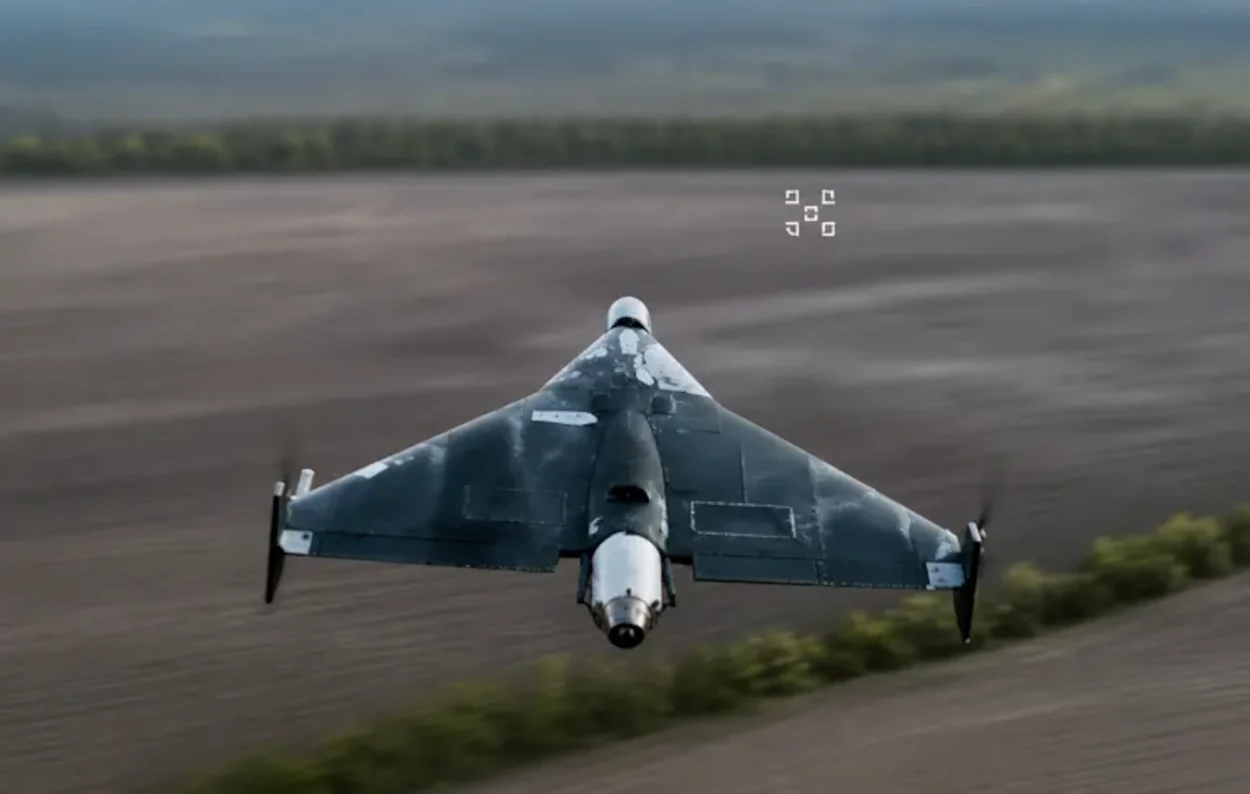
Ukraine has successfully tested another interceptor designed to counter Russia’s increasingly common jet-powered Geran attack drones, President Volodymyr Zelenskyy said on 15 September.
The test comes as Russia rapidly expands the use of faster jet-powered Gerans, creating a new problem for Ukraine’s air defenses: these drones give defenders less time to detect and engage them while allowing Russia to maintain large-scale attacks. A successful interceptor could give Ukraine a cheaper, scalable way to counter that threat without relying as heavily on scarce high-end air-defense missiles.
Zelenskyy said Commander-in-Chief Mykhailo Drapatyi reported the successful test, during which the new interceptor struck a Russian Geran drone.
The system still reportedly needs further work, including improvements to some aspects of its control. But the successful test marks another step in Ukraine’s effort to develop a new layer of air defenses against Russia’s faster drones.
Russia is making its drone attacks faster and larger
Russia has sharply expanded its use of jet-powered Gerans in recent months, adding a faster and more difficult-to-intercept threat to its large-scale drone campaign.
Geran is Russia’s designation for its domestically produced Shahed-derived attack drones, with newer jet-powered variants representing a major upgrade over the earlier propeller-driven models.
Zelenskyy recently said Russia launched around 2,100 drones against Ukraine last week, alongside nearly 1,700 guided aerial bombs and 78 missiles. The attacks have increasingly targeted energy facilities, railway infrastructure, businesses, and residential areas.
The newer Gerans are faster than earlier Shahed-derived drones and can reach targets deep inside Ukraine. Their speed gives Ukrainian air defenses less time to detect, track, and engage them.
Russia has also changed how it uses its drones. Rather than concentrating attacks almost exclusively overnight, Russian forces have increasingly launched waves during the day as well, keeping Ukrainian cities under repeated air-raid alerts.
The result is a growing challenge not only of interception, but of scale. Ukraine must defend a large territory against increasingly large drone barrages while preserving more sophisticated air-defense missiles for ballistic missiles and other threats.

Ukraine is building a new layer of air defense
Ukraine has already been racing to develop such systems. In late August, Defense Minister Yevhen Khmara said four potential interceptor systems capable of shooting down jet-powered Gerans had undergone field testing. Ukraine was aiming to bring them to the required level and eventually produce thousands of units.
Today’s announcement shows that effort continues to produce concrete results.
Ukraine is also expanding other parts of its counter-drone network. Zelenskyy said the country is increasing purchases of electronic warfare equipment and reorganizing mobile fire groups and air-defense positions.
The goal is to build enough layers to cope with Russia’s evolving drone campaign: electronic warfare, mobile fire teams, traditional air defenses, and increasingly specialized interceptors.
Russia is making its drones faster and launching them at greater scale. Ukraine’s response is now moving beyond adapting existing defenses toward developing weapons specifically designed to catch them.


