


The United States is pressing Ukraine to ease restrictions on Belarusian potash imports and to lobby European governments to do the same, Bloomberg reported on 20 May, citing people familiar with the discussions. The Ukrainian Foreign Ministry did not respond to a request for comment.
The request lands three months after Kyiv expanded its own sanctions on Aliaksandr Lukashenka and his inner circle over Belarus's role hosting Russian Shahed drone relays that strike Ukrainian cities. Washington is now asking Ukraine to argue against the same economic pressure it just moved to tighten.

“This will affect not only Lukashenka, but also his inner circle, his sons”: Ukraine promises further actions against Belarus for drone relays
What potash is, and why Belarus needs it back
Potash is a potassium-based fertiliser. Crops need it to grow. Belarus produces roughly a fifth of the world's supply, and before 2022 the trade brought in around $3 billion a year — close to 4% of the country's GDP. Almost all of it left through the Lithuanian port of Klaipėda on the Baltic Sea.
Lithuania shut that route after Russia's full-scale invasion. Since then, Belarus has been forced to send shipments through Russian ports — a longer, more expensive journey that, according to journalist Igor Kuley of the Belarusian Investigative Center, eats "almost all the profit." Unlocking the European route is the single biggest financial prize Lukashenka can ask for. It is also the one the US cannot deliver on its own.
What Washington has already done
Since September 2025, the Trump administration has softened US sanctions on Belarus in four rounds, each timed to a release of political prisoners. The state airline Belavia was delisted first. In December, three potash producers received partial relief. In March, the US Treasury fully removed Belaruskali, the Belarusian Potash Company, the subsidiary Agrorozkvit, and the state-run Belinvestbank from its sanctions list. The latest round came on 28 April. Lukashenka called it part of a "big deal" still under negotiation.
The relief works only halfway. Without the EU lifting its own sanctions, Belarusian potash still cannot move through Klaipėda. Belarus is left shipping via Russian ports, paying Russian transit fees, and deepening its dependence on the Kremlin — the opposite of what Washington says its policy is meant to achieve. EU sanctions on Belarus run until February 2027 and require unanimous agreement to extend.
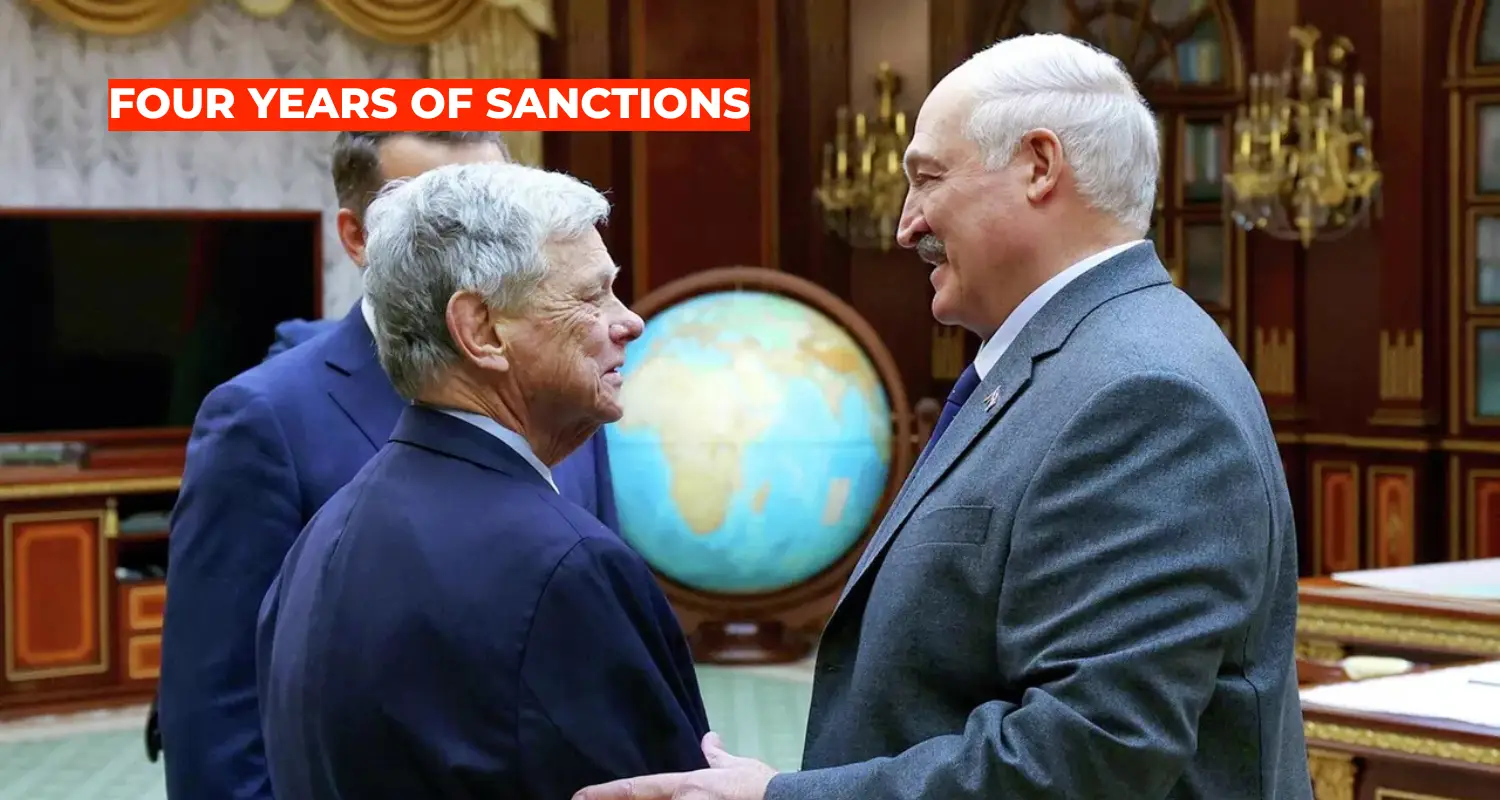
“A direct investment in ammunition flying across the border”: Belarusian defectors warn US sanctions relief is funding Russia’s war
First Lithuania. Now Kyiv.
US Special Envoy for Belarus John Coale visited Vilnius in March and urged the Lithuanian government to reopen talks with Lukashenka and restore the potash transit. Vilnius refused. Lithuanian Foreign Minister Kęstutis Budrys later told reporters on 14 May that "the situation is changing — I have always said that there is no such activity, but today I can say that yes, additional activity has appeared from the US side." Lithuania's Foreign Ministry the next day pushed back against media framing that he had used the word "pressure."
President Gitanas Nausėda then walked the temperature down further, saying Lithuania faced no US pressure but that even if it did, the sanctions were European and Vilnius could not lift them unilaterally. "The Belarusian regime is not changing its nature and continues to actively assist Russia," he said. "I would advocate for the extension of those sanctions."
The Bloomberg report extends the same conversation to Kyiv. The American argument, according to the sources cited, is that softening restrictions could pull Belarus a little further from Moscow.
Trending Now
The scenario Belarusian sources predicted
Igor Kuley sketched out exactly this kind of escalation in an interview with Euromaidan Press in April. He argued that if European transit stayed closed, the US would look for an alternative — including potentially through the Ukrainian Black Sea port of Odesa — and that Washington would seek Ukrainian cooperation to make the wider Belarus deal viable.
"It wouldn't be difficult for the Americans to agree with the Ukrainians for transhipment to go through, say, the port of Odesa," he said.
Belpol, a group of former Belarusian security officers who defected after the 2020 crackdown, told Euromaidan Press in the same investigation that each round of US sanctions relief frees money the regime previously spent on workarounds, and that the released capacity flows to "both its own survival and help to the partner-neighbour — the Russian Federation, which is solving its tasks on our territory, including military ones." Their investigation documented Belinvestbank loans to Belarusian factories producing 152mm artillery shells and 122mm rockets — the same calibres Russian forces fire at Ukrainian positions daily. Belinvestbank came off the US sanctions list in March.
What Belarus is doing while Washington negotiates
On Monday 18 May, two days before the Bloomberg report, Minsk announced that the Belarusian armed forces would conduct snap nuclear exercises alongside Russian units. Russia has stationed tactical nuclear warheads on Belarusian territory since 2023 and deployed the Oreshnik intermediate-range missile system there in November 2025.
President Volodymyr Zelenskyy warned earlier this month that Belarus could again become a staging ground for renewed attacks on Ukraine, as it was in February 2022. The Lithuanian Defence Ministry's 2026 threat assessment concluded that Lukashenka uses prisoner releases to charm Western governments while continuing to serve as a Russian instrument of pressure against Europe.
Roughly 841 political prisoners remain behind bars in Belarus, according to the human rights group Viasna. New arrests continue.
Bloomberg's sources said there are no signs the EU is preparing to ease its restrictions. Whether Kyiv will be asked to make the case for them anyway, in public, is the next question.


