

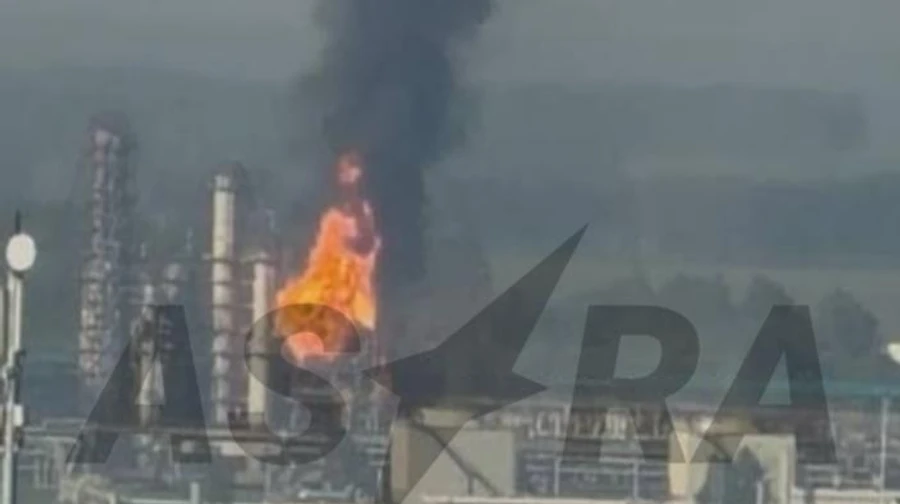
Ukrainian drones attacked the Lukoil-Nizhegorodnefteorgsintez refinery in Kstovo, Russia, igniting fires at two industrial sites overnight on 20 May, Nizhny Novgorod governor Gleb Nikitin and the Russian Telegram channel Astra said.
It was the second drone strike on the plant in two days. Astra reported the damage was in the refinery's southwestern section, likely the ELOU-AVT primary distillation unit—the first processing stage for crude oil at one of Russia's largest refineries, with annual primary refining capacity of about 17 million tons.
Damage at the Kstovo plant
Nikitin said 30 drones were shot down over Nizhny Novgorod region overnight and during the morning. "Falling debris caused damage and subsequent fires at two industrial facilities in Kstovo district," he said, without specifying which sites had been hit. Schools in the district were moved to distance learning, and he added that work was underway to contain the fires and address the aftermath.
Photographs and video circulated by Astra showed columns of smoke and open flames at the refinery. The channel cited residents reporting explosions and fire in the city.
The ELOU-AVT is a combined primary refining unit that desalts crude oil and separates it into base fractions, including straight-run gasoline, kerosene, diesel fuel, vacuum gas oil, and residual fuel oil.
A repeat target supplying the Moscow region
The refinery was previously struck by drones on 18 May. The plant is one of Russia's leading oil refineries and an important fuel supplier for the Moscow region, producing more than 50 product types including automotive, aviation, and diesel fuels, as well as petroleum bitumen and paraffins.
The Russian defense ministry said its air defenses had downed 273 Ukrainian drones since the evening of 19 May. It listed interceptions over the regions of Belgorod, Bryansk, Voronezh, Volgograd, Kaluga, Kursk, Lipetsk, Leningrad, Nizhny Novgorod, Novgorod, Oryol, Rostov, Smolensk, Tver, Tula, and Moscow, along with Krasnodar Krai, Stavropol Krai, and the Republic of Tatarstan.
The ministry's tally also included Russian-occupied Crimea and the waters of the Sea of Azov and the Black Sea.


