


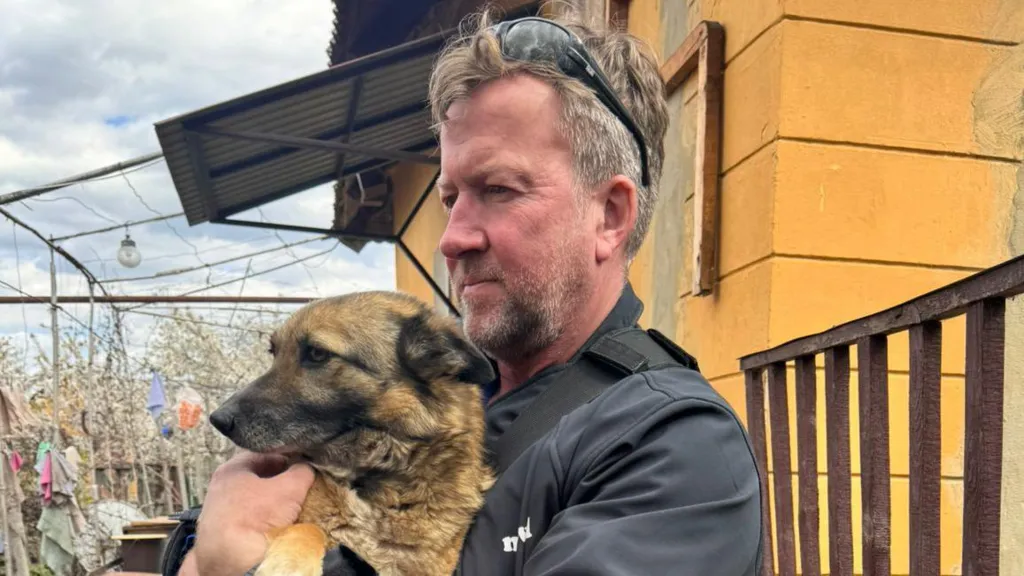
The former Royal Marine who ran the high-profile 2021 evacuation of animals and charity staff out of Kabul has done it again, this time in eastern Ukraine. Paul "Pen" Farthing and a four-person team from his Nowzad charity moved 30 cats and dogs out of Kramatorsk and drove them to safety in Smila, in central Ukraine's Cherkasy Oblast, before turning for the UK. The operation covered more than 13,000 km in total. Farthing, 56, spoke to the BBC by phone from the Ukraine-Poland border, where he said the mission had succeeded and he had vowed to come back in June.
The animals are a marker of what is happening to the city they were pulled from. Kramatorsk is one of the last big Ukrainian-held cities in Donetsk Oblast, and Russia strikes it daily — homes, parking lots and apartment blocks hit with FPV and Molniya-2 drones, an aviation bomb on the city center on 5 May that killed residents. The same week the council shipped municipal monuments out of the oblast for safekeeping. The cats and dogs left in one direction; the bronze busts left in another; the people who cannot leave stayed under the drones.
Farthing, who served in Afghanistan in 2006–07 and built Nowzad afterward, had travelled to Ukraine in April to begin pulling animals out, worried they would otherwise be shot on sight or left to starve. He was joined this time by vets Lachlan Campbell and Angela Stoop and by Nowzad grants manager Nina Ley. They drove through drone strikes and overhead missiles to reach the animals and get them out.
What he kept returning to, on the phone from the border, was not the rescue. It was the asymmetry of being able to perform it at all.
"We are just little pawns on the chess board," Farthing said, with "no ability to stop" the war.
In a few days, he said, he could be sat in Exeter "having a beer and not a care in the world about war." He called that a mockery. He did not soften it or talk himself out of it. The 23:15 strike that EP's sources logged in Kramatorsk on 13 May wounded a woman in the private sector; she was not going to Exeter. That is the gap the rescue runs across, and Farthing named it himself rather than leaving it for anyone else to.
A pattern he has run before
The Ukraine mission echoes the one that made his name. In 2021 Farthing led the chaotic extraction from Kabul that ultimately brought out 67 Afghans and roughly 150 animals as the city fell to the Taliban — an operation that drew weeks of British headlines and political argument over priorities during an evacuation.
Where the front actually is
The front Farthing drove into is closing on Kramatorsk, though by how much depends on who is counting. EP's reporting put the line roughly 15 km from the city's limits in mid-May. Russia's chief of the general staff, Valery Gerasimov, claimed on 21 April his troops were within 7 km of Kramatorsk and Sloviansk, Reuters reported. Either figure describes a city inside the range of an expanding set of Russian weapons. After capturing the ruins of Pokrovsk and Myrnohrad late last year, Russia's Center Grouping reoriented its push toward the twin cities, the capture of which would hand Moscow most of Donetsk Oblast — a 2026 objective Ukrainian defenses have so far kept out of reach.
They are going back
Nowzad has appealed for £50,000 (roughly $65,000) to keep the work going, and Ley thanked supporters for the response to it. She framed what they had done so far as a starting point, not a conclusion.
"This is just the very beginning," Ley said.
The plan is to restock in the UK, regroup, and return in June to build more temporary housing for the animals still there. Ley described leaving Kramatorsk and looking back at something that still seemed like a crisis, unnecessary and sad. The team will drive back into it. The front, on every reading of the maps, will not have moved away from the city by the time they do.
Read also
-
Washington makes it official: US Treasury license clears sale and import of Russian diesel blocked by sanctions
-
While Washington eases up on Russia, Europe hits back harder: EU plans to pass its largest sanctions package on Russia’s war machine in two days
-
Trump’s Russian diesel deal, which drew fury in Ukraine, is unlikely to lower prices, experts say


