


- The Russians are moving a tank division toward Pokrovsk in order to reinforce their eastern offensive
- The 90th Tank Division is fighting without its tanks, of course, but that's no longer unusual
- Russia's infantry infiltrators are sneaking along natural obstacles in order to advance toward the next main objective: Dobropillia, a gateway to Kramatorsk and Sloviansk
Six months after capturing the ruins of Pokrovsk in eastern Ukraine's Donetsk Oblast, the Russian Center Group of Forces is trying to break out of Pokrovsk and neighboring Myrnohrad—and march on the free twin cities of Kramatorsk and Sloviansk, 40 km to the north.
And they've brought in reinforcements to help make it possible. The Russian army's 90th Tank Division, which until recently was fighting in southeast Ukraine, has shifted at least some of its regiments 75 km to the northeast to bolster the units already deployed in and around Pokrovsk and Myrnohrad, including the powerful—and growing—76th Air Assault Division.
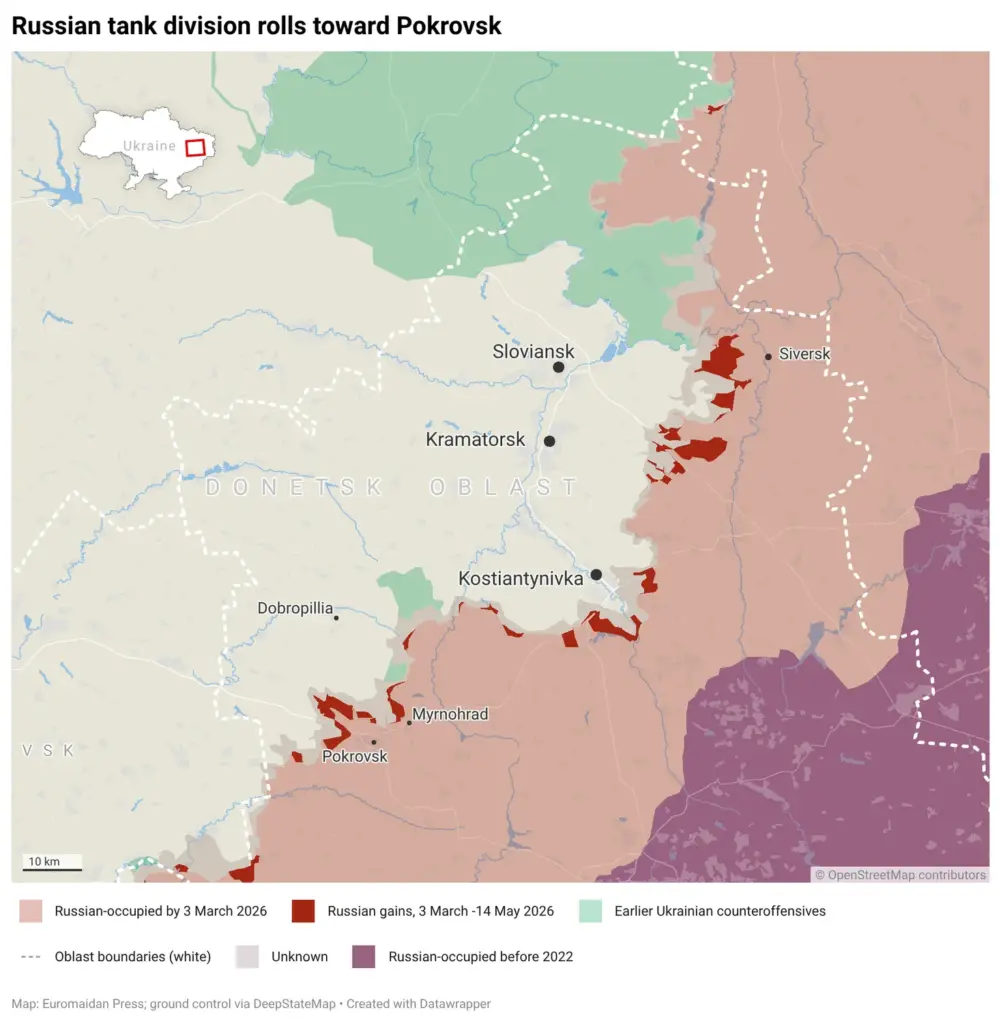
Can Ukrainian troops kill enough Russian troops fast enough to blunt the effect of these reinforcements? The answer to that question will shape the eastern front as Russia's wider war on Ukraine grinds into its 51st month.
The 90th Tank Division didn't necessarily bring the equipment that made it famous: its tanks. Instead, the division is, like other Russian formation, fighting on foot. Russian assaults around Pokrovsk and Myrnohrad are "just infantry," Lt. Col. Yevhen Bespalov, the commander of Ukraine's 38th Marine Brigade, told Rob Lee, an American analyst who has teamed up with Ukrainian marine corps drone operator Kriegsforscher to form a new analysis group, Two Marines.

But the lack of heavy equipment isn't necessary a problem for the Russians. Armored vehicles struggle to cross the wide, drone-patrolled and mine-infested gray zone that threads 1,200 km between free and occupied Ukraine. The Russians decided more than a year ago to park most of their tanks and other combat vehicles—and attack with small groups of infantry infiltrators who stand a better chance of slipping past the drones, and who can slowly but steadily sow chaos among Ukrainian defenders.
Infiltration was the key to the Russians' conquest of Pokrovsk and Myrnohrad in heady few weeks late last year and early this year. Sneaking into the cities under the cover of thick winter fog, the Russians gradually enveloped the cities' Ukrainian garrisons, capturing one city block at a time while also bringing more firepower to bear on the Ukrainians' supply lines.
"Their task is just to go forward and get in buildings, in basements and all," Bespalov said of the infiltrators.
Slow war of drones
"Instead of armored breakthroughs, there is a slow war of drones, FPV systems and reconnaissance," the 7th Rapid Reaction Corps explained. "The enemy is attempting to degrade our logistics, cut off UAV launch sites and push their own FPV teams closer to the front line, operating through infiltration in forested areas and urban terrain."
If there's any hope for the Ukrainian 7th Rapid Reaction Corps and other formations defending north of Pokrovsk and Myrnohrad, it's that there are fewer buildings for the Russians to occupy now that they've fully occupied Pokrovsk and Myrnohrad—and must cross less built-up terrain in order to reach the next major settlement: Dobropillia, around 20 km north of Pokrovsk.
If there's reason for alarm for the Ukrainians, it's that the natural geography of the area is still pretty favorable to Russian infiltration. "Riverbeds, road networks and green zones ... are being used for movement and infiltration," the 7th Rapid Reaction Corps warned.
Trending Now
Can Ukrainian forces kill enough infiltrators to prevent the reinforced Russians from gaining new lodgements around Pokrovsk and Myrnohrad in the coming weeks, setting themselves up for a push toward Dobropillia? "The enemy is trying to convert quantitative advantages in drones and infantry into gradual territorial pressure and fire control over logistics routes," the 7th Rapid Reaction Corps noted. Ukrainian forces must erase that advantage in order to win.
At this early stage in the Russians' renewed march on Kramatorsk and Sloviansk, the news is mixed for the Ukrainians. Analyst and mapper Clément Molin observed two separate Russian assault lanes pointing at Dobropillia: one coming right out of Pokrovsk and the other—the more direct assault—originating just north of the ruined city.
"As you can see, the progress is mainly coming out of Pokrovsk," Molin noted, "while the direct Dobropillia direction is currently stopped."
But Molin stressed that the situation could change. Russian reinforcements are flowing in. The weather is more favorable for assaults. And while Russia's annual spring offensive has been a bust so far and overall, it's possible it's merely delayed—not fatally damaged.
"It is very difficult to make any prediction," Molin wrote.


