


- The hypersonic Zircon is one of Russia's best long-range missiles
- Fast and low-flying, the Zircon is hard to intercept
- But its Bastion mobile launchers are vulnerable to drone attack
- Striking harder across Crimea, Ukrainian drones recently pinpointed and blasted a Bastion—and blew up its two Zircons
Russia's Zircon missile is very fast and very difficult to intercept. And that's why it's such a big deal that, on or just before Tuesday, Ukraine's defense intelligence agency—the HUR—knocked out a Zircon launcher in Russian-occupied Crimea.
It's the first hit on a Bastion launcher, which transports and fires two of the 10-m Zircon missiles. "Fewer launchers," the Ukrainian defense ministry boasted. "Fewer missiles. Less capacity to strike Ukrainian cities."
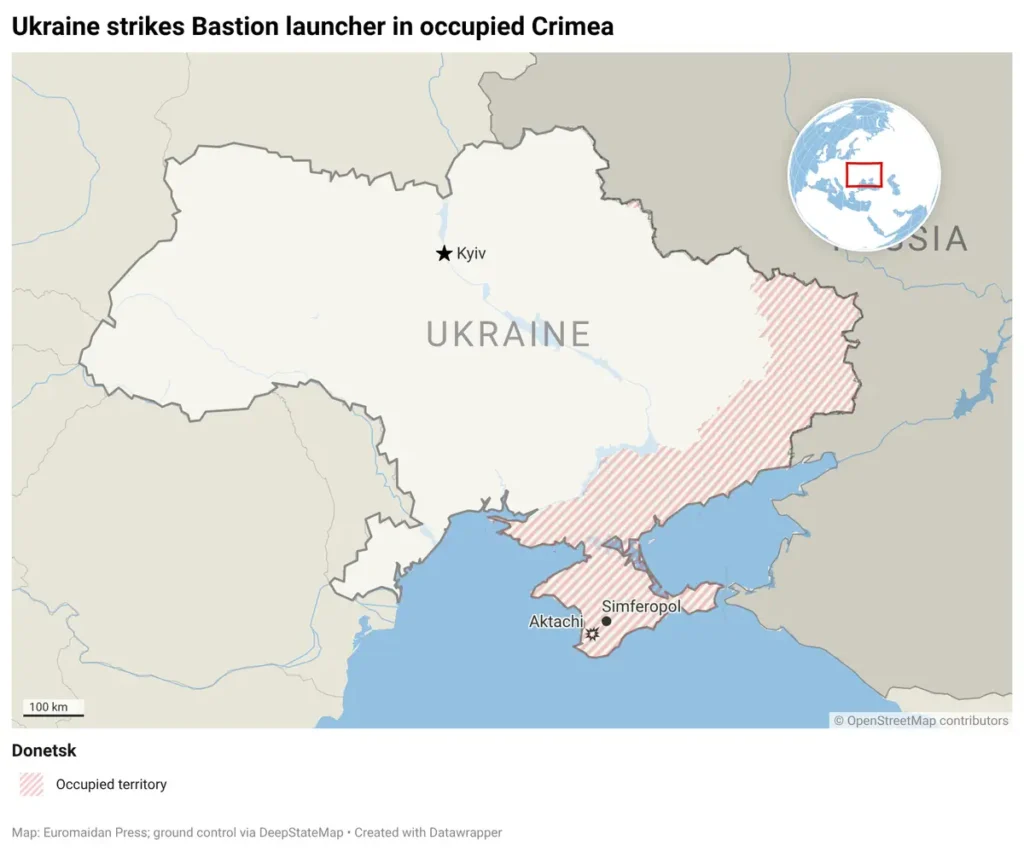
The HUR sortied long-range, first-person-view drones to strike the wheeled Bastion in a Russian convoy traveling near Simferopol, 160 km from the front line in southern Ukraine. That the Ukrainian drones could get anywhere near the Bastion convoy speaks to the ongoing collapse of Russian air defenses—not just in Crimea, but all along the 1,200-km front line of Russia's 50-month wider war on Ukraine.
Increasingly incapable of protecting its most precious assets in a zone stretching hundreds of kilometers from the porous front line, the Russians are losing more hard-to-replace weapons. A single Zircon may cost $5 million. A Bastion launcher also costs millions of dollars. As recently as 2024, the HUR estimated Russia possessed just 40 Zircons. Now it has two fewer.
The Zircon is notionally an anti-ship missile, but it can strike targets on land, too, from as far away as 400 km. Russia occasionally tosses a few Zircons in the mix when it bombards Ukrainian cities on a roughly weekly basis.
While few in number, the Zircons are uniquely dangerous. They're extremely hard to shoot down owing to their Mach-6 top speed and low cruising altitude. When Russia attacked Ukrainian cities on 7 March, there were two Zircons among the roughly 450 munitions. Ukrainian air defenses shot down most of the incoming missiles and drones, but both Zircons got through. Their high speed adds kinetic energy to their 300-kg warheads.
Vulnerable on the ground
But the Zircon, like all missiles, is vulnerable on the ground. Mobile launchers, which are harder to locate and hit than fixed launchers, can mitigate that vulnerability. But even mobile launchers need protection from air attack. And Russia is struggling to provide that protection.
Trending Now
There was a time, early in Russia's wider war on Ukraine, when occupied Crimea was one of the best-defended regions on Earth. Long-range radars scanned for incoming drones and missiles. Ground-based air defenses, including the best S-400 batteries, extended overlapping coverage. Short-range air defense and missile-armed warplanes backed up the S-400s.
In four years of relentless drone and missile strikes, Ukrainian forces gradually peeled away those defenses. The key, it seems, was Ukraine's arsenal of medium-range FPV drones such as the Fire Point FP-1 and FP-2. Directly steered via satellite by remote operators, the FP-1s and FP-2s fly low in order to avoid Russian air defenses—and then strike those same defenses with pinpoint accuracy.

Ukrainian drones now hammer Russia’s last Black Sea Fleet refuge from the sky—and this time, there’s no escape
In just one year between March 2025 and this month, Ukraine's medium-range drones hit more than 170 Russian air defense systems, many of them in Crimea. Each strike on a hard-to-replace radar or launcher makes it easier for the next wave of drones to hit more radars and launchers—so on and so forth in a virtuous cycle for Ukraine that ends with Russian forces in Crimea being practically defenseless against aerial attack.
It's that defenselessness that exposed the Bastion launcher to attack—and got it and its two deadly Zircons destroyed before they could strike Ukrainian cities.

Read Also
-
Ukraine’s Swedish radar planes have flown inside Russian missile range for six months. None has been shot down.
-
Ukraine is running short of its best missiles for hunting Russia’s jet drones. Now MiG-29s are firing 1970s weapons
-
Ukraine is taking 1980s Leopards from across Europe and giving them radar-guided anti-drone guns and gunner-less turrets


