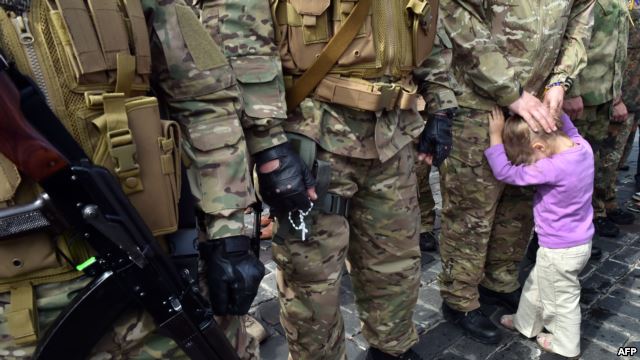
A book fair in times of war

A book fair in times of war

Article by: Oleksandr Havrosh
Translated by: Mariya Shcherbinina

The publishers’ forum in Lviv was held during the most difficult time for Ukraine in its 21-year-long history. And despite nine desperate months of fighting for the very existence of Ukrainians, the capital of Halychyna in September was visited by hundreds of writers, publishers and tens of thousands of book lovers from every corner. In terms of numbers, this year’s book fair, despite the war, was not much smaller than the previous ones.

Sometimes the dead and wounded, Putin’s possible further intervention, Western sanctions were completely forgotten, and the people dived into the realm of the book headfirst. However, the unseen atmosphere of the threat from the East sometimes unexpectedly surfaced and returned them to severe reality.

One may see an advertisement for armored doors on a billboard from the marshrutka window that says: No terrorist will pass, or on Lviv oblast television, where one is invited to share their experience, you end up live among guests from the ATO. And even having stumbled into one’s hostel late in the evening, tired and exhausted, at the kitchen table, one meets an Aydar battalion fighter at the kitchen table, who came to Lviv for two weeks’ leave and is now peacefully sipping tea in camouflage, showing you pictures from combat on his laptop.

The war is everywhere: unseen, constant, threatening. It does not allow itself to be forgotten. Even if you stop looking at your newsfeed to throw it out of your subconscious, it will still catch up with you. Even at the presentation of a collective compilation of short stories Ode to Joy, which was supposed to rip us out of the shocking circumstances of today, the authors’ speeches began and ended with war.

When you find out that the person you’re sharing a room with is from occupied Donbas, you come to understand you cannot run from it. What is left is to shift your chair forward, pour a glass (what else?) and listen, listen, listen… Listen to how people would live for 1,5 months in an apartment block without water, and then without electricity or gas. How a shell fell onto the topmost floor, however, it never exploded, fortunately. How the terrorists shot a farmer before the eyes of his family next to his very own house, because he gave food to Ukrainian soldiers. Listen about thousands of militants who are buried in mass graves (the majority of them are not locals). How the city has become empty by two-thirds and even after liberation, one-third will not come back. How Donbas is slowly ‘starting to see,’ as there are less than one-third of pro-Russian shouters left. However, they are still waiting for ‘their people.’

Nobody knows what will happen next. My neighbor doesn’t know either, who in the past months lost 12 kilograms of weight and smokes two packs of cigarettes a day instead of one. “If the mercenaries return, we will have to run,” says he, even though his entire family is strewn across Donbas. However, he doesn't want to live under their government again. He will protect his own home if he has to.

However, having talked enough about war, our further conversation slowly turns towards literature, and the argument here is no less ardent. War time has left its trace on books as well. The positive thing is the fall of book import from Russia by half, taking into account that most books in stores are Russian. Therefore the decision of the Publisher’s Forum not to give space to Russians is quite relevant, as even in Lviv there are more than enough Russian books in stores.

Meanwhile Ukrainian publishers decreased the amount of books and copies in times of bad crisis. For example, there are almost no new children’s books. However, despite the decreased volume, both the Art Palace and the square in front of it was crowded during all four days. The people bought books, even though they became more expensive (some very significantly).

Which means that Ukrainians are not only thinking about war, but about peace as well, which will definitely come after. Not panic and bite our elbows, but live in full emotion, grow intellectually and develop, construct ourselves and our own culture, become self-sufficient: this is the best response to Mordor that is coming from Moscow.

Translated by: Mariya Shcherbinina

To suggest a correction or clarification, write to us here

You can also highlight the text and press Ctrl + Enter

Please leave your suggestions or corrections here


    Leave a Reply
    Euromaidan Press

    We are an independent media outlet that relies solely on advertising revenue to sustain itself. We do not endorse or promote any products or services for financial gain. Therefore, we kindly ask for your support by disabling your ad blocker. Your assistance helps us continue providing quality content. Thank you!

    Related Posts

    February 7: The West should not rule out military resolution of the conflict in Ukraine

    February 7 – 5 Ukrainian military were killed and 26 injured in the conflict area in Donbas in the last 24 hours, – informedVolodymyr Polevyi, deputy head of the Information Center of the National Security and Defense Council of Ukraine.

    February 7 – President of Ukraine Petro Poroshenko met with NATO Secretary General Jens Stoltenberg during Munich Security Conference. NATO Secretary General has said that the alliance is strengthening collective security system as well as spoke about providing political and practical support to Ukraine on behalf of NATO.

    February 7 – The West should not rule out military resolution of the conflict in Ukraine, – said on Saturday in MunichSupreme Allied Commander Europe of NATO Allied Command Operations, Gen. Philip Breedlove, writes Spiegel Online. "We are not talking about sending troops to Ukraine," – said Breedlove. In addition, he called Vladimir Putin's proposals on the resolution of the conflict in eastern Ukraine "totally unacceptable".

    February 7 – President of Ukraine Petro Poroshenko has held tripartite talks with Germany's Chancellor Angela Merkel and US Vice President Joe Biden – "The parties have coordinated further steps and stressed the need for an immediate ceasefire as well as continued dialogue on the implementation of all provisions of the Minsk agreements".

    February 7 – Security Service of Ukraine (SSU) has publicized intercepted conversations, which suggest that Russian military are provoking clashes between the ATO forces and militants of "People's Republic of Donetsk". They must be getting new "arguments" ready for Putin's negotiations.

    February 7 – Armed Forces and the National Guards of Ukraine have received new military equipment – a modernized armored vehicle "Spartan", equipped with heavy machine gun and "Stugna" missiles.

    February 7 – Ukraine is ready to support ceasefire at any time, – stated the President of Ukraine Petro Poroshenko in his comments to journalists at Munich Security Conference. Whereas the issues of state's federal structure or the autonomy of certain regions (Putin's wishes), may only be decided at a national referendum, not in Moscow or Berlin. All is needed for peace in Donbas is closed borders with Russian Federation and withdrawal of Russian troops, not peacekeeping forces. In his speech at Munich Security Conference, President of Ukraine Petro Poroshenko presented the passports and military service cards of Russian soldiers who "must have gotten lost in Ukraine" and were detained by Ukrainian military.

    Near Debaltseve after attack Russian terrorists appeared "cemetery" Russian tanks (video).

    Poroshenko in Munich (20 min)

    By Taras Kuzio

    Arm Ukraine and force Putin back to the negotiating table

    Russia, despite its repeated denials, is sending large quantities of military equipment to the Donbas region of eastern Ukraine along with 9,000 of its troops. Movement of Russian forces, including the Pantsir-S1 missile system, are being tracked by think tanks and western intelligence agencies. Only Russian professional (not conscript) troops and intelligence officers can operate highly sophisticated Russian military equipment – not irregular separatist forces.

    Respected Russian military analyst Pavel Felgenhauer has concluded that the aim of Vladimir Putin, Russia's president, is to destroy Ukraine's independence by installing a satrap in Kiev similar to Chechen warlord Razman Kadyrov, thereby ending Kiev's goal of integration into Europe.

    Putin reportedly told German Chancellor Angela Merkel that Kiev should deal with the separatists by buying them off with autonomy and money as he had in Chechnya, which to her was unacceptable.

    Russia and its separatist proxies have never abided by the September Minsk peace accords and last month tore them up and demand a new agreement that would lend legitimacy to their territorial gains. Military assaults have claimed a growing number of civilian lives, including 40 in rocket attacks on the port city of Mariupol and a Luhansk hospital, with the total number of civilians killed rising to 5, 500, according to the UN. Growing numbers of combatants continue to die on both sides, as illustrated by these gruesome photos of a column of 16 Russian and separatist tanks that was destroyed yesterday.

    In the face of the new Russian-backed offensive, pressure on US President Barack Obama to send defensive military equipment to Ukraine is becoming ever more intense. The release of a report for the Atlantic Council of the US by eight US ambassadors calling for military assistance was published along with a crescendo of commentaries in The Times, The Guardian, The Financial Times (here, here andhere), The Wall Street Journal (here and here), The Washington Post, The New York Times, The American Interest, The Christian Science Monitor, The Atlantic, The New York Post, The Boston Globe, The Los Angeles Times and Spiegel Online.

    This chorus of support was backed by influential former US National Security adviser Zbigniew Brzezinski and former Secretary of State Henry Kissinger. A bipartisan group led by Republican and Democratic Senators Rob Portman and Dick Durbin called for military assistance to Ukraine "to defend its sovereign borders against escalating Russian aggression".

    The New York Times reported that the US was considering supplying arms to Ukraine, something reportedly confirmed by Douglas Lute, the US Ambassador to Nato. Ashton Carter, President Obama's choice to become his fourth Defence Secretary, said three days later he was "very much inclined" to provide arms to Ukraine to fight Russian-backed separatists.

    Ukraine has been seeking western weapons since the summer of last year but so far has received only non-lethal equipment such as winter clothing, bullet proof vests and night vision goggles. The US did send 20 light counter-mortar radars late last year and, with two-decades of cooperation in Nato's Partnership for Peace programme, is beginning to train four companies of Ukraine's National Guard.

    Arguments against the supply of weapons, the Wall Street Journal wrote, "look increasingly naïve". Nevertheless, Canadian commentators have pointed to Ukrainian corruption (see here and here) and the presence of "UkrainianNazis" as a way perhaps to justify the Stephen Harper government's decision not to providie military support. High levels of corruption never stopped the supply of Canadian military equipment and special force trainers to Pakistan, Iraq and Afghanistan. Although Putin and the Russian media have repeatedly raised accusations of"fascism" in Ukraine, it is the Russian (rather than the Ukrainian) regime that more closely resembles the political science definition of "fascism".

    Nato will not send weapons to Ukraine but the UK, Poland and Canada would follow the US lead. President Obama is fighting against his own Democratic party if he sticks with the position of Chancellor Merkel, who continues to put naïve faith in a peaceful solution.

    Economic sanctions (helped by falling oil prices) have not discouraged Putin's reckless and bloody intervention in eastern Ukraine. Some of those advocating military support to Ukraine believe – as in the 1980s through weapons supplied to the Afghan Mujahedeen – that only a growing number of casualties will force realignment in Russian policy to that of public opinion, two thirds of which is against intervention in eastern Ukraine.

    The Donbas conflict, engineered and sustained by Moscow, is already Europe's worst security challenge since World War II. There have been 40 close military encountersin the air between Russia and the west since the annexation of the Crimea in March last year. Putin believes he is fighting a "Nato legion" through alleged Ukrainian proxies and has always claimed the Euromaidan revolution was a western-backed coup. Russian soldiers dying at the hands of western weapons would return the world to the Cold War of the 1980s, although it remains unclear which US congressman would today step up as the new Charlie Wilson.

    Putin will stop his destabilisation of Ukraine and return to negotiations only when western arms equalise both sides on the battlefield.

    Taras Kuzio is a research associate at the Centre for Political and Regional Studies, Canadian Institute forUkrainian Studies, University of Alberta and non-resident fellow at the Center for Transatlantic Relations, School of Advanced International Relations, Johns Hopkins University.

    P.S.: Please spread this appeal as much as possible.

    Ads are disabled for Euromaidan patrons.

    Support us on Patreon for an ad-free experience.

    Already with us on Patreon?

    Enter the code you received on Patreon or by email to disable ads for 6 months

    Invalid code. Please try again

    Code successfully activated

    Ads will be hidden for 6 months.