


- Ukraine's 3rd Army Corps has retaken 150–240 sq km north of Lyman since May
- It erased 18 months of Russian groundwork for a northern march on Sloviansk
- Almost nobody reported it for three months—not even Russian war correspondents
- The fighting continues north of Lyman, but on Ukraine's terms
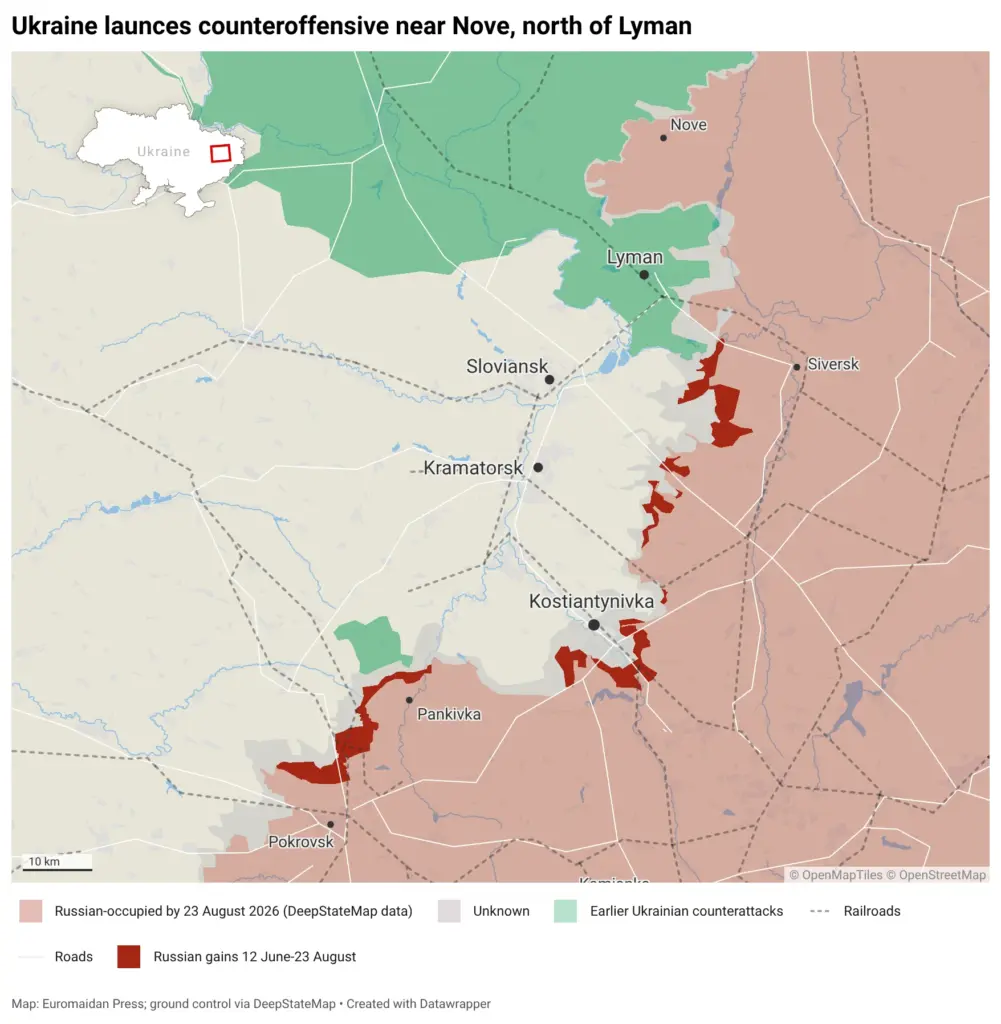
On 22 May, a mechanized battalion of Ukraine's 3rd Assault Brigade—backed by at least two more brigades, the 60th Mechanized and the 66th, attached to the 3rd Army Corps for the operation—attacked Russian positions around the village of Nove, 15 km north of the town of Lyman in eastern Ukraine's Donetsk Oblast. Russian drones were heavily jammed that day. Roughly five Ukrainian vehicles were hit, most by fiber-optic drones—the only kind still able to fly.
Nobody outside the Ukrainian army reported it for three months. The first fragmentary accounts surfaced in late August; the full picture only this week. By then the 3rd Army Corps had taken back somewhere between 150 and 240 sq km and wrecked Russian plans for a northern siege of Sloviansk, one of the last two big free cities in Donetsk. Observer Thorkill, writing in Polish, called it a success on an operational scale.
The presence of that Ukrainian armor around Nove, which at the time anchored the right flank of a 100 sq km salient held by regiments of the Russian 20th Combined Arms Army, was an ominous sign for the Russians. After months of careful preparation by the 3rd Army Corps, the Armed Forces of Ukraine (AFU) were strong north of Lyman. Russian forces were weak.
"The moment AFU could start moving vehicles through the area, the battle was basically over," mapper Vitaly wrote three months later. "Vehicles didn't win it, they showed up because the conditions that had made vehicle movement impossible were already gone." Ukrainian drones were everywhere. And Russian drones, effectively jammed by electronic warfare, could barely fly.
Not everyone reads those months the same way. Thorkill, who tracked the sector throughout, puts the breakthrough at 17 to 18 August, and writes that for most of July and early August the 3rd Corps' attacks were repelled by the Russian 144th Motor Rifle Division. On that account the slow months were not a steady advance. What turned them, he says, is not clear: someone on the Ukrainian side made the difference north of Kolodiazi. He is candid about the limits of what can be seen. Some sources say the Russians withdrew, others deny it, others say they were partly cut off. What he can confirm from satellite imagery is that Ukrainian forces retook Serednie and Zelena Dolyna.
Overextended and pummeled by drones, the Russians barely clung to their salient north of Lyman, which sat between the Nitrius and Zherebets rivers. They were especially exposed at its western edge, where they had pushed across the Nitrius. The Russians had hoped the salient would be a "base for an offensive on Lyman, which could have allowed further offensives to Izium and Sloviansk [and] threatened the northern supply road to Donbas," according to mapper Clément Molin.
Instead, the salient became a trap as the Ukrainian 3rd Army Corps relentlessly—but quietly—exploited the fragility of the Russian 20th Combined Arms Army. The Russians have now been pushed back toward the Zherebets, leaving behind their uncounted dead ... and their ambitions for a quick northern march on Lyman and then Sloviansk and neighboring Kramatorsk.
It had taken Russian forces 18 months to set the conditions for a push toward Sloviansk from the north. In the three months beginning with that mechanized assault around Nove, the Russians "apparently lost 1.5 years of progress in the area," Vitaly concluded. Estimates of the ground retaken vary: Molin puts it at more than 200 sq km, the AKM Mapping account at 151, and Konrad Muzyka of Rochan Consulting at around 240.
The appearance of Ukrainian armor around Nove in late May was a strong indication that the 3rd Army Corps had the momentum. But that doesn't mean the Corps' eventual victory in the battle for the Lyman salient was a foregone conclusion. On paper, the Russians have a manpower and firepower advantage in Donetsk.
A bridgehead too far
The 20th Combined Arms Army advanced too far, too fast. And the terrain favored the Ukrainian defenders, who could pluck at the Russians' supply lines from entrenched positions until the time was right for a counterattack.
Trending Now
"Russia putting itself inside a deep, narrow pocket only made the final phase easier," Vitaly explained. "Once AFU had enough control over the surrounding movement, every new Russian mission sent into the area walked into a reinforced perception trap—troops committed to hold positions that existed far more convincingly in reports than as a functioning front."
The silence
What kept the trap working was that nobody talked about it. The Ukrainian general staff said nothing. Pro-Ukrainian analysts, who normally map every advance within hours, held their tongues until late August. So did the Russians.
Observer Andrew Perpetua, who has followed Ukraine's other quiet operations around Kupiansk and in southern Donetsk, called this one tighter still. The Lyman operation "seemed even more protected since even the most in the know and honest Russian reporters seem to be missing it. Or at least silent about it," he wrote. "It was honestly shocking to watch how out of the loop the Russians really were, which I think is in large part due to the collective action of OSINT to avoid speaking about the situation."
Perpetua's reading is that the lying is heaviest exactly where Russian forces are being pushed back. Nearby Sviatohirsk is the case in point. Vladimir Putin recently announced its capture. On 7 September, the commander of the 3rd Army Corps, Brig. Gen. Andrii Biletskyi, walked around the town on camera.

The 3rd Army Corps cut across the salient around three weeks ago, reaching the northern edge of Kolodiazi and trapping an unknown number of Russian stragglers between the Ukrainian vanguard and the old Russian bridgehead. Most of the encircled Russians appear to have escaped. "There is a large area where there may still be Russian soldiers," Molin warned. "Most of the villages westwards have been cleared, but not the treelines."
On 24 August the Ukrainians mounted a second mechanized attack, so the operation has not stopped. But the 3rd Army Corps is likely shifting from attacking to consolidating and defending—and clearing out the Russian stragglers that, left alone, could sow chaos in the new gray zone that was once a Russian salient.
Russian channels have started to admit the problem. Rybar wrote of "problems near Lyman," conceding that Ukrainian units have been attacking southward from Ridkodub for months and that Russian forces "do not even control the airspace immediately near the front line." The fighting continues, but on Ukraine's terms, for now.
How much it changes is the one thing the analysts do not agree on. "This is one of the most important victory for Ukraine in 2026," Molin wrote, a victory that "will delay the offensive on northern Donbas." Thorkill, in the same post that called it an operational-scale success and rated it larger than the 7th Rapid Reaction Corps' gains near Velyka Novosilka in July, ends on the opposite note: it will not, he writes, affect in any way the situation of Ukrainian forces on the direction that matters most at present, the Kramatorsk agglomeration.
Read Also
-
Ukraine is working down the short list of ships that shell its cities with cruise missiles. A Neptune reached one of them tied up at its own pier
-
Ukraine is sending its winning brigades to where the fighting is worst. The 46th just turned up outside Kramatorsk
-
Desperate to save Sloviansk and Kramatorsk, Ukrainian forces counterattack and reinforce


