

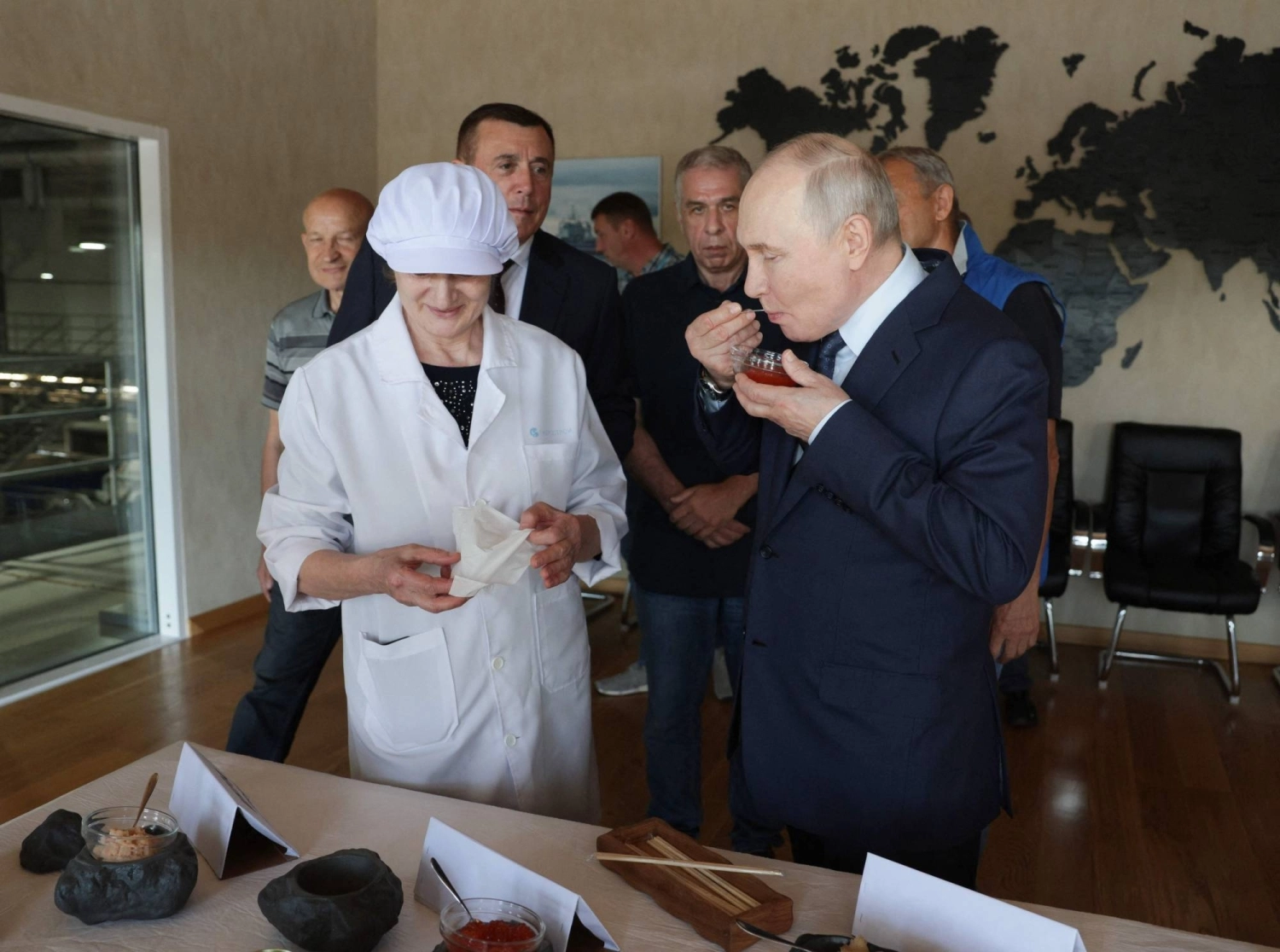
Japan is considering new sanctions on Russia after President Vladimir Putin made his first visit to the disputed Kuril Islands on 13 August, a senior Japanese Foreign Ministry official told reporters, according to Kyodo News.
Putin traveled to Iturup — Etorofu in Japanese — the largest of the four Russian-held islands Japan claims as its own, days after overseeing Russian Pacific Fleet exercises in the Far East. It is the first time a Russian president or prime minister has set foot on the islands. Tokyo summoned Russia's ambassador and lodged a formal protest, calling the visit "totally unacceptable." Prime Minister Sanae Takaichi said the islands are "an inherent part of Japanese territory both historically and under international law."
The Institute for the Study of War assesses that the Kremlin is likely using the visit to deter Japan from adopting a more assertive defense posture, and to discourage EU seizures of Russian shadow-fleet vessels — tying a Pacific island dispute directly to the pressure campaign around Russia's war on Ukraine.
An 80-year-old dispute, reopened on Tokyo's clock
Russia and Japan have never signed a peace treaty ending World War II, entirely because of the Kurils. The Soviet Union seized the four southernmost islands — Iturup, Kunashir, Shikotan, and the Habomai islets — in the war's final weeks, expelling the Japanese residents. Japan calls them the Northern Territories and has never dropped the claim.
Putin's visit lands as Tokyo's posture toward Moscow hardens. Japan's 2026 Defense White Paper, published earlier this month, named Russia as one of the country's principal threats — a paper Putin criticized directly on Wednesday, saying the islands became Russian territory "as a result of World War II" and accusing Japan of imposing "unprovoked sanctions" over what he called the "Ukraine conflict."
The timing cuts against the diplomatic track Tokyo pursued for years. Under former Prime Minister Shinzo Abe, Takaichi's political mentor, Japan met Putin 27 times seeking a peace treaty, and in 2018 the two sides agreed to accelerate talks on a 1956 declaration that would have returned Shikotan and the Habomai islets after a treaty was signed. Russia's full-scale invasion of Ukraine froze those talks in 2022, and Putin's visit closes even the pretense that they might resume soon.
Ukraine has already staked out a position in the dispute: Kyiv's parliament in 2022 recognized the islands as Japanese territory, and President Zelenskyy signed a decree affirming Japan's sovereignty over its "Northern territories" — a reciprocal gesture in the broader alignment between Kyiv and Tokyo against Moscow.
What Japan is weighing
A Foreign Ministry official said only that Tokyo is "considering what step to take going forward," with an additional sanctions package under consideration. No specifics on scope or target have been announced.
The precedent for a symbolic response exists: in 2010, then-President Dmitry Medvedev became the first Russian head of state to visit the islands, traveling to Kunashir — a visit that also drew formal protest without derailing bilateral contact entirely. Putin's visit as president is a harder marker, arriving alongside Russia's sustained war footing rather than a peacetime dispute.
Read also
-
Ukraine shares its fortification know-how with Estonia’s new defense minister, weeks after 70-million-euro shells scandal felled his predecessor
-
Russia quietly grows fleet that funds its war: one shell firm in Marshall Islands buys two gas tankers from Chinese and Greek owners
-
Five Russian bombs kill 17 in Ukraine’s Zaporizhzhia next day after Trump lets Russia ship first 300,000 tonnes of its diesel


