

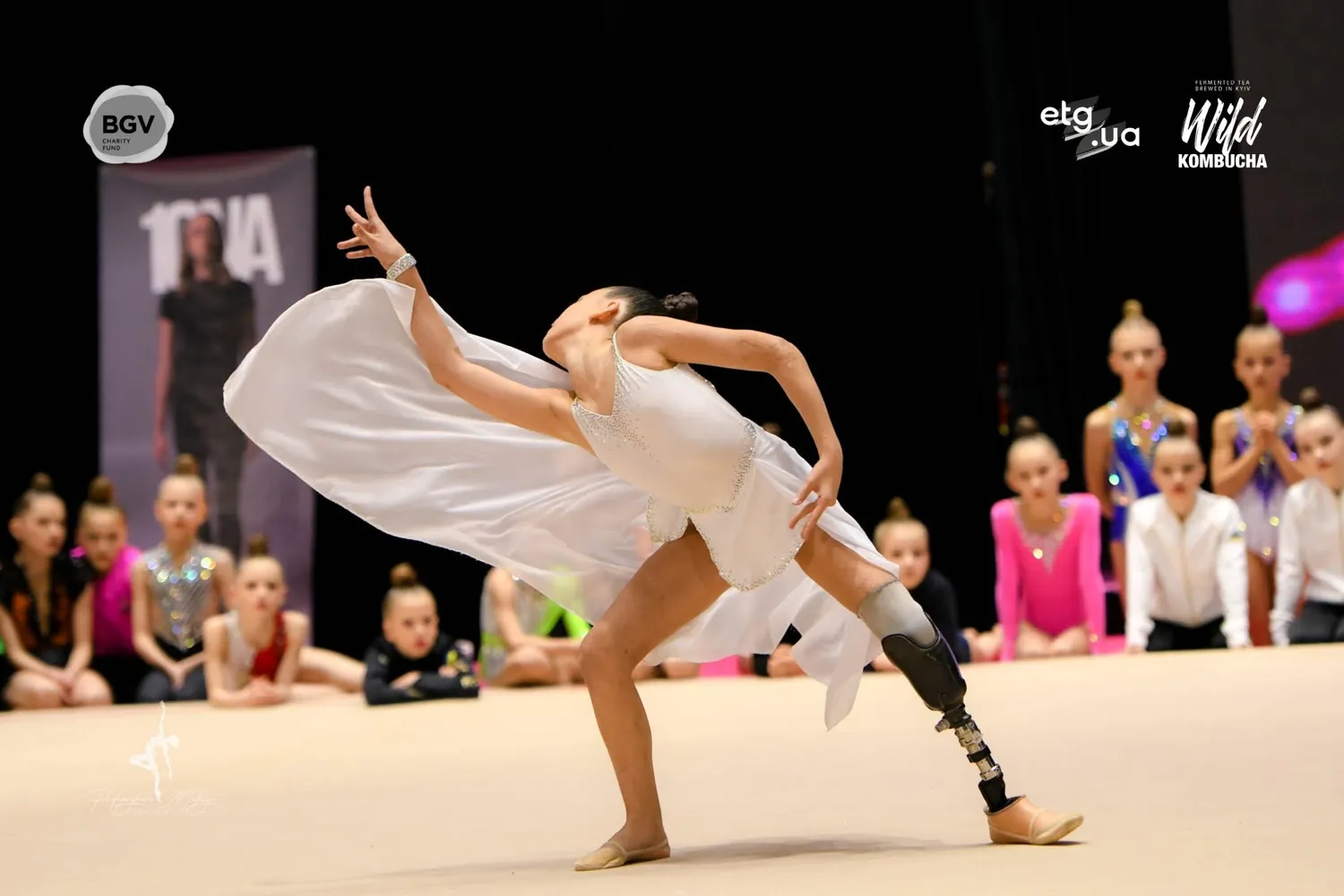
The Dance of Freedom tour, featuring young Ukrainian gymnast Oleksandra Paskal, has carried her from Paris to Tokyo, Akhmetov Foundation reported. Behind it lie a seaside home reduced to rubble, 15 days in a coma, and a place among the more than 3,200 children Russia's war has killed or wounded.
Russia has spent the war striking the cities where Ukrainian families live, turning apartment blocks and holiday coasts into places where children are wounded far from any front line. For every Ukrainian child whose recovery becomes a story the world follows, many more carry injuries and losses that never surface beyond a case file.
In May 2022, three months into Russia's full-scale invasion, a missile struck a home in Zatoka, a resort village on the coast of Ukraine's Odesa oblast. No air-raid siren sounded in the neighborhood, the family says. Beneath the collapsed concrete lay Oleksandra Paskal, six years old, her leg pinned under a slab.
Her mother, Maria, lost consciousness in the blast. Maria later recounted the scene to the Museum of Civilian Voices. She described what she saw when she came to: a heavy concrete slab lying across her daughter's leg, the girl's arm dislocated with the bone exposed, a finger hanging loose, her head badly bruised. Neighbors helped lift the slab. Sasha, as the family calls her, spent 15 days in intensive care in a medically induced coma. Doctors first feared a severe head injury. Then they found that blood had stopped circulating to her left leg. They amputated.
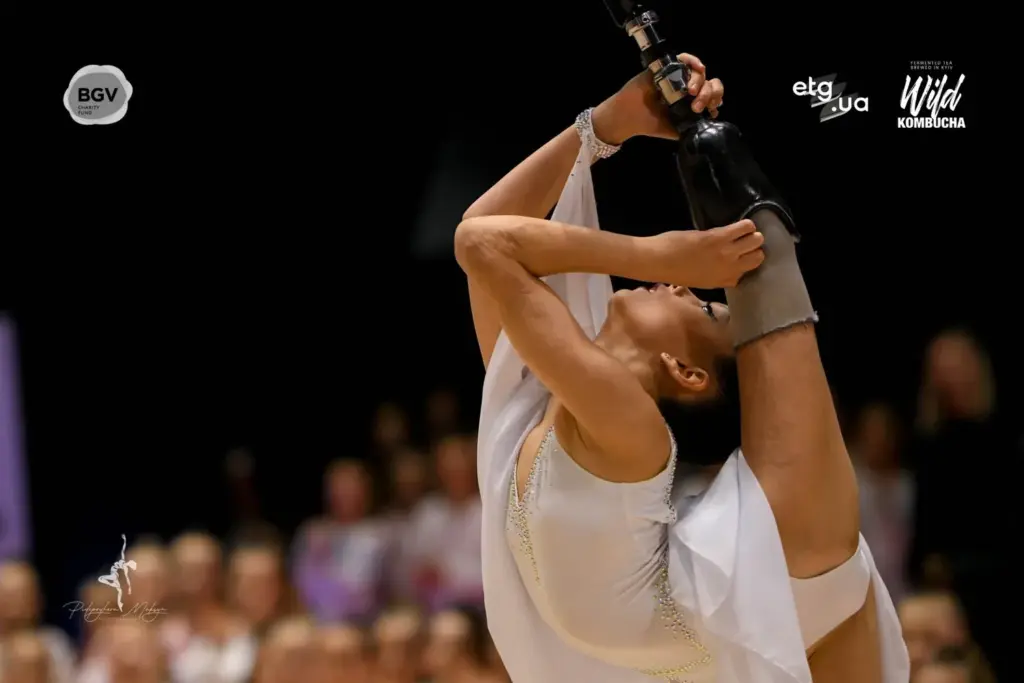
Four years later, Oleksandra is 10 and a competitive rhythmic gymnast performing on five continents.
Her case is at once singular and representative. In the fifth year of Russia's full-scale war, the fighting is still killing and wounding Ukrainian children, even as global attention fades. Oleksandra survived and found a stage; most children harmed by the war never have their stories told beyond Ukraine. The distance between the scale of that harm and the world's diminishing notice is what her tour is built to close.
The return took roughly seven months.
She learned to walk with a prosthesis, returned to the gym, and won her first post-amputation competition in Chornomorsk.
"My passion for sport is bigger than my loss," she told CNN Sports.
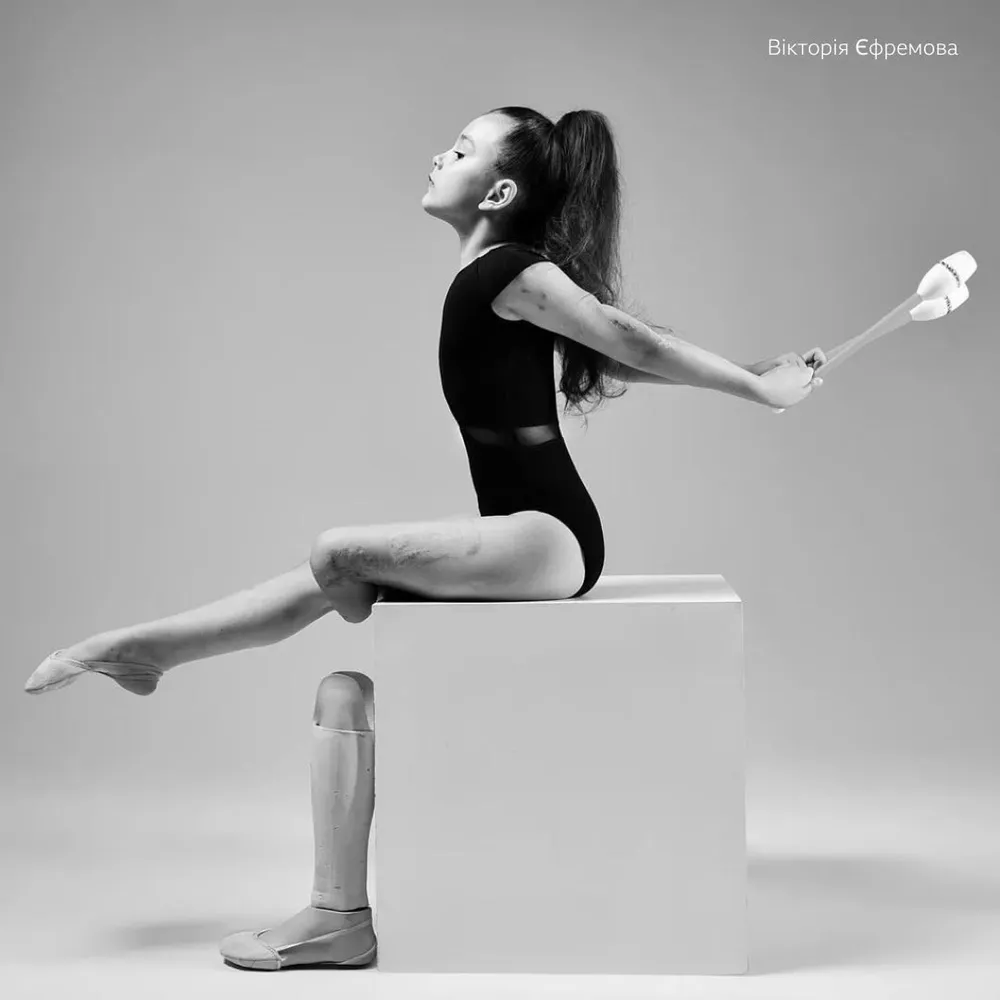
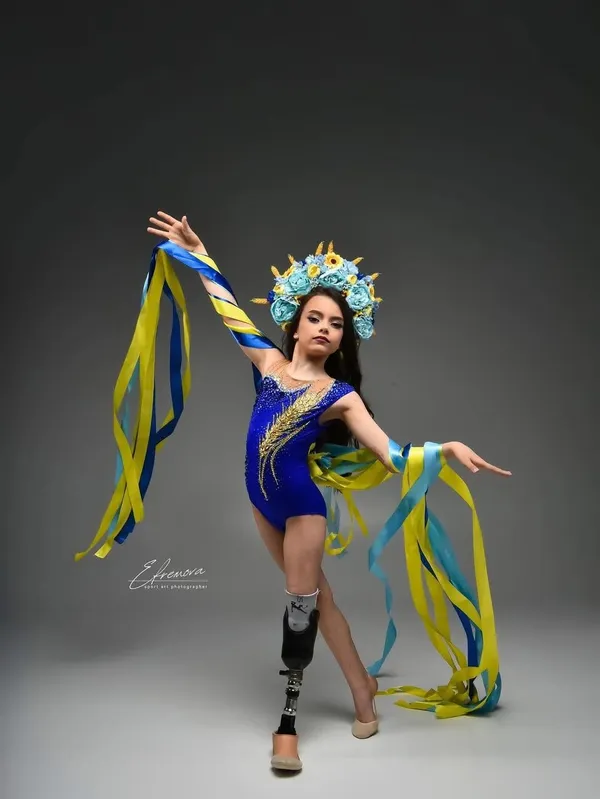
In 2025, President Volodymyr Zelenskyy and First Lady Olena Zelenska awarded her the "Future of Ukraine" honor. Earlier this year, she took gold at Carla's Rhythmic Cup, an international competition in Romania, where she competes against children without disabilities.
The performances abroad are part of the Dance of Freedom tour, an initiative of the Rinat Akhmetov Foundation in partnership with the football club Shakhtar Donetsk, timed to the 35th anniversary of Ukraine's independence on 24 August. Over two weeks, Oleksandra performed her routine in Paris, in New York's Times Square, in Rio de Janeiro, in Nairobi, and finally in Tokyo. In New York, she met the boxer Oleksandr Usyk, visited Ukraine's mission to the United Nations, and stood beneath the Statue of Liberty.
For Oleksandra, the travel is partly an escape. "I'm really happy to travel because it's an opportunity to distract myself from what's going on in Ukraine," she said. Her mother frames it as a purpose.
"She's so strong and motivated," Maria said. "Although she's very young, she's a role model for many people with similar circumstances. We never pushed her. What she's doing comes from her."
Oleksandra's story is singular, but the injury that shaped it is not. According to UNICEF, more than 3,200 Ukrainian children have been killed or wounded since Russia launched its full-scale invasion on 24 February 2022. These are UN-verified casualties, a count that captures only the cases investigators have been able to confirm, so the real toll is almost certainly higher. Almost 2.6 million, more than a third of the country's children, remain displaced. More than 1,700 schools and other educational facilities have been damaged or destroyed. Every stop on the tour, her mother says, is meant to hold that reality before an international audience.
Oleksandra's own ambitions run past the tour. She wants to compete at the Paralympics in Brisbane in 2032 and win gold if rhythmic gymnastics is included in the program. In New York, Usyk gave her a method: write down that you are an Olympic champion, and read it every day. When they met, Zelenskyy gave her a sentence to carry: never give up and move forward.
Read also
-
Ukraine is stalling EU-required reform of bureau that can raid any official, risking European money it badly needs
-
Musk warns military use of Starlink could spark space war. Kyiv’s ex-disinformation chief says he’s building alibi after Starshield scandal
-
US midterms could restore Ukraine’s American aid and curb Trump’s Russia deals, if Democrats win Congress


