


- Russian forces have fallen back in Ukraine three of the last five months
- In June, they netted a loss of around 40 sq km
- Russian losses are rising and Russian logistics are under strain
- The war may be freezing despite isolated Russian gains
Russian forces fell back in June.
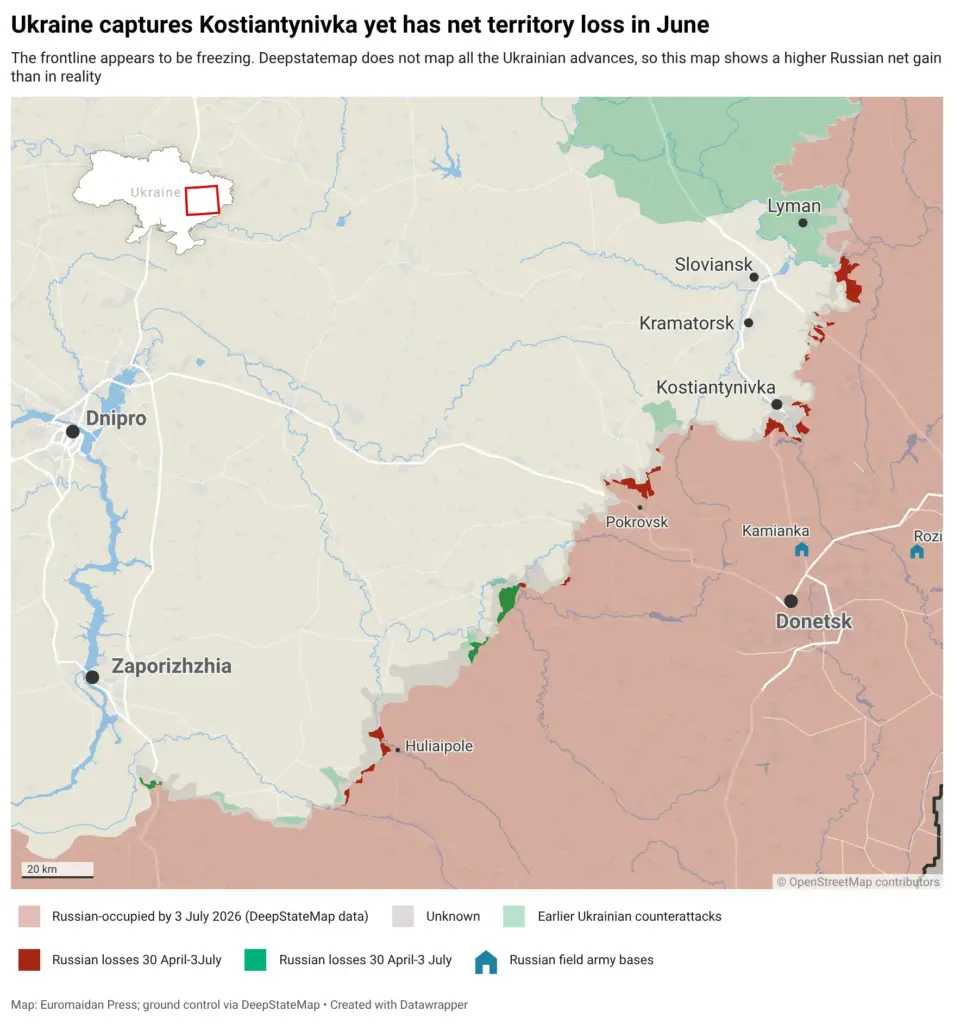
Yes, the Russians drove deep into the city of Kostiantynivka in eastern Ukraine's Donetsk Oblast, their biggest gain of the year. Russian forces are "beginning to take control of several districts in eastern Kostiantynivka," logging Moscow's "first strategic victory of the year," according to mapper and analyst Clément Molin—though fighting is sure to continue.
But in other key sectors south and north of Kostiantynivka, the Russians lost ground. Russia advanced into some 30 sq km across the front in June, ISW calculated—but once Ukrainian counterattacks are subtracted, the month came out negative. Russian forces ended June with a net loss of around 40 sq km of Ukrainian soil, according to analyst Konrad Muzyka of Rochan Consulting.
The Ukrainian monitoring group DeepState framed the same trend a different way. Russia's occupied area grew by 84 sq km in June, the group assessed—but set against what Ukrainian forces clawed back over the month, the balance tipped negative for the Russians. "In May, we took two steps forward. In June, it's one step forward and one step back," DeepState wrote. Russian assault actions actually rose 4.4% over the month, the group noted, even as those assaults bought less ground. The Russians did log gains in the second half of June around Kostiantynivka, Dobropillia, and Huliaipole.
The reasons are myriad. Ukrainian drones are better and more numerous than ever. Ukrainian fortifications are deeper and denser than ever. And Ukrainian forces are hitting Russian logistics in the middle zone between the disputed gray zone and Russia proper with greater intensity than ever, weakening Russian regiments before they can even organize an assault.
The Ukrainian advantages now outweigh the Russian advantages in traditional firepower and, most notably, manpower. Russian troops have outnumbered Ukrainian troops by as much as 8:1 in the Pokrovsk sector, Zelenskyy has said. Yet Ukraine is inflicting far heavier losses than it takes: Russian casualties are running roughly eight times Ukrainian ones, according to the Center for Strategic and International Studies.
"Russia has lost the military initiative in Ukraine as costs continue to mount," the Washington-based Center for Strategic and International Studies concluded.
May points the same way. Russia advanced into around 40 sq km that month but lost control of some 280 sq km, the Institute for the Study of War calculated—a net loss. Ukraine's own Militarnyi, citing defense sources, put the gap even wider, and a source tied to Ukrainian military intelligence called May the first month since 2023 in which Russia lost more ground than it took. DeepState is the outlier, scoring a small May gain. Muzyka logged roughly 25 sq km for Russia but cautioned the real figure may have been negative.
But most sources agree the Russians lost ground in April and March after registering a modest overall advance in February. Russia has probably fallen back in three of the last five months.
Zooming in
Narrowing the frame changes the outlook. "Russian forces took control of some neighborhoods inside Kostiantynivka and advanced near Sloviansk," 34 km north of Kostiantynivka, Molin noted. But "this initial victory—achieved in the summer—does not appear to offer any prospect of a second victory within the year," he added.
That's because it takes maximal effort over many months by the 700,000-strong Russian army of occupation to achieve a single meaningful gain.
Trending Now
Having ground into the ruins of some small city at the cost of potentially tens of thousands of lives, the Russians are exhausted in victory. And they sit in the ruins of Pokrovsk or Myrnohrad or Kostiantynivka eyeing tens of kilometers of mined, fortified, drone-patrolled open terrain stretching between them and the next major objective.
In the case of the Russian survivors in the east, the objective is the free twin cities of Kramatorsk and Sloviansk. There are two approaches: one from the south through Kostiantynivka. Another from the east through Lyman, 14 km northeast of Sloviansk.

Russia is losing ground for the first time in 27 months. Ukraine’s drones might be why.
If the Russians in Kostiantynivka are spent, could the Russians laying siege to Lyman break through and march on Sloviansk and Kramatorsk?
Probably not. Sensing weakness along the flanks of the Russian force just north of Lyman, Ukrainian forces counterattacked this spring. The counterattacks are "preventing Russian forces from establishing staging positions for attacks against Ukrainian [supply lines] between Lyman and Sloviansk," Muzyka wrote, "and thereby disrupting efforts to envelop the Sloviansk–Kramatorsk agglomeration from the north."
Meanwhile in the southeast, counterattacking Ukrainian forces have stabilized the front line after a period of rapid Russian advances last year.
The Russians aim to capture Zaporizhzhia city, 69 km west of the southeastern front line, but "it is evident they have failed to maintain the same rate of progress seen in the latter half of 2025," Molin observed. "Frequent and precise Ukrainian drone strikes on access roads are complicating their logistics."
The war is freezing in place. But that doesn't mean it's ending. "Russia continues to fight—a decision that rests firmly with [Russian President Vladimir] Putin, who has given no public indication he intends to slow down," CSIS warned.
Likewise, "Ukraine also shows no sign of collapsing."


