

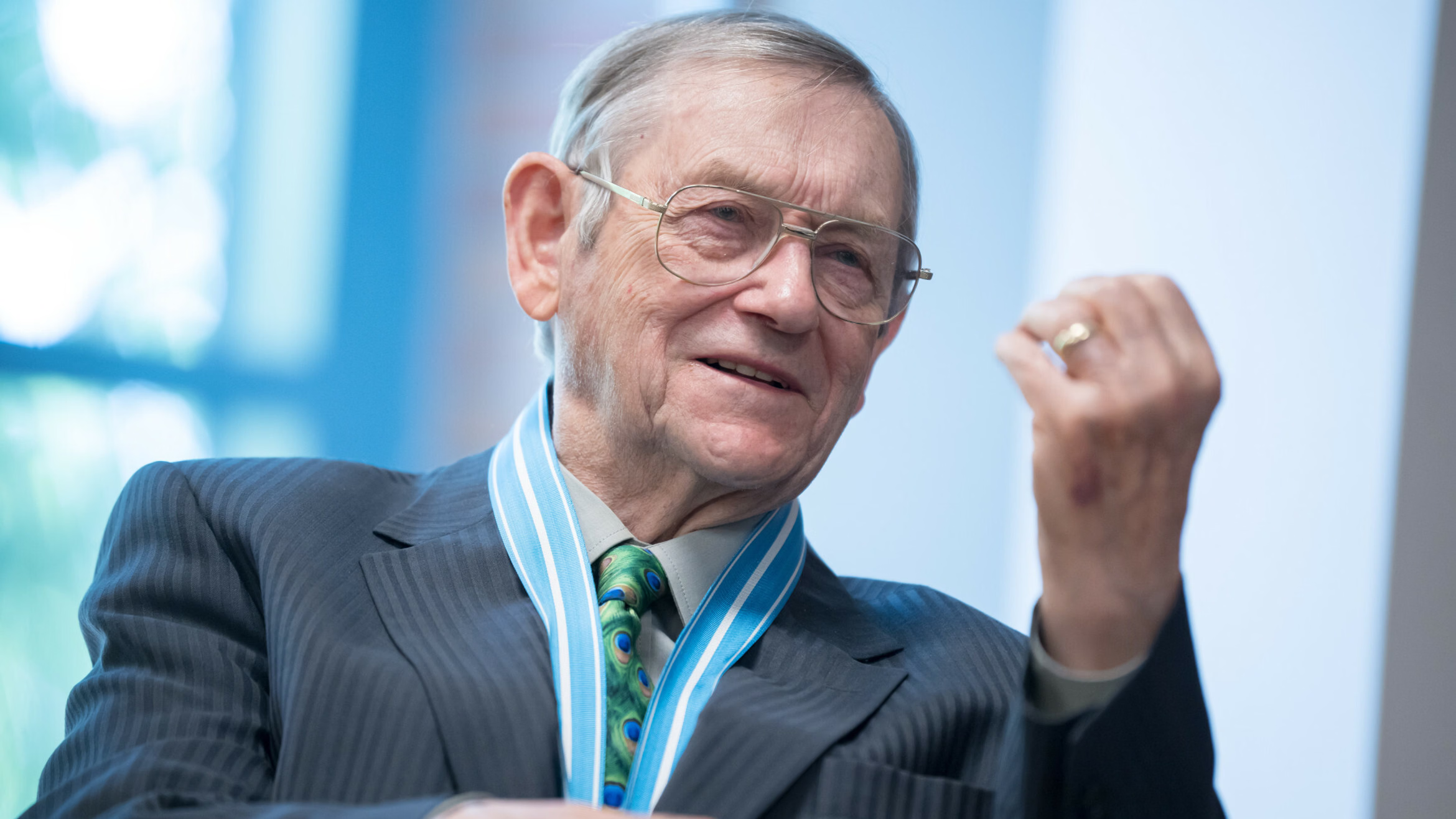
Poland's decision to make the UPA naming controversy a flashpoint of its relations with Ukraine at the height of a full-scale war was a mistake that Warsaw will "pay for in the future," Norman Davies, one of the foremost Western historians of Poland and Europe, told Polish outlet Onet in an interview published 29 June.
Davies — himself a Knight of the Order of the White Eagle, the same award Poland stripped from Zelenskyy last month — pushed back sharply against the framing that Ukraine's president had provoked the crisis. Ninety percent of the Ukrainian Insurgent Army (UPA) had no connection to the Volhynia massacres at all, Davies said. Zelenskyy's decision to name a special forces unit after Heroes of the UPA was not a statement about Volhynia: "What the Ukrainian president did has nothing to do with Volhynia."
The dispute began on 26 May, when Zelenskyy signed Decree 440/2026 granting the honorary title "Heroes of the UPA" to the Separate Center of Special Operations "Pivnich." Polish President Karol Nawrocki responded on 19 June by stripping Zelenskyy of the Order of the White Eagle — Poland's highest state honor. Zelenskyy returned it by post. Three former Ukrainian presidents renounced their own White Eagles in protest.
Not a provocation — a historical problem of framing
The Onet journalist repeatedly pressed Davies to place responsibility on Kyiv. Davies reversed every framing.
Every underground movement from World War II carries dark chapters, he said. That does not make the organization as a whole criminal: "The UPA was generally not a criminal organization. Their goal was to fight against the occupiers." The UPA fought the Soviets on one side and the Germans on the other — and the anti-Soviet struggle lasted into the 1960s. That history, Davies said, is precisely why Ukrainians see the UPA as heroic. It is comparable, he noted, to the Żołnierze Wyklęci — Poland's own celebrated postwar anti-Soviet resistance fighters.
Davies also pointed out that decades of Soviet prohibition meant generations of Ukrainians — including Zelenskyy, who grew up in eastern Ukraine — had limited exposure to the UPA's contested history. Memory was suppressed; it was not curated. The two things, he argued, are completely different.
On Volhynia itself, Davies did not minimize. He has called the massacres a crime "in the spectrum of genocide." But he also named what Polish discourse tends to leave out: that Polish forces killed between 10,000 and 15,000 Ukrainians in retaliatory operations in the same region, and that Operation Wisła — Poland's postwar forced deportation of Ukrainians — belongs in any honest accounting of that era. "If you talk about one aspect, you have to talk about all of them," he said.
The timing is the problem
Davies' sharpest criticism was directed at when Poland chose to raise the issue. Ukraine is in its fifth year of a full-scale war for its existence. Polish leaders chose this moment. "This affair will cost Poland in the future," Davies said. There will be consequences — Ukrainian memory is long, and Ukrainians will remember that Poland chose this moment to start "talking about unpleasant things."
His prescription: Poland should have said, "Fine, the matter is unresolved — but we'll wait until the end of this war." The war Ukraine appears to be winning. When it ends, whoever wins will have a stronger position in Europe, in the EU, in NATO. Poland chose instead to hand Russia what Davies called "a very favorable pretext."
The absolute foundation of free Poland's survival, he said, is good relations with its neighbors. "Today Poland's neighbor to the east is Ukraine, not Russia. Every Polish-Ukrainian conflict benefits Moscow."
His proposed remedy — a Truth and Reconciliation Commission, modeled on post-apartheid South Africa — should wait until after the war. The current moment is simply wrong for it.
Background
The UPA controversy sits inside a broader set of pressures in Polish-Ukrainian relations, including agricultural competition ahead of Ukraine's EU accession, a surge in anti-Ukrainian incidents in Poland, and the political positioning of President Nawrocki, who Zelenskyy has compared to Hungary's Viktor Orbán. Davies declined to advise Nawrocki if asked, calling it a "waste of time" — he is not drawn to politics.
He was, however, direct about what he sees as the deeper structural problem: patriotism and nationalism are built on inaccuracies, because every nation is reluctant to speak about its own mistakes and crimes. Honest history requires a commission, not a political confrontation during wartime.


