

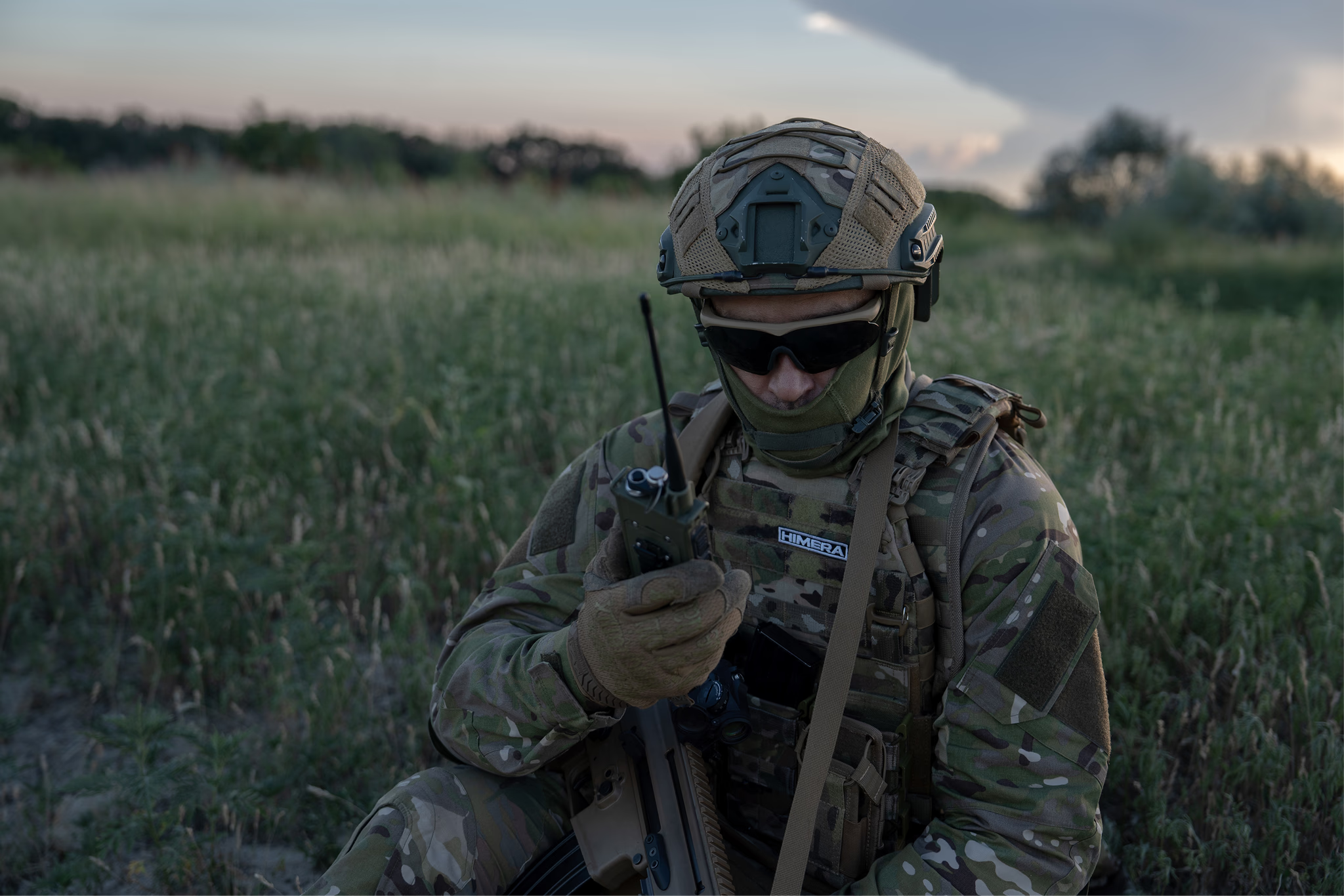
Last August, the 1st Separate Brigade got 45 km of clear signal across forested terrain with just four handheld G1 Pro radios. Since then, these devices, made by Kyiv-based company Himera, have helped many more units fight complex operations in rough terrain blanketed by Russian jamming, object lessons in the power of mesh networks and Ukrainian engineering.
Himera builds comms systems that Ukrainian special forces and regular troops can rely on when the exquisite systems don't arrive and the cheap ones can't do the job. Foreign buyers are interested because Himera’s radios are built for an electronic war that’s going global. Recently, orders have spiked, co-founder Misha Rudominski said in an interview.
Mesh network architecture helps signals survive pervasive EW and difficult terrain, while the light, cheap design that’s delivered quickly is attractive to military procurement officers and operators alike. That’s why Himera sees a bright future for themselves and other Ukrainian radio companies, both in the domestic and international market.
"What's been happening from the beginning of this year is there are a lot of those kinds of 'aha' moments from the military side," Rudominski said. "They tried it. They see the power of its use in their operations... and they say 'okay, great. Now, we want a lot of it.'”
Invisible war
Ukraine is fighting the war on many fronts. One of the toughest is access to equipment, be it vehicles or comms systems. Some units wait months for radios, of which there are roughly two types. The first is potent, secure, expensive, and takes forever to get in large numbers. The second is much cheaper and easier to get but far less reliable.
Another front is the battle over the electromagnetic spectrum. Ukraine is the most signal- denied battlefield in the world, with Russia doing everything it can to jam defender communications. One of weapons in this fight is the mesh network, which keeps working if any given node goes down.
These are the challenges that Himera has set out to close with its handheld radios and signal repeaters. In doing so, it has become a top player in the country’s market.
The company works with various National Guard units, Land Forces, Territorial Defense, Special Operations Forces, and the State Security Service. Himera’s tech has been praised by Serhiy “Flash” Beskrestnov, who said that “very few Ukrainian teams have managed to design, build, and scale a military electronic device into small-series production.”
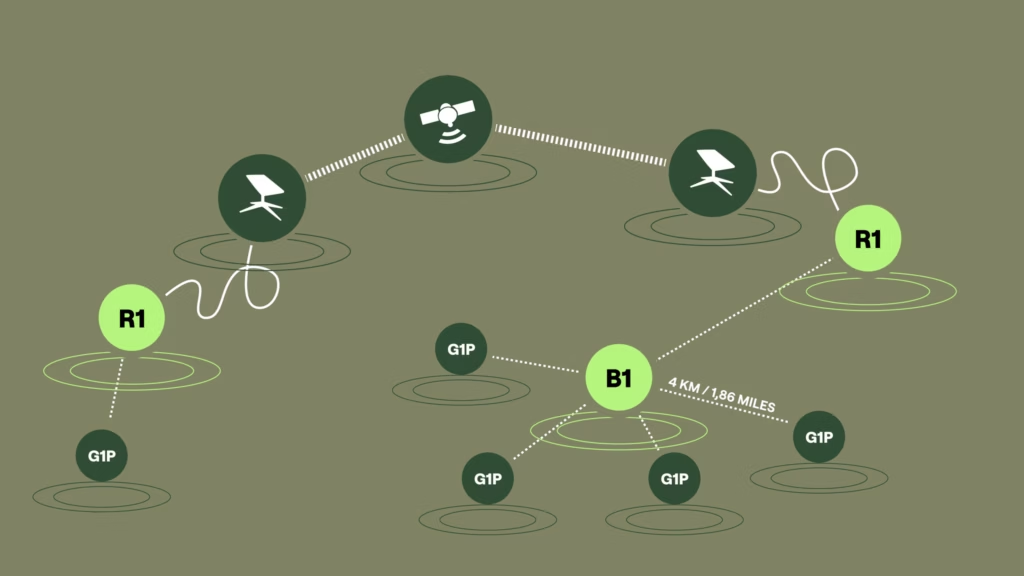
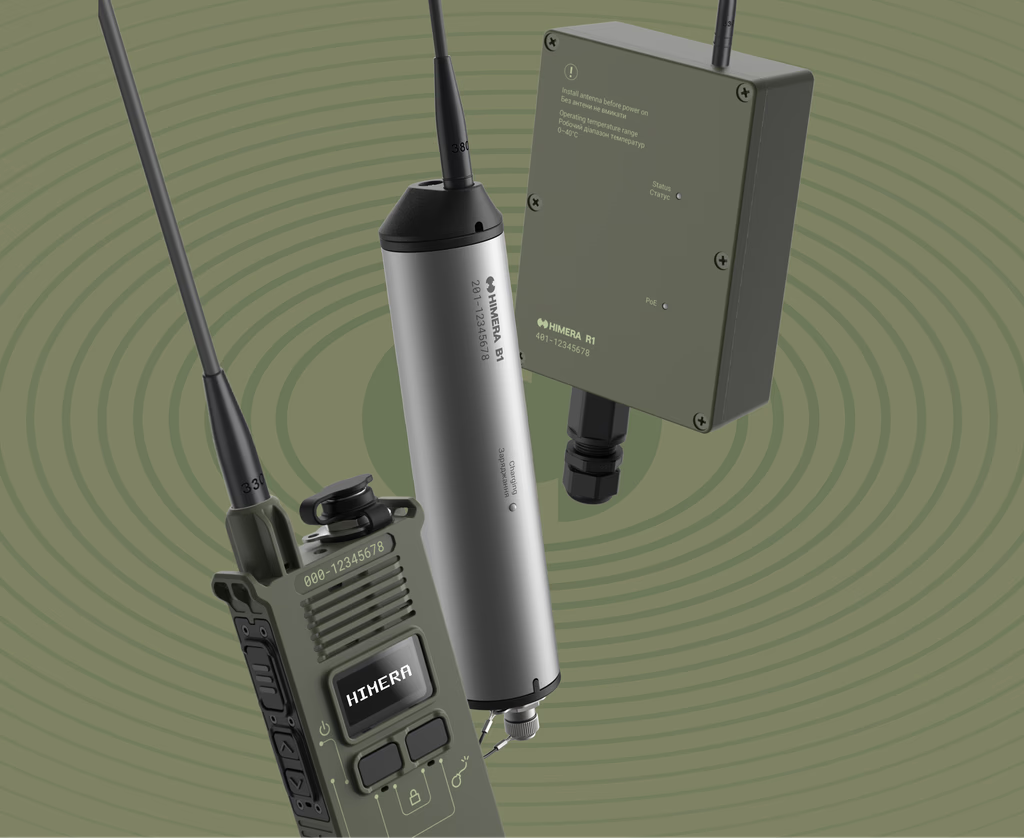
Himera’s mainline products include the G1 Pro handheld radio, the B1 autonomous repeater, and the R1 IP repeater, which can connect to internet communication, including satellite terminals like Starlink. This architecture enables “very complex operations by connecting very different troops that are currently being deployed in different parts of the front line.”
"The B1 and R1 is is our infrastructure… They extend connectivity as as deep into the enemy lines as needed," Rudominski said. "The B1s are even deployed from drones, basically dropped into advancing positions on our side or the enemy's side where we're planning to be… so our soldiers have the best connectivity possible."
Foreign interest in Ukrainian innovation
As the drone war proliferates beyond Ukraine, so too do many of its challenges: the Ministry of Defense previously said that other countries see Ukraine as a laboratory of how wars will be fought.
RAND wrote that “Mastery of the electromagnetic spectrum is now essential for digitalised militaries dependent on sensors, satellites, and networked systems to function effectively under fire.” It’s forcing some Westerners to reexamine their tech, tactics, and procurement.
As such, foreign buyers are increasingly interested in this Himera as well, drawn by battle-tested performance, user-friendly operation, small form factor, potent batteries, quick delivery on orders, and competitive prices.
Rudominski cited an example of a European buyer that was surprised when Himera said it could deliver a sizable order in three weeks.
“They're like, ‘oh, three weeks? We meant like three to six months.’ And three to six months being for that international customer is a very quick timeline.” Orders can take years to fulfill for some international defense contractors.
Last year, US firm Reticulate Micro announced that the G1 Pro was available to the US military. The foreign customers also include the defense ministry of an EU country Rudominski did not disclose for security purposes— they like the lighter weight, smaller dimensions and longer battery life of Ukrainian solutions. The drone war forced Ukrainian companies to learn to squeeze every drop of potential from their batteries and lighten the load of other field equipment as much as they could.
"Our (foreign) competitors' radio can weigh like a kilogram. I guess ours is like 300 grams," he said. "If you go on a three-day mission, you need to take five, six, maybe up to 10 batteries. And if you're a comms person for a squad, you need to do it four times. So now you have a whole backpack of batteries. It becomes impractical very quickly."
Rudominski said that while Ukraine’s military comms companies are still behind their foreign counterparts in some respects, they are on a much steeper growth curve and may even overtake some international companies in the next few years in functionality, scalability, and competitive pricing.
Trending Now
Himera capabilities
The Himera system uses standard 256-bit encryption, with an option to add another layer from their partner, Canadian company Quantropi. Every repeater and handheld radio (which can also serve as a repeater) work together to create an area-spanning mesh network.
This is especially helpful for Ukrainian forces fighting in dense forests, urban environments, or uneven terrain that can interfere with signals.
“So our model of the network and our architecture helps operators there conduct their missions much more efficiently because they now… coordinate better in the areas where they couldn’t before,” Rudominski said.
The devices integrate with situational awareness systems like Ukraine’s Combat Vision, Kropyva and Delta, but also ATAK, which is used by NATO countries. They are working on integration with Danish company Systematic Inc’s SitaWare system. This plus friendly force tracking enables more complex operations with multiple units.
Himera’s devices act both as a source of information and a data transport layer network, able to relay signals between terminals like tablets, laptops, and smartphones used by soldiers, even when WiFi, LTE or satellite communication is unavailable.
Russian EW is a formidable foe
EW is a big part of Russian doctrine, from strategic jammer Murmansk-BN that reaches across hundreds of kilometers to platforms like the Krasukha-4 broadband jammer, the R-330Zh Zhitel VHF and UHF jammer, Pole-21 GPS suppressor, as well as drone-mounted solutions.
Russians are also moving towards smaller, less powerful, more numerous and spread-out solutions that can’t be destroyed as easily. Across the front, nearly every vehicle carries mounted jamming systems and infantry are setting up these systems where they can.
Fighting against these overlapping systems is an unending climb of trying to outthink the enemy. As Military Machine wrote: “physics favors the jammer, a jammer close to the drone will always overpower a transmitter kilometers away, because signal strength decreases with the square of the distance.”
Ukrainians tried to solve this in multiple ways: adopting fiber optic drones for close range, AI-enhanced autonomy, and mesh networks. In a prior interview, Mykyta Puz, a technology liaison with the Azov Corps, said that Ukraine needs “really scalable, robust mesh systems designed for battlefield use.” Himera’s approach aligns with this demand.
“We figured out that there is no one all-powerful solution. Everything can be jammed, everything can be detected, everything can be intercepted,” Rudominski said.
“It's not about making it impossible. It's about making it very hard and very complicated and very expensive. So your enemy decides to dedicate resources to something else.”
Scaling depends on international supply chains, which are not always reliable and the impact magnifies the more a company grows. But Rudominski said that so far, the company has always been able to deliver orders on time, due to the work of the team.
As Ukraine fights on and other countries try to build up their militaries in the current geopolitical climate, Rudominski believes that there is ample room for Ukrainian comms companies, including his own, to thrive.
“We build things smartly,” he said. “Ukraine's never asking for the best. Ukraine is asking for what is perfectly fit for this task and then a lot of it.”
Read Also
-
Turkey’s Korkut guns now shoot down Russian drones over Ukraine. Almost half of the jet-powered Shaheds still get through
-
Russia just accidentally crashed its first Tu-95 bomber in 11 years. Its missiles will keep striking Ukraine anyway
-
In Ukraine’s Vivaldi offensive, nobody rides in the BTR-60s. Bulgaria’s old troop carriers go into Russian bunkers packed with mines


