


Ukraine's strike campaign against occupied Crimea is "carefully calculated," and the right help from Western partners would let Kyiv quickly force Russia toward peace, President Volodymyr Zelenskyy said in his evening address on 24 June. He would not say publicly what that help is, only that his G7 partners "know exactly" what he means. He paired the claim with intelligence findings that say Ukraine's deep strikes are now hurting the Kremlin.
A secret ask, and a promise to end the war fast
Zelenskyy framed the Crimea operation as part of a wider effort to stop Russia using stolen land to drag out the war. He said the strikes prove Ukraine can move quickly if partners deliver.
"Our operation, including the one concerning Crimea, is carefully calculated," he said, adding that if Ukraine gets exactly what was discussed within the G7, "we will promptly create the conditions that will force Russia to choose peace." The decision, the President stressed, rests with the partners, and Kyiv counts on a positive answer.
He did not name the request. Ukraine has spent months pressing the US for a license to produce Patriot interceptors, an ask Trump reportedly responded to positively at the G7.
Captured documents show the pressure landing
The President said Ukraine's military intelligence had obtained internal Russian assessments of the deep-strike campaign. By Russia's own reckoning, he said, the pressure is being felt painfully at the top.
He listed targets. Ukraine destroyed more than 6,000 tonnes of ammunition at a Baltic Fleet arsenal near St. Petersburg. It hit missile-component plant in Voronezh and struck a plant in Cheboksary. Drones also reached gas facilities in Russia's Orenburg Oblast, more than 1,200 kilometers from the front.

Ukraine drones black out all of occupied Sevastopol. Balaklava power plant was target
Zelenskyy said he ordered intelligence and the army to strike Russian sites in advance, before Moscow can scale up the war.
Russia pulls air defense to guard its leadership
The captured files also showed how the Kremlin is reacting. Russia is moving air-defense systems from across the country to shield Moscow and the Kerch Strait bridge, Zelenskyy said.
In the Moscow region alone, Russia has massed hundreds of launchers for S-400, S-500, and Pantsir systems. Nearly 90 launchers have been moved to Valdai, the lake district where Putin keeps a residence, and a special air-defense division is forming there too. Most of Russia, by contrast, holds only a couple of launchers per direction.
"Those are their priorities. They are protecting their power—the source of this war," Zelenskyy said.

Strain spreads across Russia
More than 60 Russian regions now face fuel shortages, the President said, with sharp price jumps for gasoline and diesel where any is available at all. He said Russia's security services have even proposed postponing or scrapping the country's September vote for the ruling United Russia party.
Intelligence reports, he said, show the Kremlin no longer sure what conditions will look like by September. He tied the difficulties to one cause: Putin's refusal to end the war or hear Ukraine's offers of talks.

The fuel blockade tightens: Kerch struck again, power knocked out across occupied Crimea
Crimea under the heaviest strikes of the war
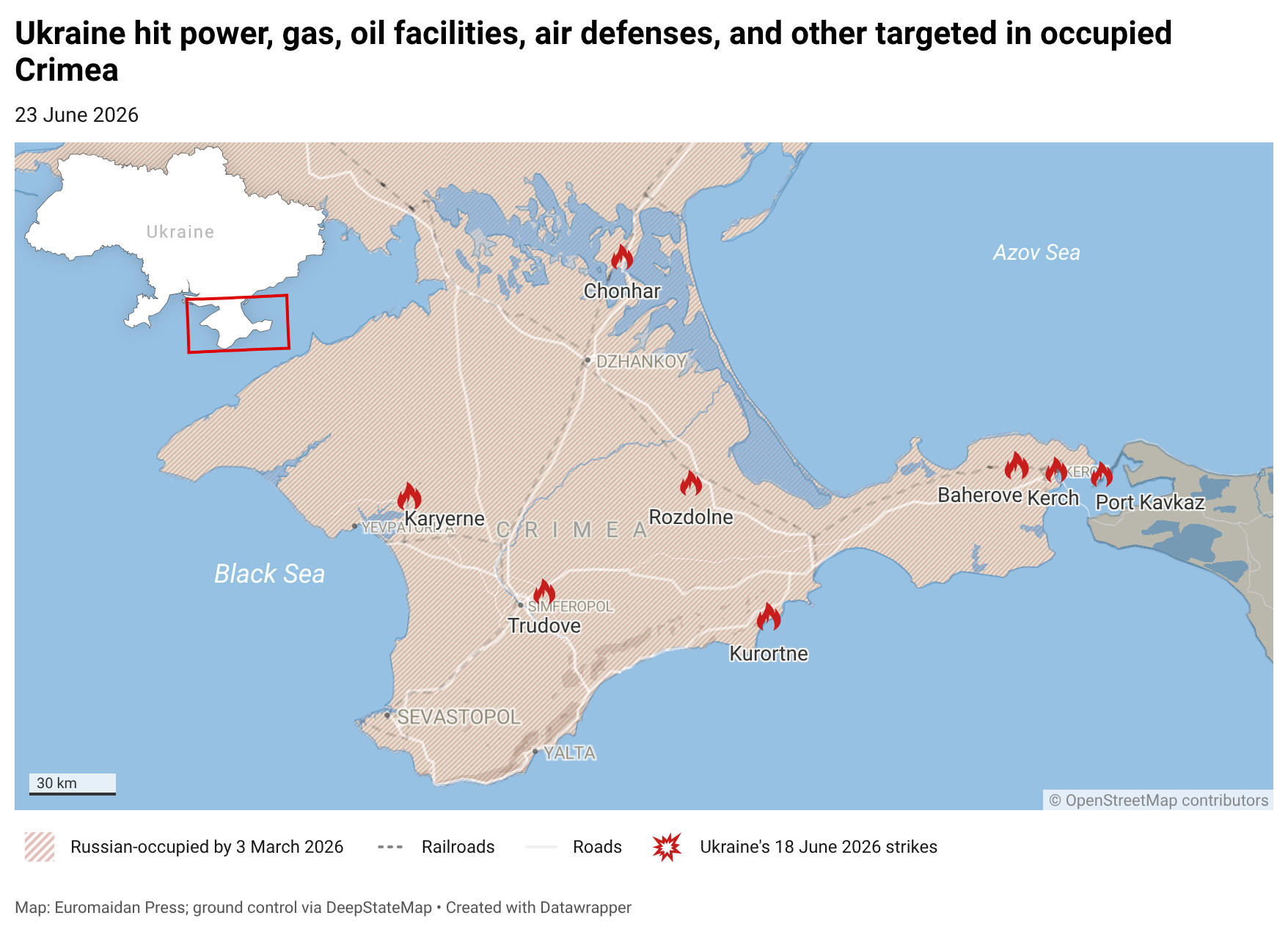
Zelenskyy's address followed a week in which Ukrainian forces hit occupied Crimea harder than at any point in the full-scale war. Drones struck a fuel depot in Kerch and the Port Kavkaz crossing overnight on 21 June, halting fuel sales on the peninsula and closing the ferry link.
Power failed across much of Crimea, and on 24 June, a strike on the Balaklava thermal power plant left Sevastopol fully dark. Ukraine's Special Operations Forces separately said they destroyed a rail bridge over the North Crimean Canal near Rozdolne, a supply line into the occupied south. Damage was reported to the Kerch power plant and other sites.


