

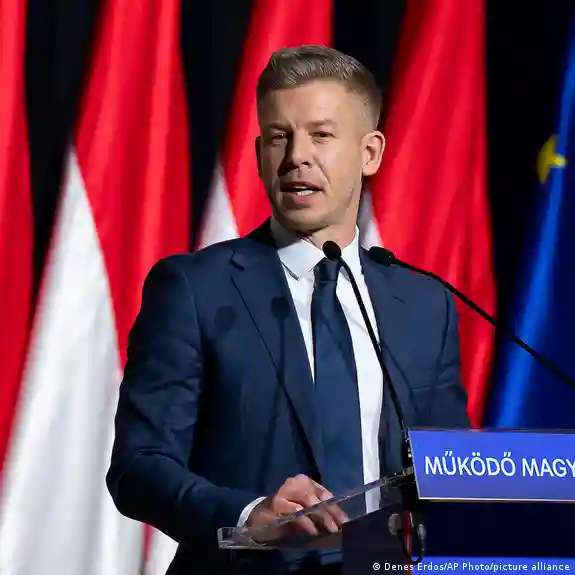
Hungary's new government has dropped a two-year veto on partially reimbursing EU member states for arms transferred to Ukraine, immediately releasing €6.6 billion ($7.7 bn) in delayed payments and clearing a path for more than €40 billion in queued claims, according to a Politico report citing six EU diplomats.
The reversal was announced on 1 June by Hungary's ambassador to the Political and Security Committee — the Council body overseeing EU foreign and defense policy — an official present in the room told Politico.
The decision unblocks the European Peace Facility, an off-budget EU instrument that compensates member states for roughly 40 percent of the value of weapons drawn from their own stockpiles and sent to Kyiv. Because EPF disbursements require unanimous backing from all 27 EU governments, Hungary alone was able to freeze the mechanism for more than two years under former Prime Minister Viktor Orbán.
Backlog and workarounds
The blockade angered the bloc's largest donors — Germany and the Netherlands among them — and forced the EU to engineer alternative channels to keep weapons and ammunition reaching Ukraine, Politico reported. Allied governments had at one point floated creating a parallel fund to bypass Budapest entirely.
The €6.6 billion freed by Monday's decision represents only a first tranche; the remainder of the backlog is expected to follow once EU governments agree on disbursement criteria. Open questions include whether the recovered funds will flow back to national treasuries or be recycled into fresh aid for Ukraine, whether the 40-percent reimbursement rate will hold, and how the EPF itself will be refinanced.
Those issues are expected to be raised at next week's informal meeting of EU defense ministers in Cyprus.
Wider reset with Brussels and Kyiv
The veto removal forms part of a broader policy realignment under Magyar, who was sworn in on 9 May after his Tisza party won a supermajority and ended Orbán's 16-year rule. On Friday, Budapest reached a separate agreement with the European Commission to unblock €16.4 billion in previously frozen EU funds.
Hungary has also entered talks with Kyiv on the status of the ethnic Hungarian minority in Zakarpattia, dropped its opposition to a €90 billion EU loan for Ukraine, and signaled it will no longer block Ukraine's bid for EU membership — reversing each of Orbán's flagship obstructions within weeks.
Trending Now
The lifting of the veto "will come as a positive reinforcement for those member states that provided most of the support for Ukraine," an EU diplomat told Politico on condition of anonymity, adding that the move would make burden-sharing more equal.
Kyiv wants the money spent on Patriots
Ukrainian Foreign Minister Andrii Sybiha, speaking after a Russian overnight strike on 2 June 2026, urged EU governments to channel the recovered funds into the NATO-led Prioritized Ukraine Requirements List, under which European states purchase US-made weapons for Ukraine.
"Use the unblocked European Peace Fund to fund the PURL program and buy additional 'Patriot' systems and missiles for Ukraine. Advance the anti-ballistic coalition. Increase investment in Ukraine's long-range capabilities," Sybiha wrote on social media.
Magyar met German Chancellor Friedrich Merz in Germany on 2 June and said Budapest and Kyiv were making positive progress in their own bilateral track, signaling he is now prepared to meet President Volodymyr Zelenskyy in person.


