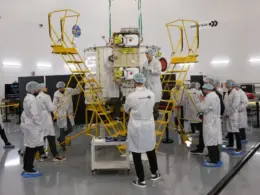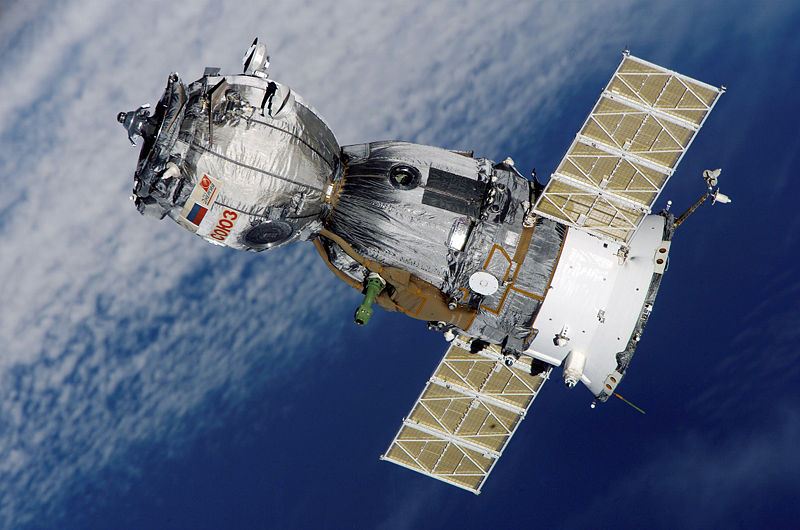
Russia has launched the first 16 satellites of its "Rassvet" ("Dawn") constellation, a state-backed bid by the private aerospace company Bureau 1440 to build a domestic alternative to SpaceX's Starlink. However, the project remains at an early stage and has not been confirmed for military use, Serhii "Flash" Beskrestnov, advisor to Ukraine's Minister of Defense, says.
The constellation is Russia's path to satellite-communications autonomy after SpaceX cut off the company's Starlink terminals that Russian forces had illegally used in late January 2026. The shutdown collapsed Russia's frontline command-and-control system in many sectors.
"It would be unwise to think they wouldn't pursue this direction," Flash stresses.
16 satellites today, 200-plus needed for stability
For continuous, stable satellite communications, Flash estimated that 200–250 satellites are needed in orbit. The 16 now circling are not enough.
For comparison, Starlink currently operates over 9,000.
"No adequate countermeasures"
The advisor was direct about Ukraine's options.
"I have no idea who in our country... is tracking this project and thinking about possible problems. I can only speak for myself. From day one of the war, I've been collecting all information on this topic," Flash says.
He flags that there is no good way to counter Rassvet at this stage: striking Russian cosmodromes such as Plesetsk, Vostochny, or Baikonur with Ukrainian drones would be "nonsense," he said.
Ukraine's working method is monitoring through satellite traffic, intelligence, and trophies recovered on the battlefield.
6–10 minute window and Shahed scenario
Each Rassvet satellite currently in orbit passes over Ukraine roughly once a day, offering a 6–10-minute window for high-speed data transmission, Flash explains.
Theoretically, Russia could mount satellite terminals on Shahed strike drones and time launches to the passes, but coordinating that, with so few satellites in orbit, is "too complex organizationally," and military use will not begin until the constellation is dense enough for stable connectivity.
In May, Ukrainian drone commander Robert "Madiar" Brovdi warned that Russia could establish an alternative communication network along the entire frontline within a year, Euromaidan Press reported.
"If military use of Rassvet satellites begins," Flash wrote, "we'll detect it by satellite traffic, by intelligence, or by trophies."
Read also
-
AI is changing Russia’s drone war on Ukrainian cities, deputy air defense commander says
-
Ukraine’s drone pilot calls it his proudest strike: cheap FPV drone detonating over two tons of explosives packed inside Russian mine-clearer
-
Ukraine squeezes more defense out of Soviet-era stock, pairing Kub launcher and American RIM-7 interceptors to catch Russia’s jet-powered drones