

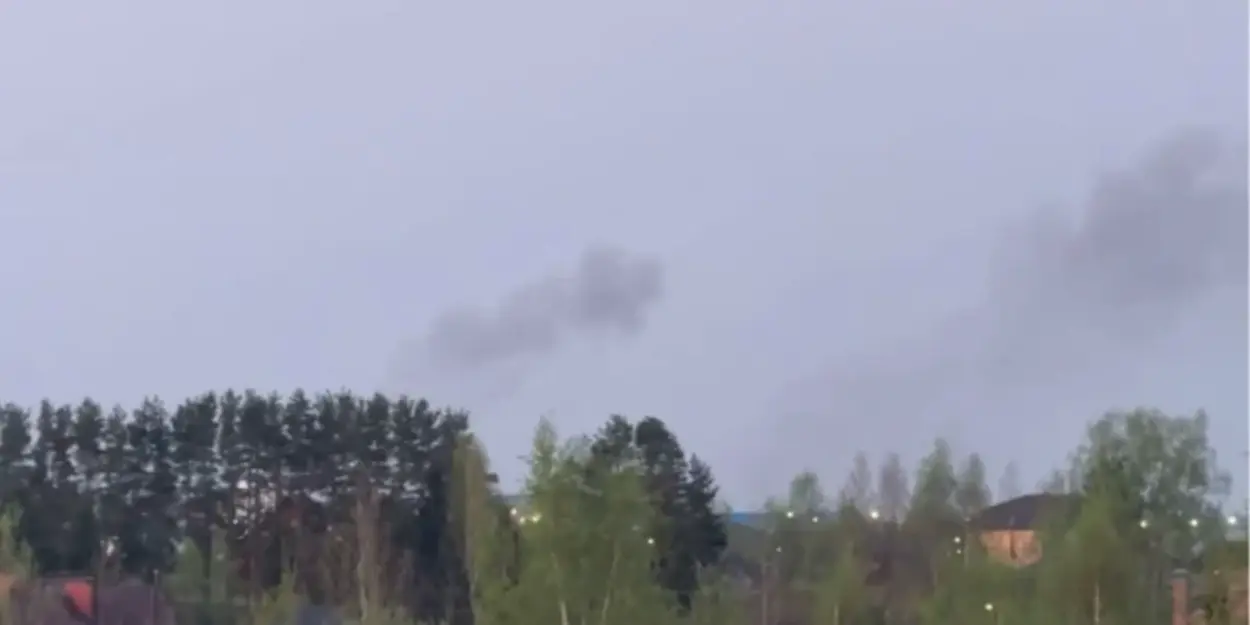
Ukrainian drones struck the Nara production and logistics complex in Naro-Fominsk, southwest of Moscow, overnight on 7 May, Russian monitoring channels and Ukrainian open-source analysts reported. The 200-hectare facility belongs to Russia's Defense Ministry and runs automated distribution of military cargo to the Russian armed forces.
Russian authorities have not confirmed damage. Moscow Mayor Sergei Sobyanin said 11 drones were intercepted on approach to the capital and emergency services were responding to debris sites. He said nothing about the reported hit on the Nara complex.
The strike—if confirmed—lands two days before President Vladimir Putin's 9 May Victory Day parade on Red Square. For the first time in nearly two decades, that parade will go ahead without tanks, missile launchers, or any of the heavy military hardware that has been its centerpiece. The Kremlin cited security concerns.
A 200-hectare logistics node
The Nara complex sits on military town No. 3 in Naro-Fominsk, a town of about 70,000 on the Nara river roughly 70 kilometers from central Moscow. The site stores and distributes military supplies for units across Russia's armed forces. A successful strike on automated logistics infrastructure can disrupt resupply chains feeding Russian forces in Ukraine.
Moscow has been hardening for months. Pro-Ukrainian open-source analysts have identified at least 40 new Pantsir-S1 short-range air defense positions added around the capital in recent weeks—including one at a former radio engineering facility in Naro-Fominsk itself.
The wider overnight attack
Local residents reported drone flights, explosions, and air defense activity across the Moscow region overnight. Russian authorities acknowledged similar activity in Bryansk, Tver, Rostov, Samara, and Tula oblasts. Russia's aviation regulator restricted operations at Domodedovo, Sheremetyevo, and Zhukovsky airports.
Three days earlier, on 4 May, a drone slammed into Dom na Mosfilmovskoy, a luxury residential complex about six kilometers from the Kremlin. That strike marked one of the deepest drone breaches of Moscow's urban core since Russia's full-scale invasion began.
The Naro-Fominsk strike fits a pattern. Ukrainian medium- and deep-strike sorties have expanded roughly six-fold in 10 months, from 60 in July 2025 to 354 in March 2026. The strikes target three things in sequence: Russian air defense, then production, then logistics in transit.
Lockdown ahead of the parade
Russia plans internet shutdowns across Moscow, ATM closures, airport restrictions, and unprecedented security measures around the 9 May ceremony. Ukrainian foreign intelligence described the lead-up as resembling a mode more similar to military lockdown than celebration. Authorities have cancelled Victory Day events in occupied Crimea entirely, citing safety concerns.
Putin has proposed a 72-hour ceasefire around 9 May. The proposal was communicated only to Washington. Russian officials are not in direct contact with Kyiv.
Speaking at the European Political Community summit in Yerevan on 4 May, President Volodymyr Zelenskyy argued the stripped-down parade was itself an admission.
"This will be the first time, if this is indeed the case, in many, many years that they cannot afford the presence of weapons at the parade. And Ukrainian drones may also fly over this parade. This shows that they are already not as strong as before."
Sobyanin confirmed the 11 interceptions over Moscow. He has not addressed the Nara complex.
Also the "Ghosts" of Ukraine’s Defense Intelligence (GUR) recently executed one of their most daring operations in Crimea to date.


