


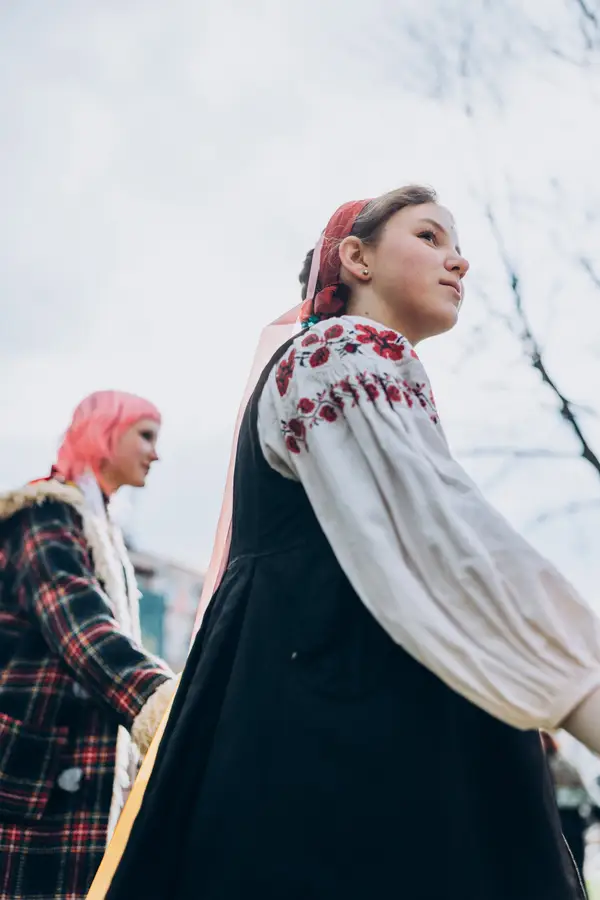
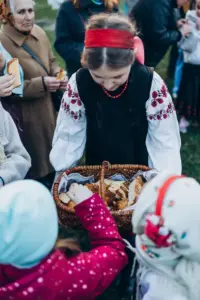
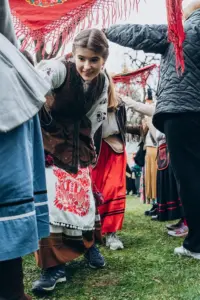
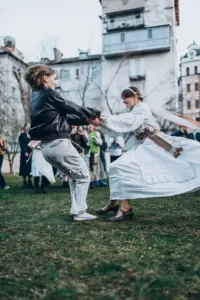
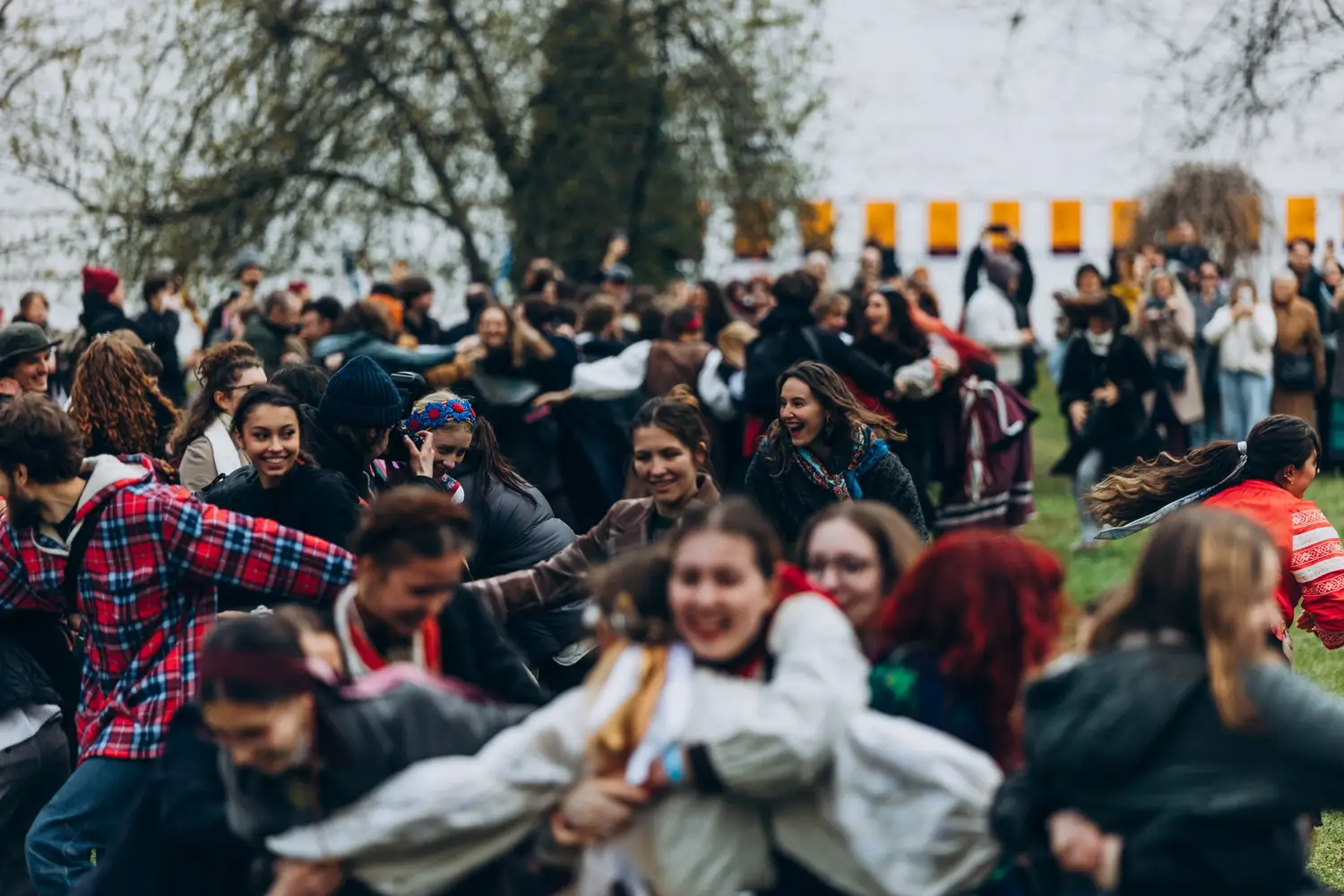
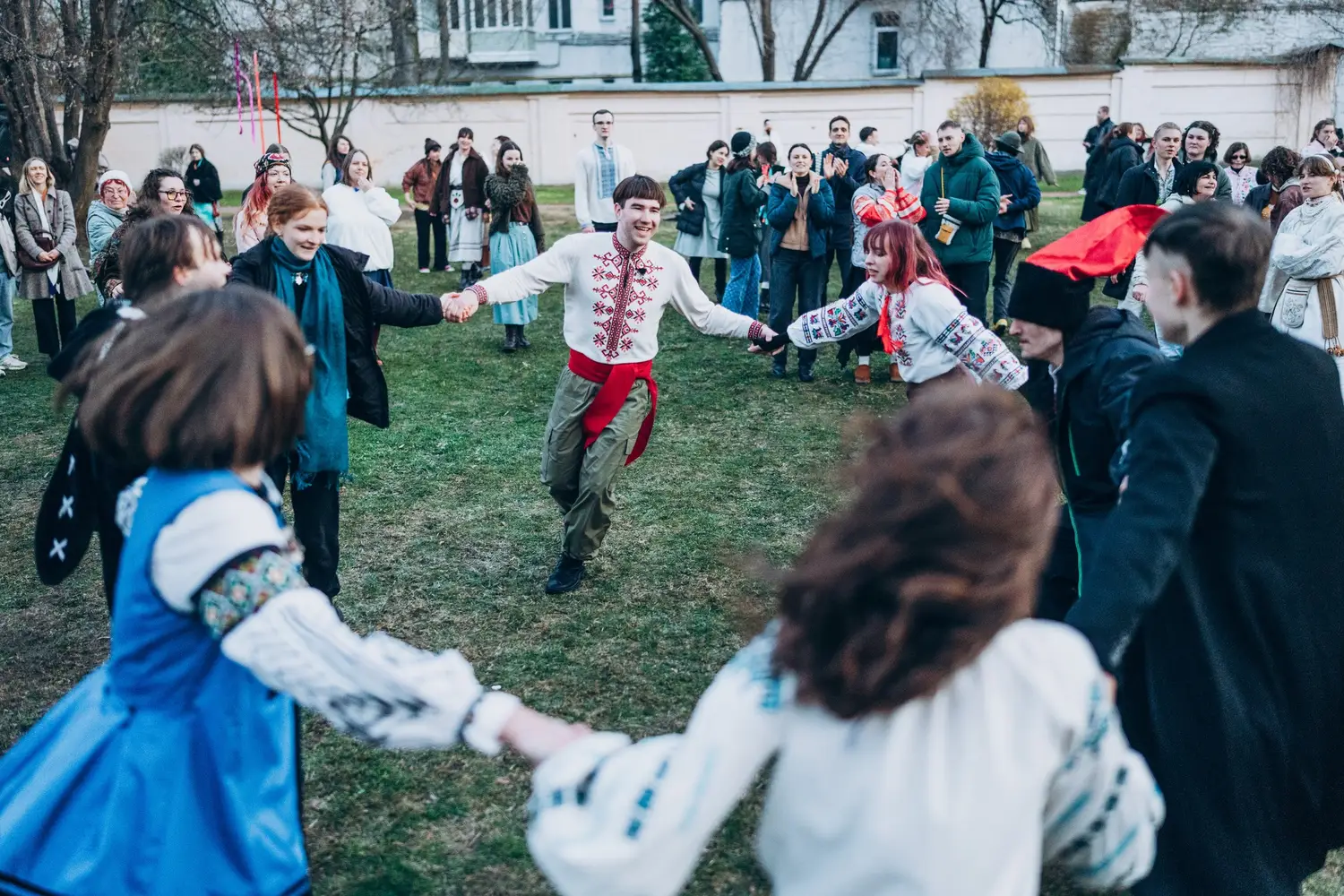
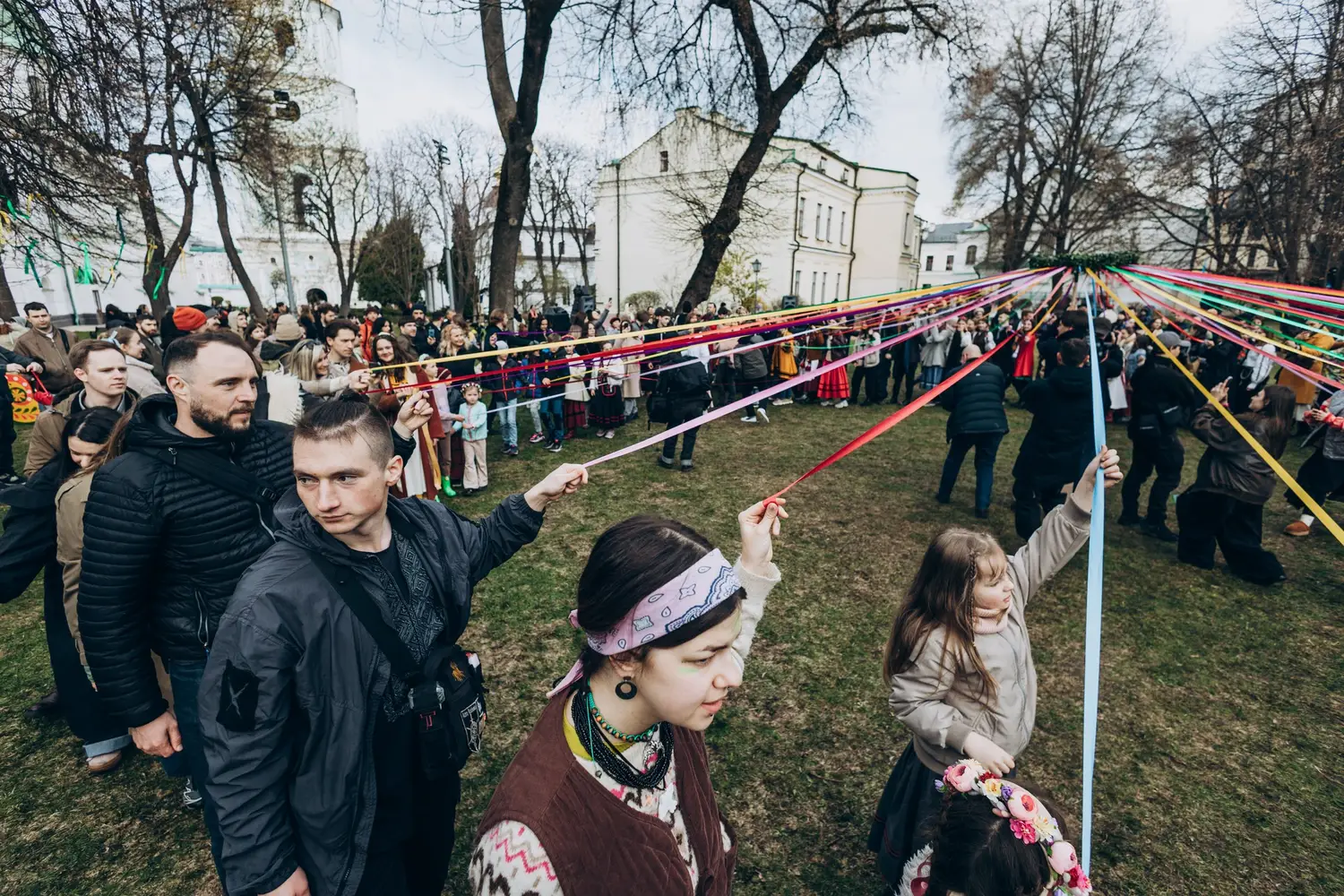
On Easter Sunday, a girl in embroidery walked across a living bridge of linked arms in the courtyard of Sofia of Kyiv, and the bridge kept reforming in front of her so she could keep walking. The dance is called Verbova doshchechka—the willow plank—and it comes from villages that preserved the cosmic logic: the child walks on the bridge, the bridge is spring, the bridge is the sun coming back, the bridge is life renewing itself, and the walking is how you enact the renewal.


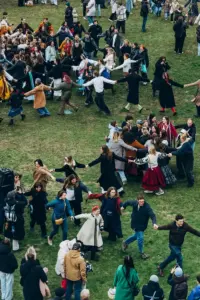
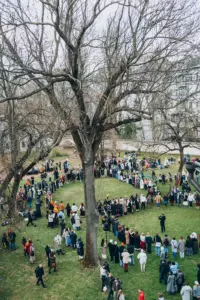
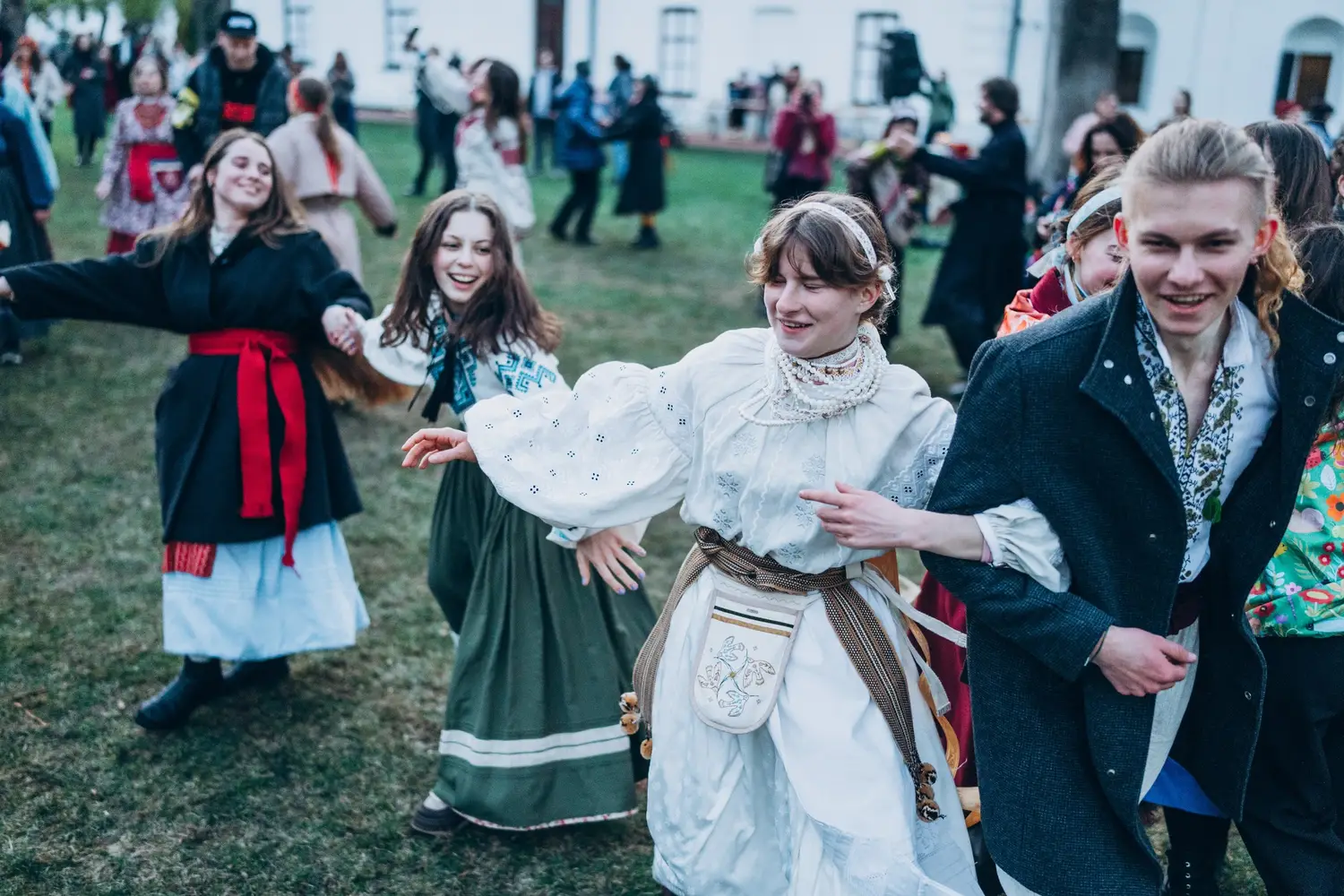
Nobody in the courtyard on Monday explained any of that to the crowd while it was happening. The ritual did its own explaining. Five thousand people participated. Most of them were under thirty.
None of this should exist. It should have been destroyed first when the church attempted to ban pagan customs, and then when Soviet atheism tried to ban the church. It survived both, and today is a vehicle for both religious and national revival.
This was the third year of the dances. The first year, it was a smaller crowd and a research project that the Ivan Honchar Museum and the Sofia Kyivska National Reserve had started with archive recordings and a handful of youth folk ensembles.
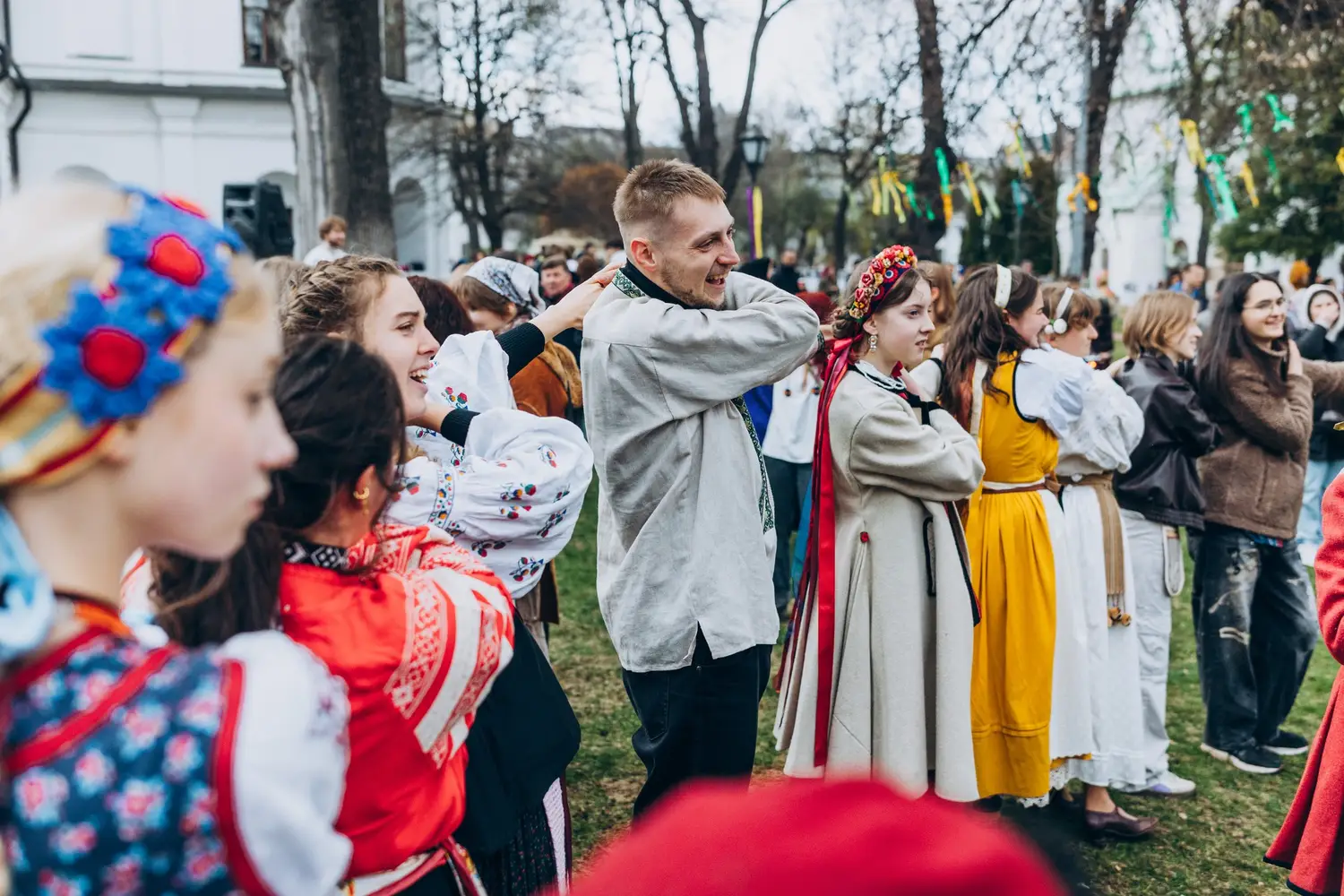
By this spring, the project had trained around 300 people to perform the material—not as a concert, but as lived experience—and drawn an audience of around 5,000, mostly young, mostly from Kyiv, many of them students from Kyiv-Mohyla Academy and Shevchenko University and the arts universities the organizers had spent months visiting.
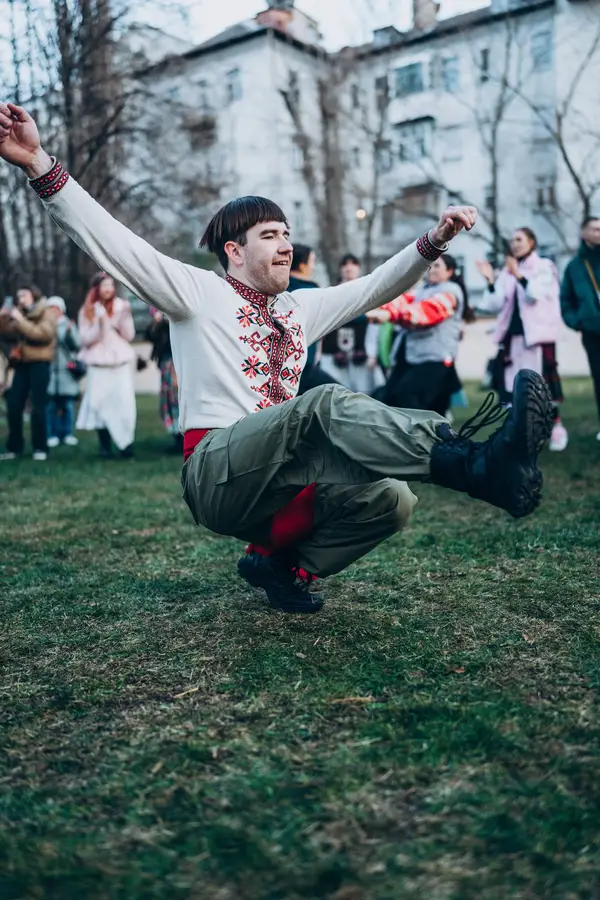
There is a reason the organizers wanted it to look like this rather than like a folk festival. Folk festivals are performances. What they were trying to revive was participation. Vesnianky, the spring songs, were never stage material in the villages they come from. They were what young people did over three days of Easter—Sunday, Monday, Tuesday—to meet each other, to pair off, to bless marriages, to mark that the earth had turned.
In one village, the ethnographers would record fifty different versions. The songs were a technology for being twenty years old in a specific place in a specific April.
The ritual that blessed the couples planning to marry
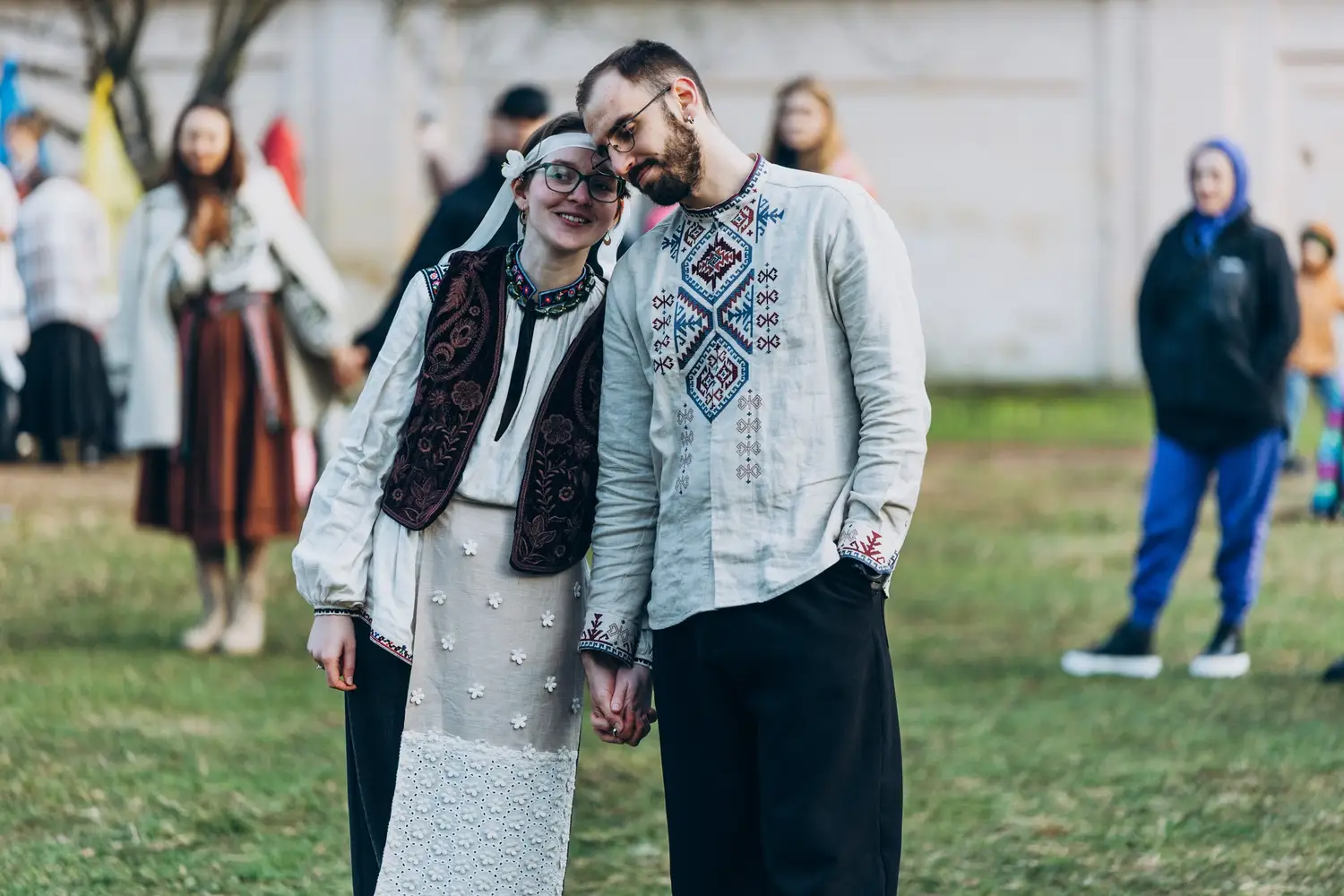
Among the things reconstructed this year was a rite recorded in the village of Roskoshivka in Vinnytsia Oblast: the singing-over of young couples who plan to marry within the year. Nine couples came forward in the Sofia courtyard on Monday and stood in the middle of the circle while the dancers sang over them. The songs name the couple, name the intent, name the year.
It is not a wedding. It is a public blessing of the wanting. The ethnographic logic is that spring is when the pairing happens, and the community sings it into being before anyone signs anything.

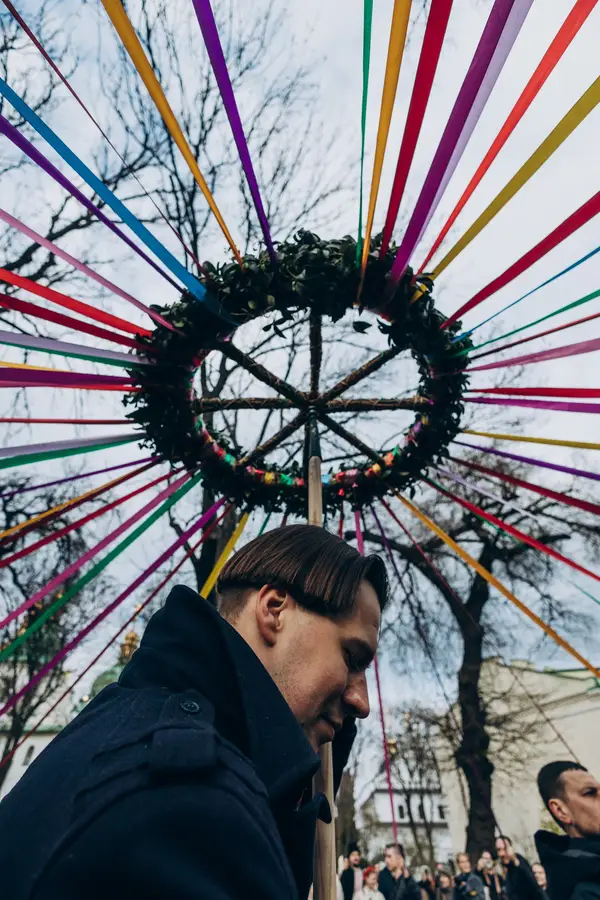
The willow branches on the wheel with colored ribbons is older than any of this, older than Christianity on these territories. The wheel is the sun. The ribbons are the rays. The wheel gets carried through the spring cycle of feasts that runs from the first snowmelt through Trinity.
The fact that you can still see it being carried in 2026 in a courtyard fifty meters from a cathedral founded in 1037 is a specific kind of evidence about what the Soviets failed to finish.
The two suppressions
The rituals are older than Christianity here. The willow plank, the spring round dances, the structures inside the songs come from a pre-Christian agrarian and solar tradition the medieval church spent centuries trying to suppress as paganism. The church mostly failed. What it could not stamp out, it absorbed.
The texts of vesnianky often do not match the content of the Christian feasts they accompany. Priests allowed them anyway, because the cultural inheritance was too vast to refuse.
When the Soviet state came for religion, it was coming for a Christianity that had become the vessel for the older folk inheritance the church itself had once tried to ban.
The institution that spent the medieval centuries stamping out the pagan layer became, under Soviet atheism, the channel through which fragments of that layer survived. Both came through together. Neither would have made it on its own.
Even what survived is not fully understood. Many of the spring rituals carry symbolic structures whose meanings were never fully decoded by ethnographers, and the Soviets banned not only the practice of the traditions but the scholarly study of them.
"Some ancient traditions can be preserved as cultural heritage, and the time will come, God willing, when we can interpret and understand them," Myroslava Vertiuk, deputy director of the Ivan Honchar Museum, told Euromaidan Press. "Because in addition to bans on practice, there were bans on research."

How the Soviets tried to end Easter
They tried hard to finish what the church had given up trying to finish. Easter was the largest religious holiday in the country they had inherited, and a country that still wants to bake paska bread and dye eggs and carry branches is a country that has not fully accepted atheism as its operating system.
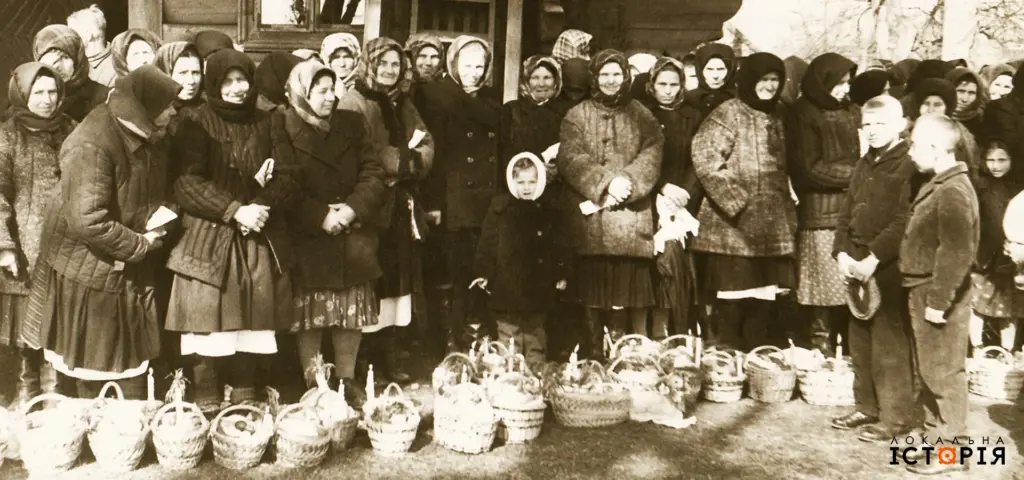
So from the 1920s onward, the Soviet state did everything a modern state can do to replace Easter with something it controlled.
Spring holidays were invented and scheduled for the Easter dates. Compulsory Saturday work brigades—subbotniki—were scheduled for Holy Saturday, followed by Sunday brigades on Easter itself. In the village of Levkiv in Zhytomyr Oblast, the residents were made to plant what was officially called a "godless garden" on Easter 1930. Schoolteachers stood guard at churches on Holy Friday to catch students trying to venerate the shroud. Women's hands were checked for traces of egg dye on Monday mornings.
In Marija Lukych's village of Bebekhy in the Radekhiv district, schoolgirls who went to have their paska blessed found themselves drawn in the school wall newspaper the week after — in the embroidered skirts they had worn to the church — and mocked in front of everyone.
In the east and center of the country, the suppression mostly worked. May Day and Victory Day moved into the space Easter had occupied, and the vesnianky stopped being sung. Galicia held on longer, because Galicia was Soviet only from 1939, and because the Greek Catholic underground kept Easter services in private apartments. But even there, the village-scale ritual layer thinned.
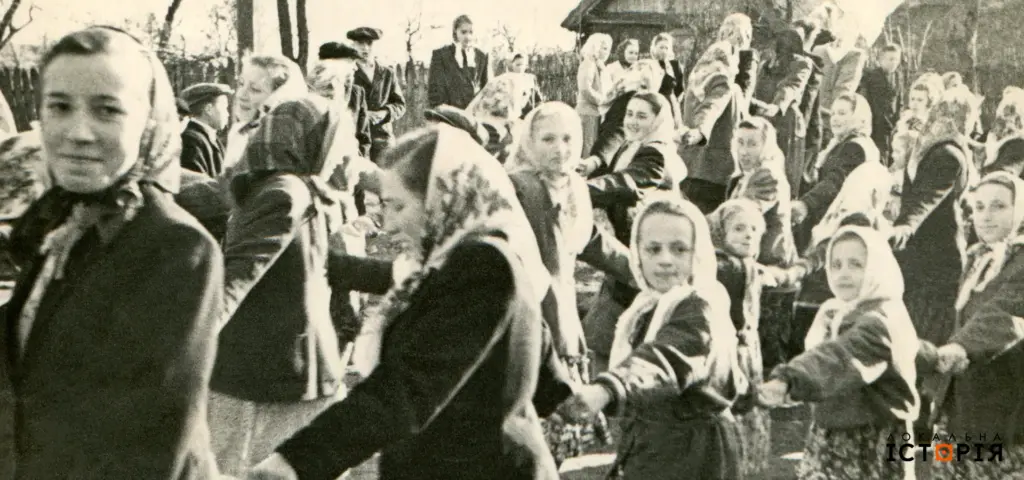
What the Honchar Museum team started doing three years ago was working their way through the IMFE archives and older ethnographic recordings to reconstruct what had been in those villages before the curtains came down—specifically in the Dnipro-region traditions that had been hit hardest and existed now mostly on paper.
Why this is the foundation being fought for
The curator team describes what they are doing in terms that are not only cultural: a national identity is being forged by remembering the oldest layers.
"These rituals can unite all regions and all generations," Myroslava Vertiuk believes. "They are universal instruments that can form our common background, the common ground we are standing on at this stage, when we are looking for shared heroes and the shared history we are now reinterpreting. The same is true of cultural experience. We are now forming the very state that the fight is being fought for."
The Soviet century disfigured the recognition. The Soviet-molded version of "national" culture became a mockery of what it once was, and the post-Soviet decades filled the vacuum with imported formats — Halloween, mall-Christmas, other people's holidays.
Ukraine's own customs were not laid at the foundation of nation-building. The borrowed ones, Vertiuk says, "look unconvincing, sometimes absurd."
The Honchar Museum's bet is that when the real material is shown clearly, young people will choose it without being told to. The process is democratic, contrasting with the USSR's top-down approach to cultural sterilization.

But why reach for this archaic culture? The deepest roots are the ones that nurture the best, Vertiuk believes, and they bring the most powerful cultural continuity in all European nations.
Ukraine holds these treasures, yet they were not transmitted to the younger generation; at one point, it even became ashamed of them.
"Across Europe, the most famous events—the ones that shape the cultural identity—are festivals with a history spanning 100 years or more...This is what the greatest brands are built upon, but it is something that cannot be created in a single day."
That is now beginning to change.
"We don’t want to impose anything; we simply want to show the authentic and profound culture to today’s young generation. And then we’ll see if they want to carry this with them into the future," Vertiuk added.
What Russia cannot burn out
There is a pan-European argument underneath all of this. Most European peoples once held the same complex of Easter customs—dyed and decorated eggs, special breads and cheese-based dishes, calendar fires lit at the threshold between winter and spring. Some of it survived widely. Some of it survived only in fragments, and only in specific places.
"Ukrainian traditional culture is closely tied to the broader European one," Yaroslava Muzychenko of the Ivan Honchar Museum told Euromaidan Press.
"Almost all European peoples, like Ukrainians, have the custom of dyeing eggs at Easter or decorating them with wax and pigments. Most have a special Easter bread and dishes made of cheese. These customs were preserved at least into the early twentieth century. In many European countries, Easter fires are still lit. The spring ritual games, however, were preserved and recorded only in Ukraine and Lithuania, and to a lesser extent in Serbia. In Ukraine, they are preserved most fully and most completely."
The Soviet project was to make the next generation ashamed of this. The next generation came anyway. This is the third year. Next year there will be more of them. Russia is trying to end Ukraine. Kyiv on Easter Monday was ending the ending.


