
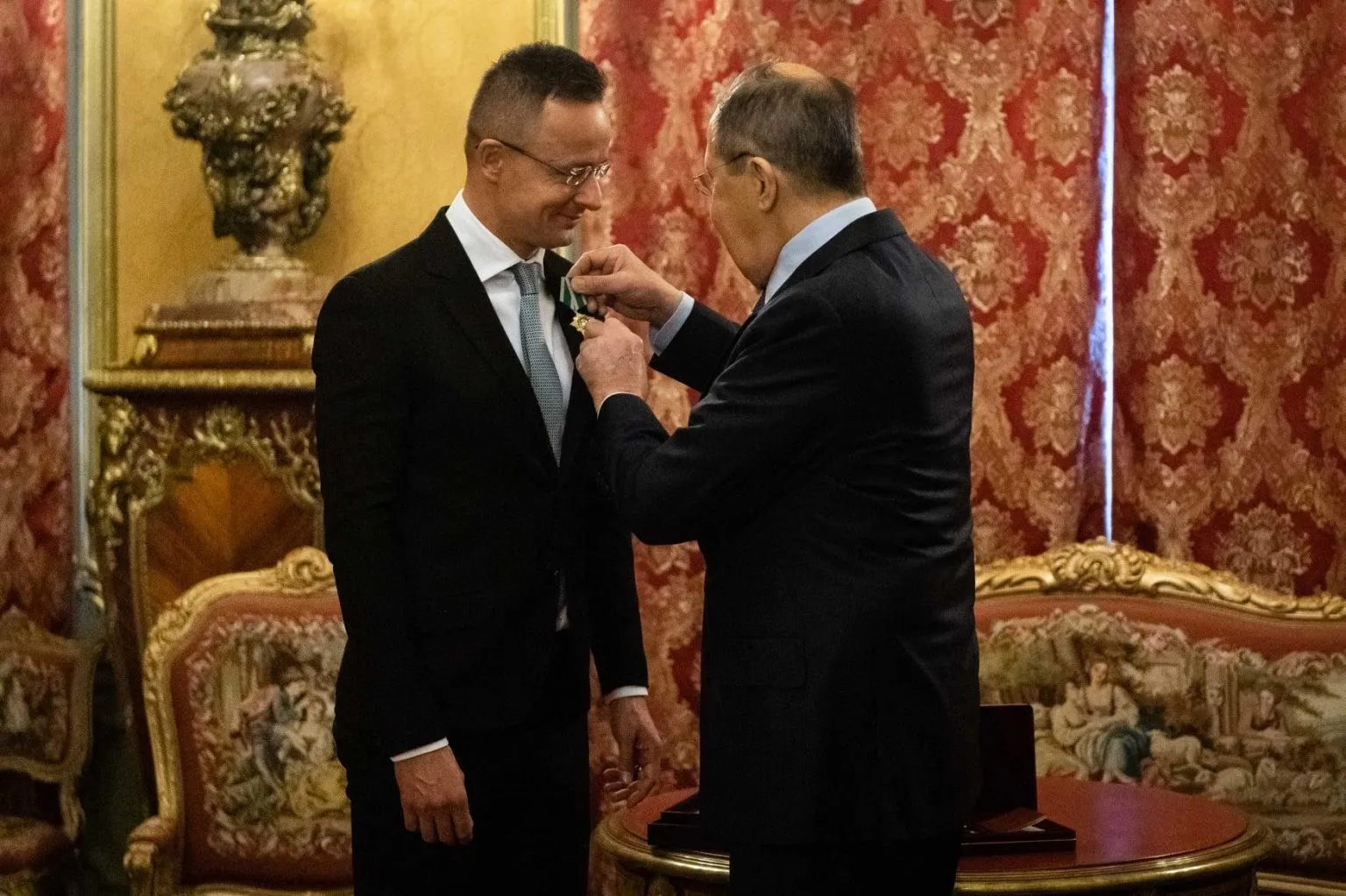
French Foreign Minister Jean-Noël Barrot on 9 April called Hungary's conduct toward its EU partners a betrayal, responding to published recordings that show Hungarian Foreign Minister Péter Szijjártó in sustained, covert coordination with Russian Foreign Minister Sergei Lavrov.
"This is a betrayal of the solidarity necessary between European Union countries," Barrot told Le Parisien.
The statement came a day after investigative outlet Vsquare published the second installment of an inquiry into audio recordings of Szijjártó–Lavrov phone calls spanning 2023 to 2025. The recordings were obtained and verified by a journalist consortium comprising Vsquare, Frontstory.pl, Delfi Estonia, and the Ján Kuciak Investigative Center (ICJK).
"Vassal of empires"
Barrot framed Hungary's behavior as a structural threat to European agency. "If the EU wants to be strong in a world where new empires are emerging, it must be united and solidary," he said. "Sometimes we have disagreements, including strategic ones. But unity must prevail; otherwise we will become vassals, playthings of empires — which we refuse."
The remarks came the same week transcripts emerged of a separate conversation between Hungarian Prime Minister Viktor Orbán and Russian President Vladimir Putin, in which Orbán, invoking a fable about a mouse and a lion, expressed readiness to act as Putin's "little mouse."
What the recordings show
According to Vsquare, Szijjártó used breaks in closed EU ministerial sessions to call Lavrov directly, briefing him on the state of internal discussions and Hungary's tactical plans.
During the European Council summit of 14 December 2023 — when EU leaders were deciding whether to open accession negotiations with Ukraine and Moldova — Szijjártó called Lavrov mid-session and relayed how the talks were developing. Lavrov's response, according to the recording: "Good, good, yes, yes, excellent. Sometimes friendly direct blackmail is the best option."
On 2 July 2024, the day Orbán visited Kyiv, Szijjártó called Lavrov immediately after Orbán's meeting with President Volodymyr Zelenskyy, disclosed the contents of that conversation, and discussed arrangements for Orbán's subsequent trip to Moscow. Hungary had just assumed the rotating presidency of the EU Council. According to investigators, the Moscow visit was deliberately concealed from EU and NATO partners to prevent allies from blocking it. A European official told the consortium: "It is striking how Szijjártó was working to get an invitation for Orbán to Moscow… Obviously, Hungary was deceiving the EU in this case."
In that same call, Lavrov asked Szijjártó for an EU document relating to minority language requirements in Ukraine's accession negotiations. Szijjártó replied that he could "no problem" send it via the Hungarian ambassador in Moscow. A senior EU official told investigators with "99% certainty" that the document Szijjártó offered was the negotiating framework — which was, by that point, already public. A senior Western intelligence official suggested Lavrov may simply have been "testing the limits" of how far his counterpart was willing to go.
A senior EU diplomat offered a blunter assessment: the situation was not that of a handler and an agent, but simply that Szijjártó was "a useful idiot."
Minority rights as leverage
A recording from 17 June shows Szijjártó explaining to Lavrov how Hungary uses Ukraine's minority-rights commitments as pressure in accession talks. Lavrov then steered the conversation toward how the same approach could be applied using "the protection of Russian-speaking rights" to obstruct Ukraine's European integration further. Szijjártó agreed it was "a universal Council of Europe principle," adding: "Today it concerns your minority, and tomorrow it may concern ours."
A senior EU official told investigators that Szijjártó was "also lying to Lavrov," since the negotiating framework addresses only Ukraine's bilateral commitments with EU member states, not minority protections for third-country nationals.
Trending Now
Sanctions coordination
Earlier installments of the Vsquare investigation established that Szijjártó acted on Lavrov's request to push for removing the sister of Russian billionaire Alisher Usmanov from EU sanctions lists, and coordinated with Russia's Energy Minister Pavel Sorokin over the interests of dozens of Russian companies and banks targeted under the 18th EU sanctions package, which was under discussion in early summer 2025. Hungary and Slovakia blocked that package in June 2025, citing energy security concerns. Recordings show Szijjártó also mentioned coordinating with Slovak counterpart Juraj Blanár.
Lavrov praised Hungary's posture in a call on 16 August 2025, which focused mainly on the Anchorage summit between Putin and Donald Trump — a meeting that raised alarm in European capitals over the possibility of a settlement being negotiated without input from EU or NATO allies, or from Ukraine itself.
The European Commission said it expected the Hungarian government to explain the possible transmission of confidential EU ministerial deliberations to Russian authorities, but did not confirm reports that Brussels had restricted Budapest's access to sensitive information. Szijjártó himself confirmed that he regularly contacts Lavrov during closed EU foreign policy sessions.
Vsquare previously reported the same pattern of behavior, corroborated by several current and former European security officials who told The Washington Post that the Hungarian government had for years provided Moscow with a "significant window" into sensitive EU deliberations.
Ukraine-Hugnary relationship
Hungary occupies a singular position among Ukraine's neighbors and EU partners: the one country within both the European Union and NATO that has consistently acted as a brake on Western support for Kyiv since Russia's full-scale invasion in February 2022. The relationship between Budapest and Kyiv has deteriorated through three interlocking disputes — the status of the ethnic Hungarian minority in western Ukraine, Hungary's repeated blocking of EU and NATO financial and military assistance, and Prime Minister Viktor Orbán's cultivated personal relationship with Vladimir Putin.
For the first two and a half years of Russia's full-scale war, Viktor Orbán did not visit Ukraine. He arrived in Kyiv on 2 July 2024 — the same day Hungary assumed the rotating presidency of the EU Council — presenting the trip as a personal "peace initiative." It was his first meeting with Volodymyr Zelenskyy since the invasion began.
Zelenskyy received Orbán but did not endorse his framing. Kyiv made clear it had not granted Hungary any mediating role, and that no ceasefire discussion had taken place on Ukrainian terms. Within days, Orbán flew to Moscow to meet Putin, then to Beijing to meet Xi Jinping, and subsequently to Mar-a-Lago to meet Donald Trump — a sequence that European capitals interpreted not as shuttle diplomacy but as a performance staged for domestic and international audiences.