


Ukrainian drones targeted Russia’s Ust-Luga oil export port in Leningrad Oblast early on 7 April, according to Russian officials and monitoring channels, in what appears to be a renewed strike on a facility that had only just resumed crude loading after earlier disruptions.
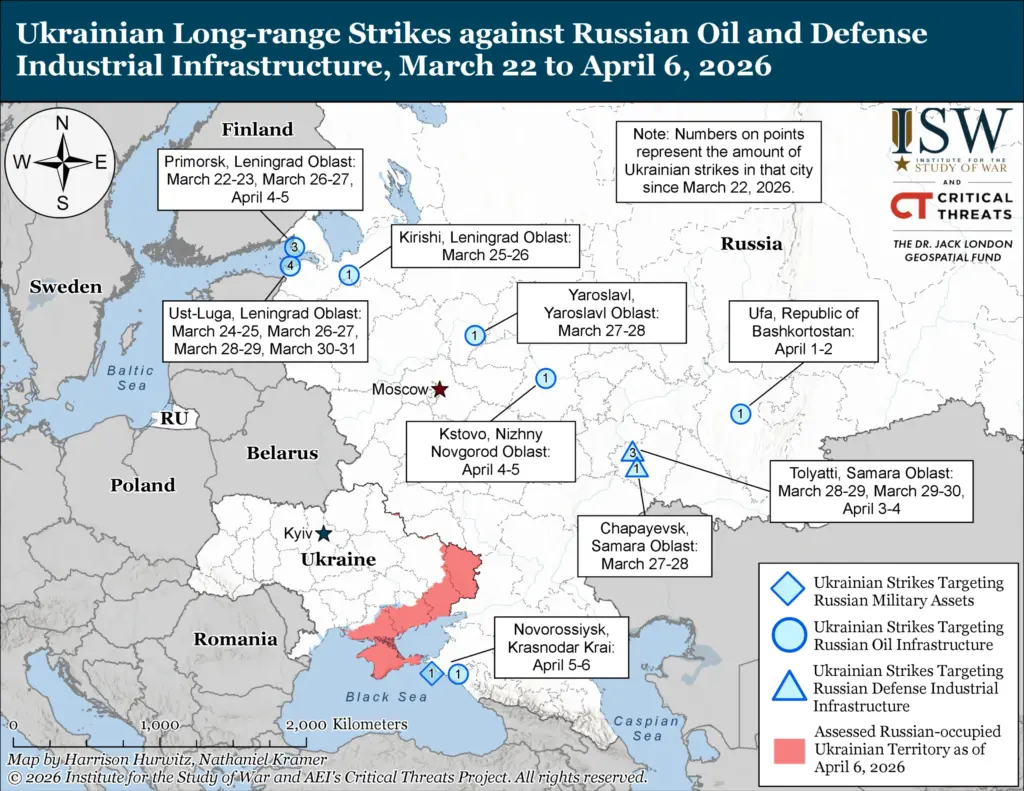
The strike fits a broader Ukrainian campaign targeting Russia’s oil export infrastructure, particularly high-volume ports on the Baltic and Black Seas. By repeatedly hitting storage, loading, and transfer nodes, Kyiv aims to disrupt export flows, cut into energy revenues that fund the war, and compound damage by striking the same facilities before repairs can be completed.
Ust-Luga port under attack again
Telegram channel Exilenova+ reported that the attack began around 05:00 local time and was ongoing for several hours, with air defenses active over the port.
Independent Russian outlet Astra reported that the port had been under drone attack throughout the night. Leningrad Oblast governor Aleksandr Drozdenko claimed that 22 Ukrainian drones were downed over the region, without specifying damage at the facility.
Ust-Luga and nearby Primorsk are Russia’s largest oil export hubs on the Baltic Sea, together handling roughly 2 million barrels of crude per day – about 40% of the country’s seaborne oil exports, according to Astra.
Port had just resumed loading after previous strikes
The latest attack comes days after Ust-Luga resumed crude shipments following earlier Ukrainian strikes.
According to Bloomberg, loading operations at the port had halted at the end of March amid repeated drone attacks on Russia’s Baltic energy infrastructure. On 5 April, an Aframax-class tanker, the Jewel, began loading crude at the terminal, signaling a partial recovery of operations.
Bloomberg reported that the resumption of flows could help stabilize global markets, which have been under pressure due to disruptions linked to the war in the Middle East. At the same time, Ukraine has continued targeting Russian export infrastructure in an effort to cut energy revenues funding the war.

Part of sustained campaign against oil infrastructure
The strike is the latest in a sustained Ukrainian campaign targeting Russia’s oil export network, including ports, refineries, and storage facilities.
On 5–6 April, Ukrainian forces struck the Sheskharis oil terminal in Novorossiysk, one of Russia’s main Black Sea export hubs. The attack hit multiple loading berths and pipeline control infrastructure, with several fires reported across the facility. The damage likely halted loading operations entirely, temporarily cutting a significant share of Russia’s Black Sea crude exports.
Earlier, on 5 April, drones targeted fuel infrastructure at the port of Primorsk, Russia’s largest Baltic oil export terminal. Satellite data indicated a fire at the tank farm. The strike added to ongoing damage at the site following earlier attacks that had already destroyed a large portion of its storage capacity.
Ust-Luga itself has been under repeated attack since late March. Multiple strikes over several days ignited fuel tanks, damaged port infrastructure, and forced temporary shutdowns of operations. The sustained pace of attacks has at times left tankers waiting offshore and disrupted a significant share of Russia’s Baltic oil export flows.
Together, Ust-Luga and Primorsk form the backbone of Russia’s Baltic oil export system, and previous assessments indicate that Ukrainian strikes have at times halted up to 40–50% of this export capacity.
Kyiv has not officially commented on the latest attack.


