
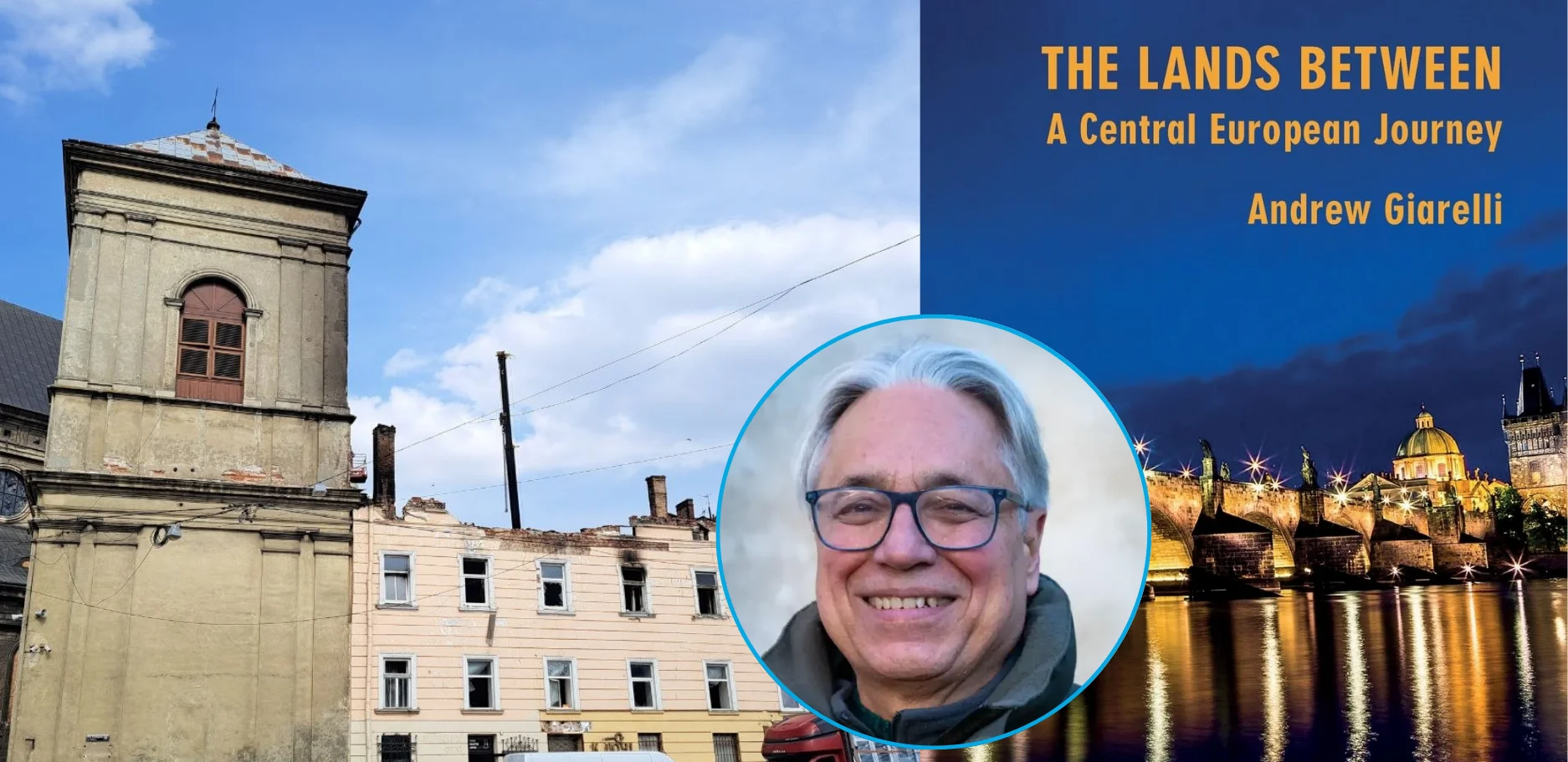

Giarelli is a senior lecturer in journalism and literature at Anglo-American University in Prague and the author of The Lands Between: A Central European Journey (danzig & unfried, 2025), a book about the cultures that took shape across the former Habsburg lands, ending with a chapter on Lviv.
He was in the city in early April when Euromaidan Press sat down with him. The conversation ranged from the suppression of Ukrainian literature to Russian propaganda’s real goal—not to persuade, but to leave people feeling that nothing can be known.
“There are no small literatures”
Peeter Helme: The Ukrainian language and Ukrainian culture have never been held in such high regard — both in Ukraine and internationally — as nowadays. You can even see it in something as mundane as Duolingo. After Russia’s full-scale invasion began in February 2022, the number of people learning Ukrainian on the app skyrocketed 577% globally.
At the same time, this war makes Ukrainians very self-conscious, and while the Ukrainian government has taken the right steps on things like the historical grievances with Poland, is there a risk that this self-consciousness hardens into a strong nationalism where old conflicts, instead of being healed, get worse?
Andrew Giarelli: Isn’t that a little bit what Russia’s argument is? That Ukrainian nationalism is dangerous? Well, Ukrainian nationalism was made dangerous by the people who suppressed it. By the Austrians, by the Poles, and most especially by the Russians. I think the idea that it is potentially dangerous is exaggerated.
What you said about Ukrainian literature is more interesting to me. I’m meeting my publisher in Vienna in a few weeks—he’s a small publisher—and one idea I’ve been promoting to him is to start putting out English and German translations of late 19th- and early 20th-century Ukrainian works that are out of copyright.
People in the west will want to read this Ukrainian literature to see where the idea of Ukraine comes from.
I started asking people at the university here about Ukrainian writing from that period, and it seems like there’s a treasure trove. I was just in the bookstore near the Dominican Church, and the woman gave me as a gift the first of three volumes published by the Canadian Institute of Ukrainian Studies—fiction by male Ukrainian authors from 1900 to 1930.
I just finished reading one of them. Gripping stuff. My first thought was: there’s money to be made here. People in the west will want to read this Ukrainian literature to see where the idea of Ukraine comes from.
Peeter: When you look at the literary map of the world, Russian literature has really overshadowed the whole global impression of what Eastern European literature is. Ukrainian literature has basically been historically invisible. Yet, if you start reading it, there’s qualitatively nothing wrong with it.
Giarelli: This is exactly what I’ve been wrestling with this semester. I just introduced a course called European Literature 2. The major figures make it very easy to end up with a course that’s basically about French, German, and Italian literature and nothing else. What do you do with Russian literature?
One professor told me Russian literature is overrated.
My Czech friends say: sure, they went to Europe, but finally they were Russian. My Ukrainian colleagues here say: absolutely not. Leave them out. They’re not European. One professor told me Russian literature is overrated. Another asked: why don’t we ever hear about a Bulgarian writer or a Croatian writer?
So I made a compromise. I included the best-known Bulgarian and Croatian early 20th-century modernist poets—just a couple of poems, but they’re there. I also came to understand that the writer I always called Gogol is really Hohol, and his early work was specifically about Ukrainian village culture, topics and tropes rooted entirely at home.
For Ukrainian literature, I settled on two stories by Olha Kobylianska, a modernist writer from western Ukraine who has drawn renewed interest in recent years through her correspondence and close relationship with Lesia Ukrainka.
Helme: This connects to something the philosopher Johann Gottfried von Herder argued in the late 18th century: that there are no small literatures. Every literature has weight. What we’ve had instead in practice is the Slavic big brother syndrome—and it extends to literature.
Giarelli: I saw it in person. Around 2013 or 2014, I was invited by a Slovak colleague to his family’s house for his birthday—a mix of young literature scholars from Slovakia, the Czech Republic, and Poland. And then there was Mikhail from Moscow. So extroverted, so overwhelming.
“Now you know what the Slavic big brother syndrome feels like.”
At every single dinner the Slovak colleague’s parents hosted, Mikhail would insist on standing up to make a long speech—about the father, the mother, how we are all Slavic brothers. One morning, at 7 a.m., he came in with a beer already, picked me up, and started calling my name. One of the Slovaks said, quietly: “Now you know what the Slavic big brother syndrome feels like.”
Helme: And at the same time, Ukrainian literature is older than Russian.
Giarelli: When the Russian ambassador to the UN gave his usual speech about how Ukraine is historically Russian, going back to Kyiv Rus, the Ukrainian ambassador Andrii Melnyk replied: “In the beginning of the 12th century, Kyiv was the capital of the largest and one of the most powerful states in medieval Europe. In those times, the area of present-day Moscow was nothing more than a swamp where only frogs were croaking.”
It’s a cultural war, a war of historical re-evaluation, a war of ideas and images.
So this is not only a war on the battlefield. It’s a cultural war, a war of historical re-evaluation, a war of ideas and images. And that’s why I worry about bots and trolls—how easy it is to twist these arguments just by repetition. "No, no, no. It’s all Russian.” Over and over.
Why facts bounce off
Helme: What is the answer to that?
Giarelli: Probably weaning yourself off social media is maybe just a little bit easier than quitting heroin. So that’s not very realistic. My answer is to stop spending two hours accusing people on Facebook of being Russian trolls, and spend those two hours instead doing the kind of deep dive into history that lets you write something connecting this war to centuries of context—which you simply can’t do in a Facebook post or an X post.
Trending Now
They might not be persuaded by arguments. They might be reached by stories.
I also see this in who posts pro-Russian comments—often young people with no connection to the region, from all over the world. They might not be persuaded by arguments. They might be reached by stories.
Helme: And Russian propaganda understands this. It doesn’t try to make people believe the Kremlin’s claims. It tries to leave people feeling that nothing matters—that everything can be true, that everything can be a lie. The goal is not persuasion. It’s paralysis.
Giarelli: I think about the film 20 Days in Mariupol—at the very end, a reporter catches Russian ambassador Vasily Nebenzya walking into the UN and asks him about the attack on the maternity hospital, which Russian media had immediately said was staged, all actors.
He sighed and said, “There are so many fakes. Who wins the information war is the one who wins the war.” That is a very cynical thing to say. Not a denial—just: who knows? Who can say?
“There are so many fakes. Who wins the information war is the one who wins the war.”
That feeds directly into a postmodernist nihilism—the idea that truth is just my interpretation, that a text is whatever I bring to it. Very comfortable for people who don’t want to take a position.
I met an American in a bomb shelter here in Lviv—he’d shown up because he felt the Ukrainians were like the American revolutionaries: outgunned, outnumbered, determined to free their country.
“I look through the internet and use my rational judgment to decide what is true.”
But he told me he didn’t trust the news media. “I look through the internet and use my rational judgment to decide what is true,” he said. That impulse comes from something good—the refusal to let someone else decide for you. But it becomes very dangerous.
Helme: And showing horrors doesn’t fix it. People push it away. What works is something much harder to get right: getting a person to feel that this could be me. Empathy. But there’s no universal recipe for it.
Giarelli: Empathy really is the key. Social media’s ability to encourage cynicism—to make people feel that what they’re seeing is no more real than a video game—is very dangerous.
We see it in the US: young people who commit terrible crimes and are brought into court smiling, because when you’re 15 or 16, and you did something terrible on camera, it doesn’t feel like you made another human being suffer. It felt like a video game.
What I find most frightening is the erasure of the line.
That extension applies to Ukraine, too—the people who make laughing emojis when memorials for Bucha victims appear. In a way, those who celebrate it are at least being honest: they’re acknowledging it happened.
What I find most frightening is the erasure of the line. You can say it was fake, you can say Ukraine did it, you can say Russia did it, and you’re glad—all three positions coexist, and none of them demand anything from you.
Helme: Things have to develop to the point where a critical mass of people feels that this is not how we want to live.
Giarelli: Yes. But apparently, it’s no longer enough to see images like the ones from Bucha. So what does work? I don’t know. If there’s going to be a way out of it, it’s a harder and longer way than I can see clearly. I just want to keep writing stories.


