


From a corner table here in Virmenka café, three days after a Shahed drone hit downtown Lviv's 17th-century Bernardine monastery, I consider how Ukraine's complex history exposes its vulnerability to not just Russian imperialism but also to Western simplifications.
Three ladies in their 50s sit across from me, one updating her lipstick. Perhaps they came as rebel teens when Virmenka drew Ukrainian dissidents before the Soviet Union shuddered and fell, or later in the early 90s when dissident-turned-politician Viacheslav Chornovil rallied people for democracy in a fragile new Ukrainian state, or during the 2004 Orange Revolution for democracy, or during the 2014 Maidan uprising for democracy.

Chornovil, who'd spent 15 years imprisoned or exiled by Soviet Russia, died in a 1999 car crash still clouded in suspicion, but clouds and suspicion come with Ukrainian history, as its giant neighbor on three sides prefers. Most lately, that neighbor has succeeded in clouding the minds of an increasingly dim-witted American president and his followers, who believe the country is a failed state that should not have resisted Russian aggression and is unworthy of Western attention, let alone respect.
"Hostility to Ukraine is becoming a party line on the MAGA right," Cathy Young wrote a year ago in the conservative Quillette after Zelenskyy's Oval Office ambush and subsequent US suspension of air defense supplies and intelligence to Ukraine.
Though the latter resumed, it all normalized what followed: no more direct military aid, holdups of previously approved aid, and now limitations on the Prioritized Ukraine Requirements List (PURL), which replaced direct aid by allowing NATO countries to purchase US weapons for Ukraine—because some of those most essential weapons, like air defense interceptor missiles, are now essential to America's confused and backfiring Iran misadventure.
That Trump and his MAGA followers now dominate the Ukraine narrative with assertions of ostensible realism and alleged Ukrainian perfidy is just Russia's latest accomplishment in historical distortion dating back even half a millennium before that monastery and its St. Andrew church was built in the early 1600s. Actually, that church replaced earlier 15th and 16th-century churches, themselves probably built over earlier structures dating to the 13th and 14th-century Ruthenian kingdom of Danylo Romanovich and his son Prince Lev, after whom Lviv is named.

Recently, Russia's UN ambassador Vasily Nebenzia cited those times 800 years ago as justification for his country's aggression, repeating Putin's line that the Kyivan Rus' empire that flourished from the 9th to the mid 13th century until Mongol hordes destroyed it was Russia, and that Ukraine was always an artificial idea. Ukraine's UN ambassador Andriy Melnyk called bullshit on him, saying Moscow was a swamp with croaking frogs while Kyiv flourished during this time.
On Palm Sunday in Lviv, it was obvious that religion is not near death in this part of Europe, at least. I toured churches in the center, starting with that formerly Bernardine and now Ukrainian-Greek Catholic Church of St. Andrew the Protokletos, the first-called by Jesus. The church was packed, and the crowd on Soborna Square outside was growing. Song rose with Byzantine muscle from loudspeakers, overwhelming the alms plea from a legless war veteran who had parked his wheelchair front and center.
Last year just its stained-glass windows were covered. However, since the latest attack the church has become a festival of plywood and serrated sheet metal, oddly now better matching the facing statue of Polish-Lithuanian patron saint John of Dukla that has been thickly scaffolded since 2022.

Poland is everywhere and nowhere in Lviv, a ghostly presence. What the city officially calls the Latin Cathedral, but locals usually call the Polish cathedral, was my next stop, just off Rynok, itself a Polish word for the main market square. Here, bells pealed in more melodic and restrained Roman Catholic fashion, it seemed.
People poured out with their blessed palm fronds, and I bucked the current to enter for a rare look, because this church—also splattered with sheet metal and plywood—is usually closed now. Just a little to the north on Teatralna street, the equally packed Jesuit Latin Cathedral of St. Peter and Paul was also broadcasting its service to a scattered crowd outside.
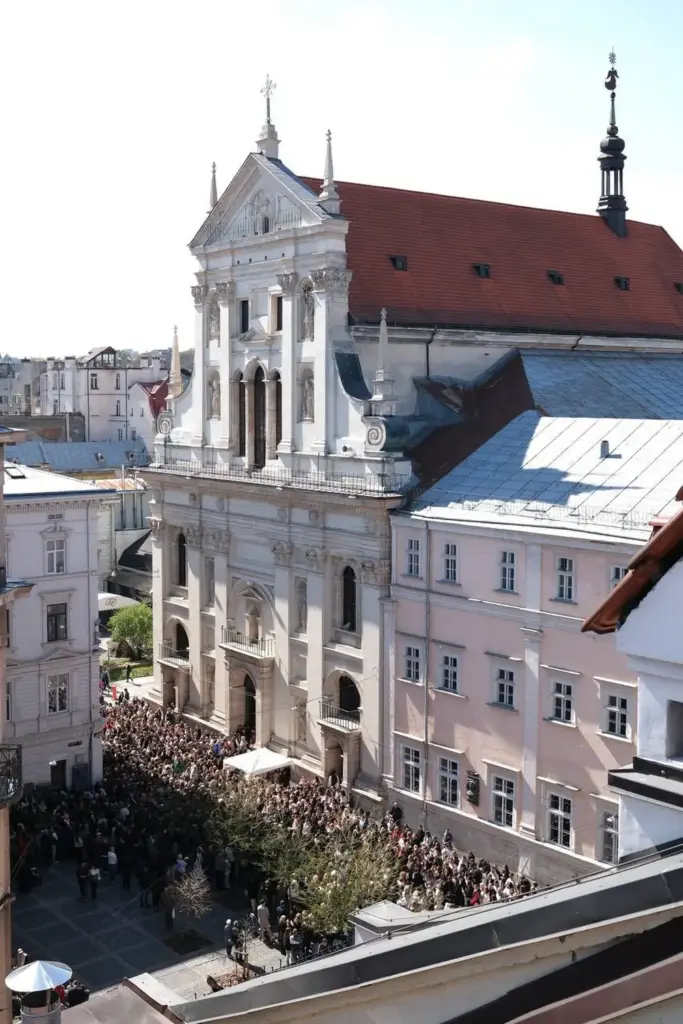
The Jesuits arrived a little before the 1596 Union of Brest got Eastern Orthodox churches here to submit to Papal authority while maintaining their Orthodox liturgies, thus becoming Greek Catholic or "Uniate," indicating union with Roman Catholicism. They built their church, imitating Rome's Il Gesù, also in the early 1600s.
After Soviet Russia took Lviv from Poland post-World War II, they closed this church and turned it into a warehouse. They also banned Ukrainian Greek Catholicism and closed its churches, though many of the latter continued practicing their religion secretly at great personal risk.
It turns out that you don't need a drone attack or even the most recent invasion in general to feel Russia's boot print in Ukraine: just take a walk and read the historical plaques.
I continued farther north, bells pealing from several directions, and further back in time to when Lviv first became Polish, when King Casimir III the Great in 1349 annexed the crumbling and wartorn Ruthenian kingdom descended from Kyivan Rus, whose identity those Ukrainian and Russian diplomats so hotly debated at the UN the week before. You need too many clauses to describe Ukraine's history, understandably making foreign readers' eyes drowsy.

The Armenian Cathedral dates from those hoary times, its stone panels at the entrance carved with medieval Armenian letters by priests and traders who settled here by the mid-1200s, under King Danylo. The latter had to declare fealty to the Mongols to save his kingdom. After he was required to drink a cup of fermented milk to seal that fealty, Batu Khan said to him "Now you are one of us," says legend.
Mongols, Poles, Lithuanians, Hungarians, Austrians, Soviet Russians, and Nazi Germans, and Soviet Russians again, and now this monstrous new Russia have all declared Ukrainians "one of us," and naturally, stubborn Ukrainian silence has often been mistaken for acquiescence.
But it's not. It matters not that Ukrainians have only called themselves by this name since the mid-19th century national revival. They have always known who they are.
Light streamed through a stained glass window high up in the Armenian Cathedral in front of a very old icon of Christ, spookily enough to nudge an old agnostic slightly more toward belief. That was Palm Sunday. By Good Friday, this most magical of churches was darker, its altar blocked by a deep purple curtain, signifying mourning.

Even an agnostic can mourn this week, leading to the anniversary of Christ's crucifixion, for it is also the anniversary of the week in which the horrors of Bucha and Irpin were revealed four years ago.
By Good Friday, too, we'd had 10 air alerts in six days, six of them mid-day. Ukrainian defense experts say this, along with more frequent strikes in western Ukraine, marks a significant shift in Russian strategy.
Following hard on the winter's punishing energy infrastructure attacks, they are Russia's next effort to create a sense of constant, ubiquitous danger among civilians, the experts say. And Russia seems suddenly able to impose such terror, in places and at times that had not yet known it, with a dramatic upsurge in drone and missile production and launches.
According to Ukrainian Air Force data analyzed by The Kyiv Independent, Moscow has launched almost 50% more drones and over 150% more missiles against Ukraine in the first three months of 2026 than in the same period last year. I could not help but wonder, in that dark and sorrowing old church, what the Iran war's soaring oil prices and lifted sanctions will do to those numbers, and whether enough countries will even care.

I promised my wife that I would go down to the hotel bomb shelter for each air raid alert, and I did, even though I felt like an idiot because Lvivans all around me just continued their daily Easter Week business, ignoring the sirens.
But I sat in the shelter and battled on Facebook with people (or bots) who overwhelmed pages memorializing the Bucha and Irpin massacres, mockingly calling them fake, or saying they were real but committed by Ukrainian troops, or that Ukraine started the war, or asking what about Ukraine's attacks on Donbas from 2014–2022, or what about Western imperialism, or what about this, or that. Some just outright celebrate the atrocities, and at least they are honest.

It is a strange war of bots and drones, fakes and posts, but it is real enough. On Holy Thursday, I rode out to the Lychakiv Cemetery with Mikhailo Bilynsky, head of Ivan Franko University's English department and a veteran interpreter for official Ukrainian delegations.
Early this year the cemetery's famous Field of Mars reached full capacity; we visited instead the new addition a little distance from the main cemetery. The earth was broken and fresh, as were the dead. Already a couple hundred were buried here, killed at the front just during the past two months. An impossibly young-looking soldier, judging from his photo, was buried next to an impossibly old-looking one. We watched a family tidy a grave and lay flowers.

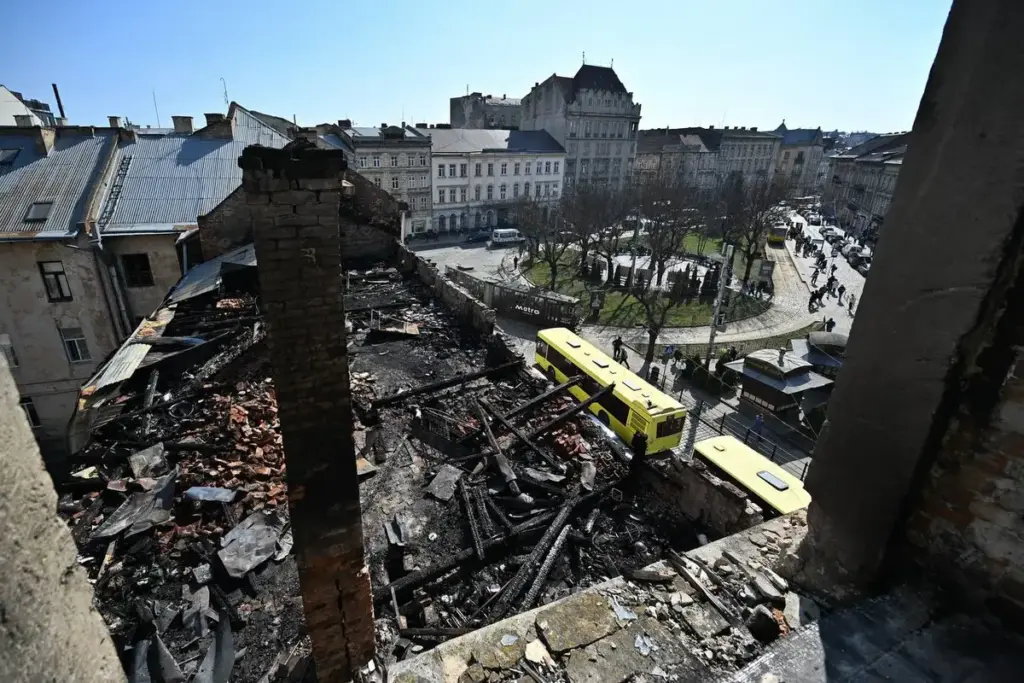
"We are paying very dearly for the fact that we exist," Bilynsky said, and then there was nothing more to say. However, right after the last air raid, the next day on Good Friday, around 3 p.m., as thick velvet descended on altars in this city of churches, I emerged from the shelter outside and noticed that workers were already half-finished replacing the drone-destroyed monastery roof. Somehow, I smiled.
Andrew Giarelli reported from Lviv during Western Holy Week (29 March–5 April 2026). Orthodox and most Ukrainian Orthodox Easter falls on 12 April this year.

More about Lviv
-
Lviv Garrison Church chaplains help soldiers find God amid war. And a pair of good boots
-
Lychakiv Cemetery, Lviv: an open-air museum of history, culture, art and remembrance
-
International project renovates priceless frescoes in historic Garrison Church in Lviv
-
Lviv Garrison Church chaplains help soldiers find God amid war. And a pair of good boots


