
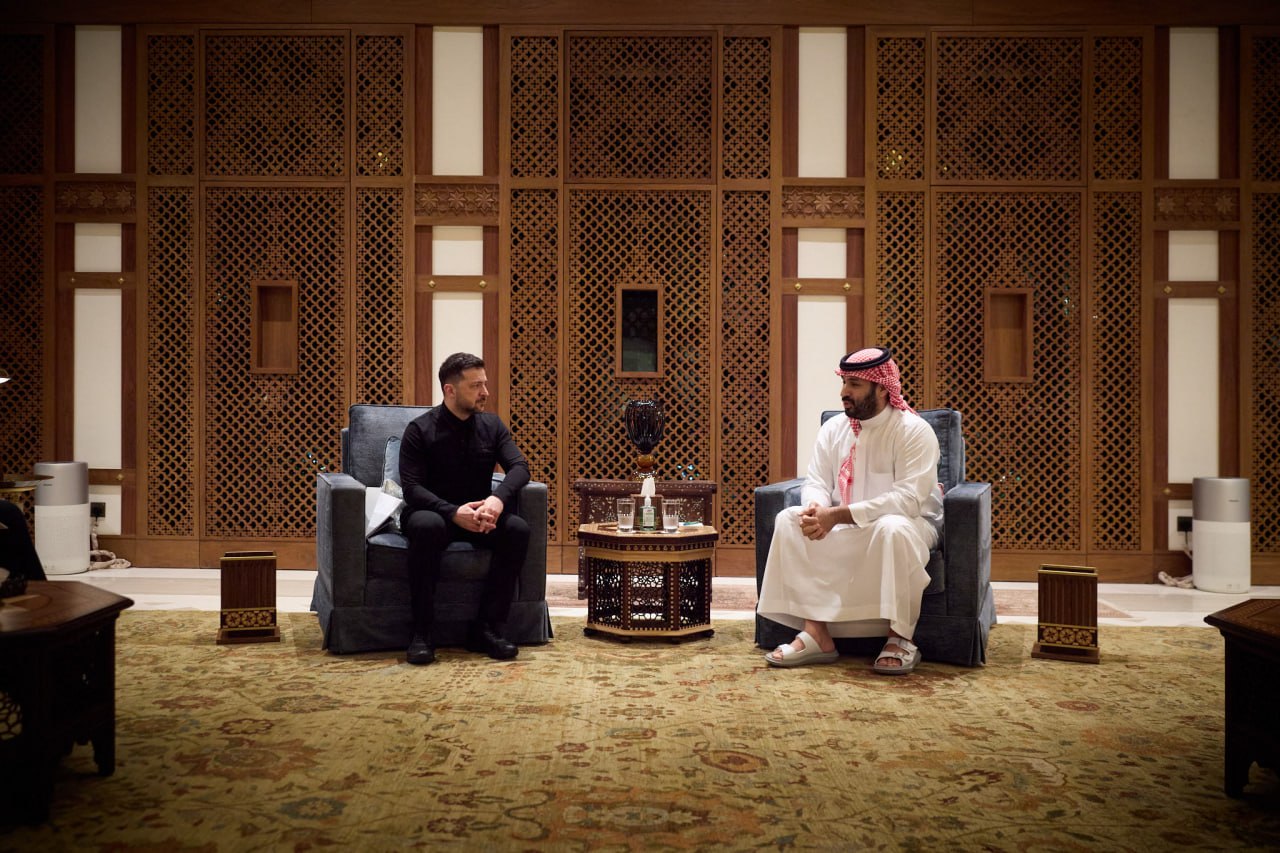
President Volodymyr Zelenskyy said he signed 10-year defense cooperation agreements with Saudi Arabia and Qatar during his tour of the Middle East last week, a first for Ukraine.
"I believe these are historic agreements. We have agreed on strategic cooperation in the MilTech direction and other areas. We are talking ten-year agreements," the president said in a statement. "This is about exports, about opening up exports. But it's about opening up properly, when you know you're actually selling partners a system, not just interceptors."
That system includes "a line of defense, software, and electronic warfare systems," according to Zelenskyy, who said that Kyiv is "approaching this issue systematically."
Middle Eastern countries are also interested in sea drones, which may be put to work unblocking the Strait of Hormuz, using Ukraine's experience of breaking the Russian Black Sea Fleet's blockade of its maritime exports.
"We raised this issue because it is painful and hot for the whole world, because there is an energy crisis," the president said. "They know that they can count on our expertise in this area. We shared the experience of the Black Sea corridor, how it functions."
Zelenskyy also visited the United Arab Emirates and Jordan, and is in talks with other states in the region. National Security and Defense Council Secretary Rustem Umerov is currently in the Middle East for a series of meetings.
In exchange, Ukraine hopes to secure anti-ballistic capabilities, which are in global short supply. The president also said that Gulf countries agreed to support Ukraine with energy supplies and diesel fuel.
Critical defense partnership
Zelenskyy's meetings were well-timed. Over the weekend, Iran attacked the US's Prince Sultan Air Base in Saudi Arabia, injuring at least 12 service members, damaging two aerial refueling planes and taking out an E-3 Sentry Airborne Warning and Control system aircraft, putting a serious strain on American air operations in the region.
Other attacks struck airport in Erbil in Iraq’s Kurdistan region, which houses a US consulate. A radar system in Kuwait’s international airport was also damaged. Earlier, Iran hit Qatar’s Ras Laffan gas plant, taking out 17 percent of the country's liquefied natural gas export capacity.
Kyiv has already dispatched its military experts to at least a dozen countries in the region to put on an air defense clinic on how to protect against modern mass strikes with drones and missiles.

Ukraine can help unblock Strait of Hormuz — Kyiv negotiates naval drone with Arab countries after Black Sea success
Ukraine now has the opportunity to sell battle-tested, affordable solutions to Middle Eastern countries, and teach them how to use them and properly integrate them into a comprehensive air defense doctrine.
Ukraine's naval drones can also be used to take on Iran's attacks in the Persian Gulf and the Strait of Hormuz, escort tanker traffic, and put pressure on Iranian logistics.
Observers told Euromaidan Press that a “systemic push to build a new security architecture” in the Gulf could become “the most important defense partnership story of the next few years.”
Trending Now
How the deals might look
Ukraine is still working on ways to pave the way for such cooperation. The legislative and bureaucratic system to allow arms exports is still being put together, sources in the Defense Ministry have told Euromaidan Press.
Sources also said that Kyiv is paranoid about giving away its proprietary tech, military secrets, or hard-won battlefield expertise, paid for in blood. This is putting the brakes on both paving the way for miltech sales, as well as the deployment of veteran warfighters to other countries to serve as instructors.
Timofiy Mylovanov, president of the Kyiv School of Economics, wrote that if Ukraine doesn't create a working system for exports and experience sharing, it risks becoming a country that "invented and proved everything, but didn't earn."
"However, recently, the Ministry of Defense team proposed a clear export model, which almost all players in the market agree with," Mylovanov added.
Under this model, the government has a 30-day window to buy from a defense contractor, after which it allows them to export their products. Additionally, exports are allowed only to partner countries; only goods not needed at the front are eligible; and a 10% export duty is charged to procure frontline supplies.
Ukraine is also eyeing joint production agreements, such as the Build With Ukraine model.
"This model is as profitable as possible for our country, it needs to be launched as soon as possible," Mylovanov wrote. "The main mistake is to think that the world will wait. It will not wait."