

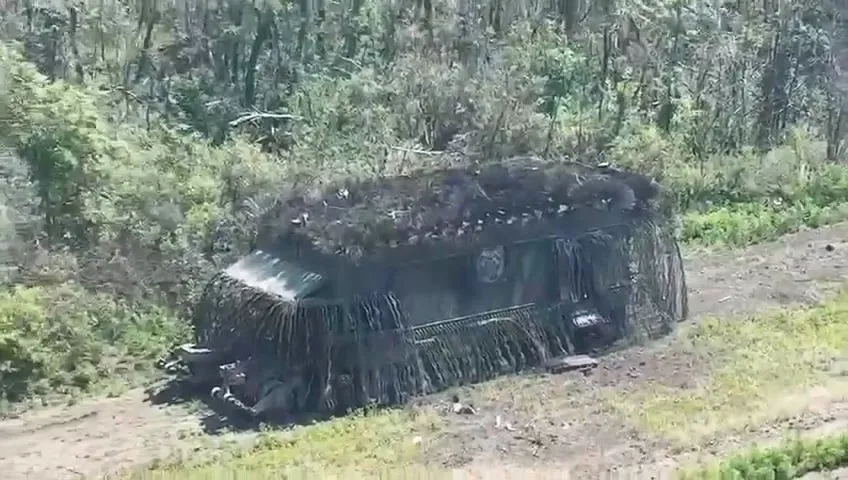
- The Russian 4th Motor Rifle Brigade produces a unique type of up-armored turtle tank
- This "giga turtle" is the biggest and heaviest of Russia's many improvised assault vehicles
- If there's a downside to all that add-on armor, it's that it slows the giga turtle to a crawl
- That slow speed may have doomed a recent giga turtle assault south of Kostiantynivka
Russian forces have been trying and failing for more than a year to capture Kostiantynivka, a major obstacle between the Russian Center Group of Forces and the free cities of Kramatorsk and Sloviansk in eastern Ukraine's Donetsk Oblast.
Despite suffering horrific casualties in their long siege of Kostiantynivka, the Russians aren't giving up. On or just before 26 March, one of the Center Group of Forces' most experienced units—the 4th Motor Rifle Brigade—rolled out its best vehicles for a fresh push toward the fortified city.
The giga turtles' return is part of a bigger shift. After a year of infantry-only assaults that cost Russia more than 418,000 casualties, Russian commanders are putting their troops back inside vehicles. The early results haven't been encouraging. A 54-vehicle assault near Lyman on 19 March ended in what one Ukrainian drone operator called a "massacre."
These giant, up-armored "giga turtle" tanks are the products of years of trial and error by Russian troops desperately innovating to protect their vehicles and themselves from Ukraine's first-person-view drones. The giga turtles have proved they can absorb multiple FPV strikes. If there's a downside to the massive vehicles, it's their slow speed: just 10 km/hr, according to one observer.
All that extra metal comes at the cost of extra bulk and weight. The giga turtles are too big to hide. They're too heavy to run. Their only protection is, luckily for their crews and passengers, also their best protection: their layers of armor.
The 4th MRB takes a standard T-72B3M tank, adds a frame for drone-defeating metal plating and spines, installs floors under the plating to support infantry and hatches for the infantry to ingress and egress—and covers any gaps with dangling metal chains.
Add a rear extension for extra infantry, frontal rollers to safely detonate mines, and top-mounted radio jammers for protection against wireless drones, and you've got potentially the biggest and toughest assault vehicles on either side of Russia's 50-month war in Ukraine.
Too bad about the slow speed, of course. It prolongs a giga turtle's exposure to attacking drones.
Frequent visitors
The 4th MRB's giga turtles frequently appeared on the roads toward Kostiantynivka late last year, but became rarer as 2025 ground into 2026 and the Russians mostly parked their armored vehicles in favor of infantry-led assaults across wet winter terrain.
Trending Now
Those assaults were extremely costly, however. As the weather warmed and the wet ground dried, Russian vehicles made a comeback. The return of the 4th MRB's giga turtles signals the re-mechanization of a temporarily de-mechanized force.
But the Russians' initial vehicular assaults have all failed—not just along the Kostiantynivka axis but also along the Lyman axis farther to the north. Kostiantynivka blocks the Russians' south-to-north march on Kramatorsk and Sloviansk. Lyman blocks the east-to-west march toward the same objectives.
On or before 26 March, at least two of the giga turtles rolled toward Kostiantynivka with assault troops tucked under their metal shells. But Ukrainian drones were watching. And as the giga turtles slowly crawled through Ivanopillya, 5 km south of Kostiantynivka, fiber-optic FPVs from the Ukrainian 28th Mechanized Brigade attacked.
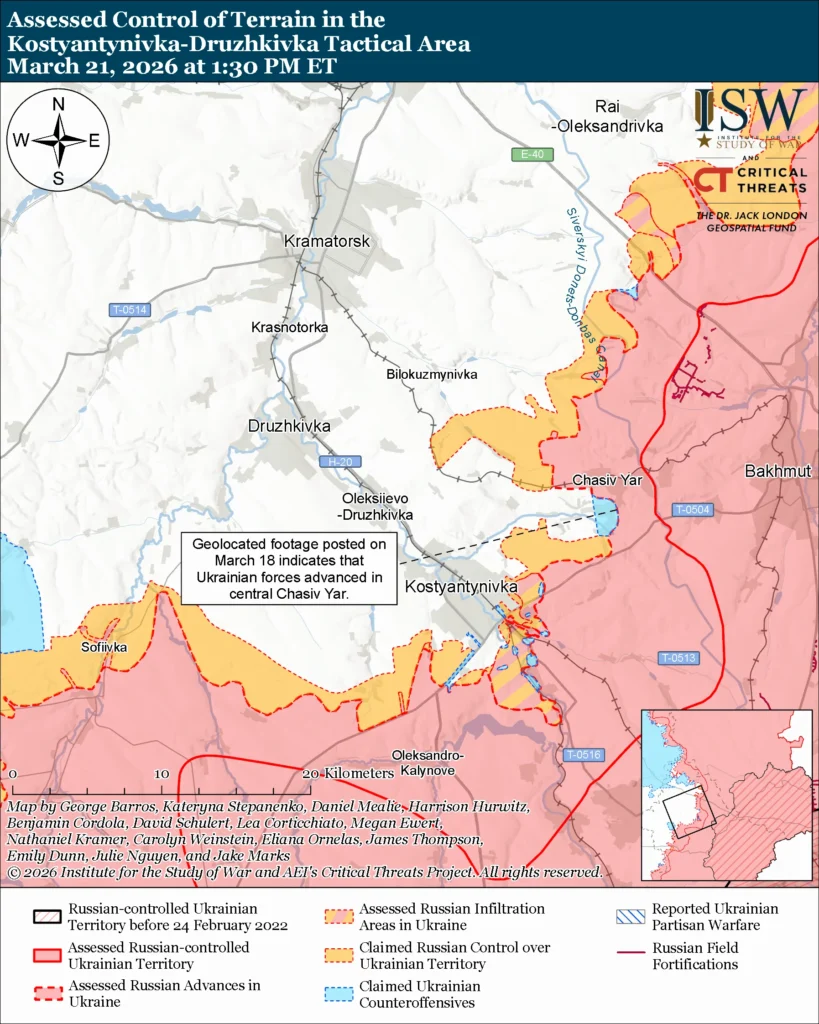
The 28th Mechanized Brigade claimed it knocked out one giga turtle. Indeed, it's evident from overhead surveillance that at least one giga turtle suffered some damage.
It's not evident that either giga turtle was immobilized or destroyed, however, despite the 28th Mechanized Brigade's claim. The co-located 100th Mechanized Brigade observed two Russian tanks leaving Ivanopillya and driving south, perhaps confirming that both giga turtles survived despite taking damage.
Subsequent strikes on dismounted Russian infantry indicate the giga turtles may have succeeded in disembarking some of their passengers on the southern outskirts of Kostiantynivka. In any event, the Russian assault troops failed to claim new ground in or around the city, according to the 28th Mechanized Brigade. "We are already used to endless small groups [and] repelling mechanized assaults," the brigade quipped.
Kostiantynivka holds for now. But the Russians and their giga turtles will be back. "Day after day, the Russians are increasing the number of attempts to drag as many of their troops as possible into Kostiantynivka," the 28th Mechanized Brigade warned.


