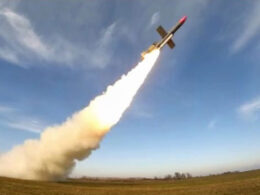


On 28 March, Ukrainian forces struck a Russian munitions factory 1,000 kilometers from the front line. The Promsintez chemical plant in Chapayevsk, Samara Oblast was hit using the FP-5 "Flamingo," a domestically developed cruise missile, reports the General Staff of the Armed Forces of Ukraine.
The Promsintez facility specializes in producing explosive components used to fill munitions such as bombs and missiles. It produces more than 30,000 tons of military-grade explosives per year, reports the General Staff.
Chapayevsk has been a center of Soviet and Russian chemical weapons and explosives manufacturing since the Second World War. It contained one of Russia’s early chemical-weapons production sites. The Promsintez plant specifically focuses on the explosive fill that go into the warheads of the bombs and missiles Russia fires at Ukrainian cities and troop positions. Destroying or degrading its output capacity would reduce the volume of ready munitions Russia can move to the front.
FP-5 Flamingo: Ukraine's deep-strike arm
The FP-5 Flamingo is a Ukrainian-developed cruise missile designed for strikes on stationary high-value targets beyond the reach of conventional artillery. Its use against Chapayevsk confirms that Ukraine now regularly employs domestically produced long-range strike systems against Russian defense-industrial infrastructure—factories, refineries, and logistics hubs that feed the war machine rather than front-line forces. On the same day, the General Staff of the Armed Forces of Ukraine reported that the Yaroslavl oil refinery in Russia was hit, one of the key fuel supply hubs for the Russian army.
Ukraine has accelerated attacks on Russian territory throughout 2025 and into 2026, targeting fuel production and munitions supply chains rather than concentrating exclusively on forces inside occupied Ukrainian territory.