

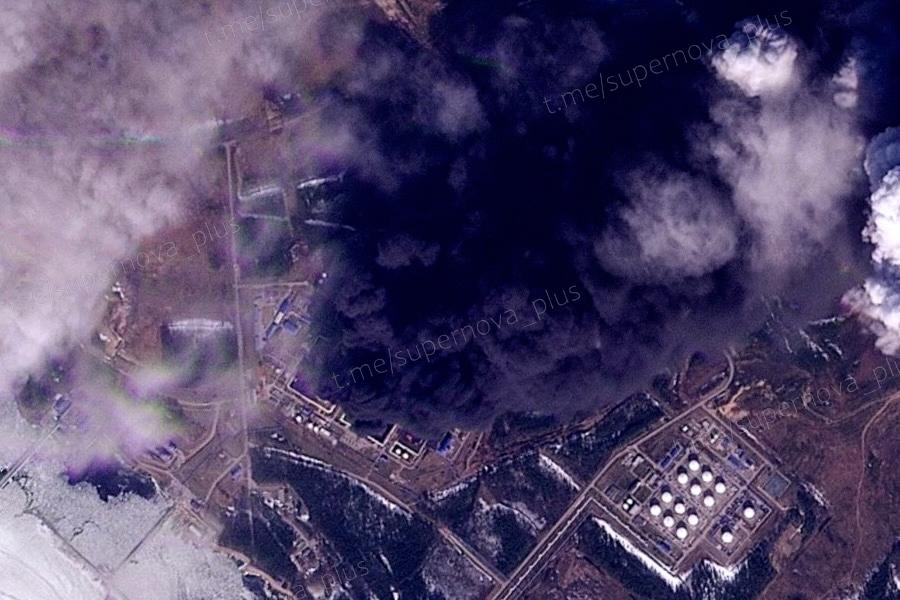
Ukraine's recent strikes on Russian ports around St. Petersburg have halted oil exports along one of Russia's most critical shipping corridors, Estonia's Defence Forces Intelligence Centre commander Colonel Ants Kiviselg said at a briefing, as reported by ERR.
"This is unambiguously a serious blow to Russia, as the Russian Federation exports 40–50% of its petroleum products through the ports of Ust-Luga and Primorsk," Kiviselg said. "At least in the short term, this will significantly affect Russia's revenues — at a moment when the retreat of ice on the Baltic Sea and higher oil prices would have allowed these ports to be used even more actively and profitably."
The timing mattered. "Ukraine chose the moment of the strike very well," Kiviselg said. "At least temporarily, Russia's revenue from oil exports will decrease — and with it, the funding for its war against Ukraine."
The campaign: three strikes in four days
The Estonian assessment follows a concentrated series of Ukrainian drone attacks against Baltic energy infrastructure. On 22–23 March, Ukraine struck the Primorsk oil terminal, setting a fuel depot on fire. Two days later, on 24–25 March, drones hit the NOVATEK gas processing complex at Ust-Luga port, with Ukraine's Security Service and Special Operations Forces both claiming responsibility.
The third strike came in the early hours of 26 March, when Ukrainian forces hit the Kirishi oil refinery in Leningrad Oblast, causing fires on site, according to Ukraine's General Staff of the Armed Forces. The strike reportedly hit primary oil processing units and two storage tanks, though the full scale of the damage is still being assessed.
Known as KINEF, the Kirishi facility is one of Russia's three largest oil processing plants, with an annual capacity of roughly 20–21 million tons of crude. It accounts for more than 6% of the country's total refining capacity and produces a range of petroleum products, including fuels used by the Russian armed forces. The refinery has been hit in previous drone attacks, including in March 2024, March 2025, and October 2025, according to ASTRA.
Leningrad Oblast Governor Aleksandr Drozdenko confirmed industrial damage in the Kirishi area but said no casualties had been reported. He added that 21 drones had been intercepted during the incident. Air raid alerts were declared across Leningrad Oblast and St. Petersburg, and Pulkovo Airport temporarily suspended flights.
Ukraine's General Staff described the Kirishi attack as part of "systematic measures" to reduce Russia's military and economic potential and limit its ability to supply occupying forces, adding that such strikes would continue until Russia ends its armed aggression against Ukraine.
Front lines
On the battlefield, Kiviselg said the most intense fighting is concentrated in the Kostiantynivka–Pokrovsk area of Donetsk oblast and near Huliaipole in Zaporizhzhia oblast. Russian forces achieved some advance toward Sloviansk, he said, but effective Ukrainian countermeasures pushed the front line back.
Russia lost more than 11,000 troops, around 80 armoured vehicles, and approximately 300 artillery systems in a single week of offensive operations, according to Kiviselg — without achieving any significant territorial gains. He also noted that Russia launched a record aerial attack against Ukraine this week, deploying nearly 1,000 UAVs.
Disinformation
Kiviselg dismissed as disinformation Russian claims — circulating in the Russian information space — that Ukrainian drones appeared over Baltic states because those countries had allegedly permitted Ukraine to launch UAVs from their territory.
Latvia's Ministry of Defence issued a parallel warning on 27 March, describing a coordinated Russian information operation targeting Latvia, Lithuania, and Estonia in connection with the same claims.


