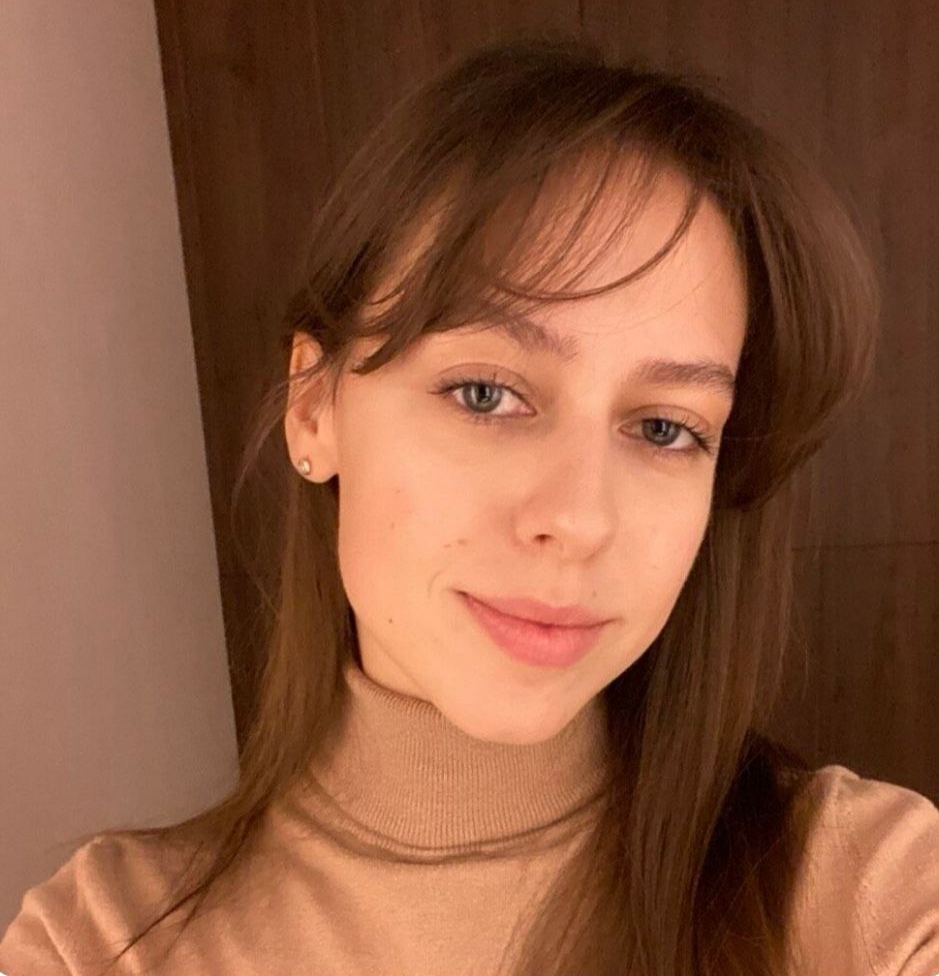
When Olga Kurtmallaiev saw her husband's name on the list of released prisoners of war in the Diia app, she posted a screenshot with a single word: "home."
Behind that word, according to a feature published by a Ukrainian outlet, were three years, ten months, and one day.
Mariupol, 2022
Ruslan Kurtmallaiev had been a professional soldier since 2013. "Since 2014 — at war. These years hardened my character," he says. He and Olga met in 2015; he proposed within months. The couple settled in Berdiansk, on the Sea of Azov.
In 2021, Olga was diagnosed with cancer. She moved her treatment to Mariupol to be closer to Ruslan, who was serving with the 36th Separate Marine Brigade. They saw each other between rotations. He went to the front; she went to her procedures.
On 24 February 2022, Ruslan was already at positions near Mariupol. As Russian forces encircled the city and moved in with artillery and aircraft, his unit fell back to the Illich steel plant and the Azovmash factory. Phone calls shortened to minutes.
During one of those calls, Olga asked him to promise he would come back. "I will come back," he said. He later told her that promise helped him hold on.
In May 2022, the Ukrainian defenders of Mariupol went into Russian captivity. Olga learned her husband had been captured by chance — she recognized him in video footage circulating on Russian Telegram channels. After that, contact went silent.
The wait
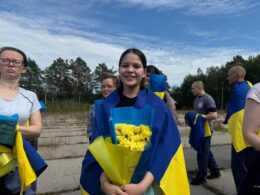
Olga did not wait quietly. She tracked information, attended prisoner exchanges in person, and brought the same bag each time: clothing, toiletries, his unit's flag. "When our boys return, it is a joy that is hard to put into words," she says. "You watch people embrace their loved ones after years of separation and you rejoice with them. But at the same time, you think of only one thing: is your person's name there."
It never was — not for nearly four years.
In 2023, families of marine POWs formed a civic organization. Olga became its head. The group focused on practical post-captivity issues: recognition of injuries and illnesses sustained in detention as combat-related, the right of freed soldiers to decide whether to continue service, and counting time in captivity toward military tenure. "Captivity is a continuation of military service," Olga says.
She continued attending exchanges through 26 courses of chemotherapy and multiple surgeries. "I knew he was holding on there. And counting on me. So I simply had no right to give up."
The letter
Shortly before Ruslan's fourth birthday in captivity, Olga wrote him a letter. She did not know whether he would read it. On the envelope she wrote a phrase from a song by the band Skladno: "I'm on your side." She had heard the song a year before his release, during a conversation with the mother of one of the band's members, and repeated it to herself when things became hardest.
The letter was sent through the Coordination Headquarters for the Treatment of Prisoners of War. It reached Ruslan almost a year later — handed to him after his release. He read it on the bus carrying freed Ukrainian soldiers back to Ukrainian-controlled territory.
"I immediately felt the warmth and support of my wife. And when I learned the story of this letter, I was very impressed," he recalls. He did not disclose the contents, calling them too personal.
The return
During his captivity, Russian soldiers repeatedly tried to recruit Ruslan, citing his Crimean Tatar identity. They urged him to renounce his service and settle in occupied Crimea. He declined each time, citing the marine corps motto: "Always faithful."
After his release, Ruslan's first moments on Ukrainian soil passed in medical checks and logistics. Comprehension came slowly. "You understand that you are already home, that you are in Ukraine. But the brain does not immediately accept it. Everything seems a little unreal," he says.
Simple things disoriented him. "When you haven't seen the sky for a long time, you start looking at it in a completely different way."
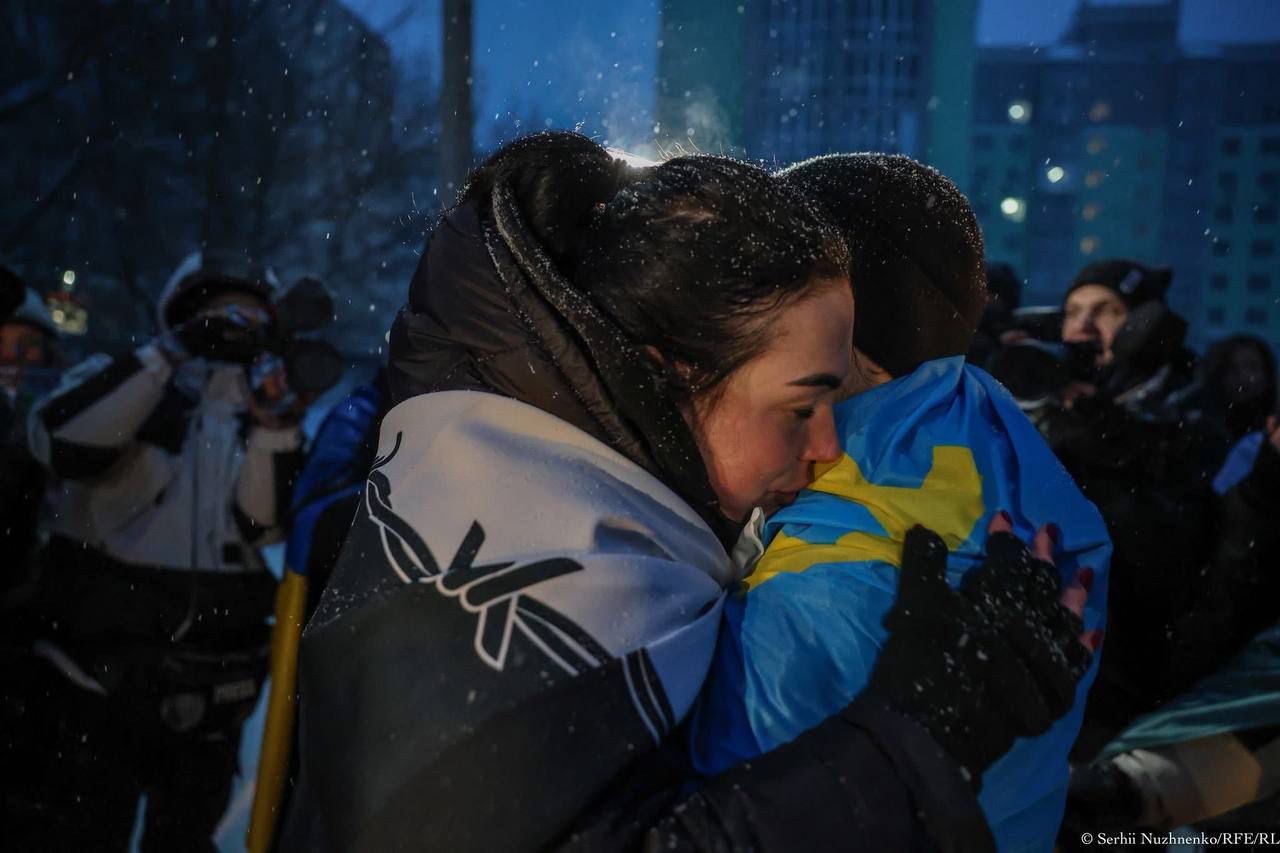
Olga was standing at the hospital entrance when the bus arrived. They embraced immediately.
"I always knew my wife was a strong person. But even for me it was a revelation how strong she is," Ruslan says.
Ruslan is in rehabilitation. Olga lives near the facility. They see each other daily, between his sessions. He says he wants to show her the country he fought for. She says she wants them to become parents.
When she posted that screenshot from Diia, she wrote the word she had repeated to herself for nearly four years.
This time it was no longer a hope.