
- As recently as December, the Russians were advancing toward Zaporizhzhia city and its hundreds of thousands of residents
- But a little luck, Russian misfortune and a well-timed counteroffensive has turned the tide in the Ukrainians' favor
- Now the Russians are bottled up in the town of Huliaipole—and Zaporizhzhia is safer
Three months after capturing a critical town along the southeastern front, Russian forces are struggling to advance any farther to the west. Moscow's plan for a quick march on Zaporizhzhia city, 80 km west of the current front line in Zaporizhzhia Oblast, are in disarray.
That doesn't mean Zaporizhzhia city and its 700,000 pre-war residents are safe. It does mean they're in less danger than they were just a few months ago.
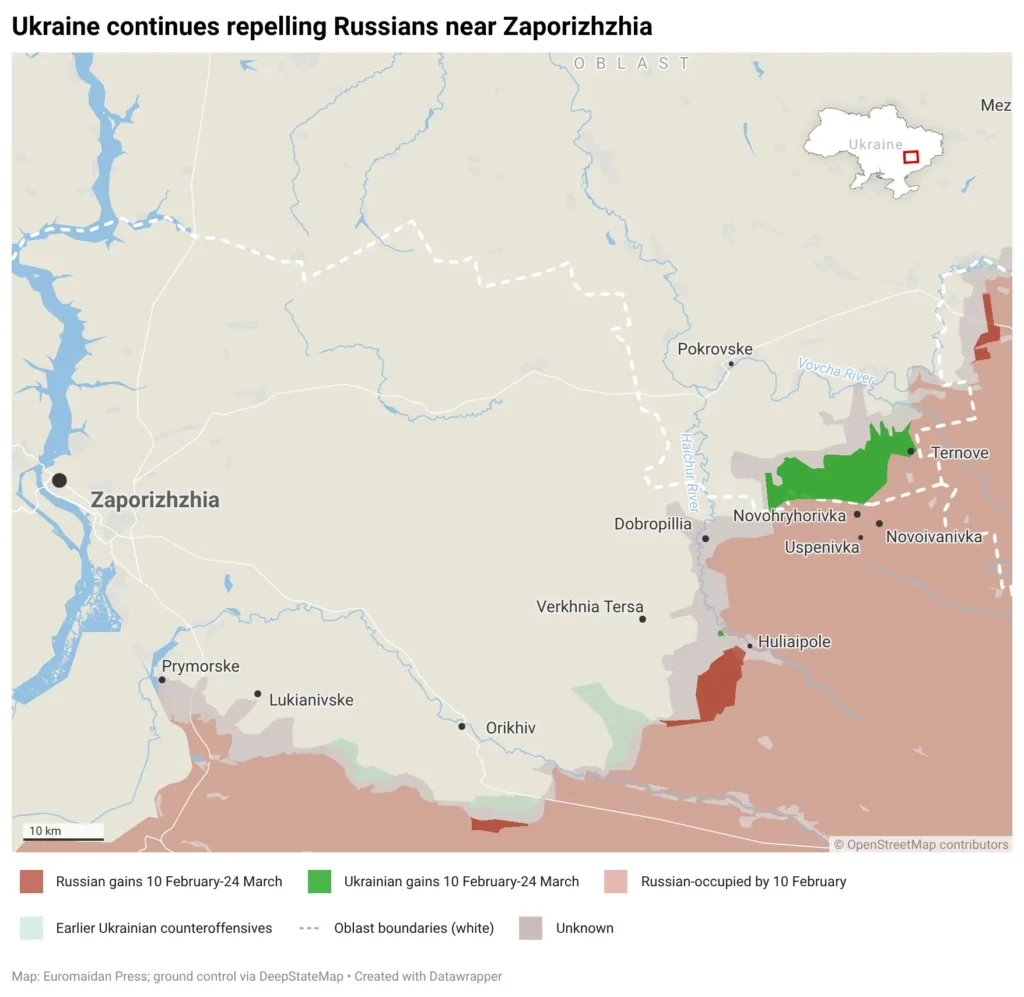
Friends of a free Ukraine panicked when, in late December, a contingent of exhausted and outgunned Ukrainian territorial troops retreated from the town of Huliaipole, an important logistical node sitting astride the Haichur River in Zaporizhzhia Oblast.
Russia motor rifle troops marched into Huliaipole behind the fleeing territorials, largely taking control of the town and its adjacent supply lines. The partial capture of Huliaipole extended a steady advance across Zaporizhzhia Oblast by the Russian 36th and 5th Combined Arms Army—and seemed to open a clear path for the Russians to march on Zaporizhzhia.
Then, a stroke of luck for the Ukrainian territorials and the airborne, assault, and mechanized troops that raced south to reinforce them. In early February, billionaire Elon Musk's Starlink bricked Russia's thousands of smuggled and stolen satellite communications terminals, grounding many Russian drones and cutting off many headquarters from their front-line troops.
Comms meltdown
The comms meltdown sowed chaos among Russian forces all along the 1,200-km front line of Russia's 50-month wider war on Ukraine. Sensing opportunity, Ukrainian forces in the southeast counterattacked. A battlegroup led by the Ukrainian 95th Air Assault Brigade cleared the wide gray zone of potentially hundreds of Russian infiltrators from the 36th Combined Arms Army—and then turned east to march against positions under the 36th CAA's firm control.
A month later, the 95th Air Assault Brigade was within mortar range of the 36th CAA's forward base in the village of Uspenivka, 14 km north of Huliaipole. In the sector north of Huliaipole, the Russians not only lost their forward momentum—they actually fell back.
Trending Now
Farther south in the sector around Huliaipole, the Russian 5th Combined Arms Army fared only slightly better against a battlegroup led by a clutch of Ukrainian assault units, including the 225th Assault Regiment. The Russians didn't fall back. But they couldn't advance, either.
Six weeks after the launch of Ukraine's southeastern counteroffensive, the fighting around Huliaipole has taken on what observer Thorkill described as "a positional character." Neither side is gaining much ground, but not for a lack of trying.
"The influence on this—besides the exhaustion of Russian units—certainly also came from the Ukrainian counteroffensive on the right flank" around Uspenivka. (See video above depicting recent Russian casualties on that right flank.)
In that sense, the Ukrainian 95th Air Assault Brigade's success against the Russian 36th CAA is helping the Ukrainian 225th Assault Regiment hold the line against the Russian 5th CAA. Their comms in disarray and their right flank under attack, the Russians are bottled up in Huliaipole.
That's very good news for Zaporizhzhia and its hundreds of thousands of residents. The city is still a major objective for the Russians as the wider war grinds into its fifth year. But the city is actually farther from the Russians' grasp than it was just a few months ago.