


A classified Russian military flight safety report covering 29 December 2025 to 18 January 2026, obtained and published by OSINT team OsintFlow, documents 24 aviation incidents across Russia's combat and transport fleets — with engine failures accounting for more than a third of all cases and a pattern of near-identical symptoms repeating at multiple aircraft types and across 18 airfields and bases, Militarnyi reported on 22 March.
Nine engine failures in three weeks — all with the same symptoms
The dominant feature of the document is a recurring pattern of failures across Sukhoi’s Su-34 fighter-bomber and Su-30SM, Su-30SM2, and Su-35S fighters, as well as Antonov An-124 and Ilyushin Il-76 cargo aircraft. In each case, the cockpit displayed one of two alerts — "metal shavings in oil" or "low oil pressure" — followed by throttle reduction to idle, engine shutdown, and single-engine landing. Nine of the 24 logged events follow this pattern.

OsintFlow noted that, under Russian aviation safety standards, the "metal shavings in oil" warning indicates the presence of metallic particles in the engine's oil system — a sign of abnormal wear or early component damage. The repetition of this warning across different aircraft types and different bases, the team wrote, "may indirectly point to systemic operational factors, including increased engine loads, extended intervals between overhauls, the use of refurbished components, or non-uniform technical condition across the fleet's powerplants."

Ukrainian FPV drone downed Russian Ka-52 helicopter – then Magyar’s Birds came back to finish the crew
The most striking case involves Su-30SM2 tail number 91. On 4 January 2026, the aircraft triggered the "metal shavings in oil, right engine" alert mid-flight, shut down the right engine, and landed single-engine at Millerovo. Five days later, on 9 January, the same aircraft, the same engine, triggered the identical alarm sequence and again landed single-engine at Millerovo.
Aviation expert Anatolii Khrapchynskyi, quoted by OsintFlow from a July 2025 interview, flagged the engine problem as structural:
"The most interesting thing is that despite loud statements about the 'revival' of aviation, Russia remains a hostage to one critical problem — engines. After losing access to Ukraine's Motor Sich and Ivchenko-Progress in 2014, the entire import-substitution program has been stalling on turbines."
A bomb dropped on takeoff. Russia kept flying.
One of the more revealing entries in the document involves an Su-34 conducting a "special flight" — a designation that in Russian military documentation typically denotes a combat sortie against Ukraine — from an airbase on 3 January 2026. At the moment of wheels-off, a FAB-500 glide bomb equipped with a UMPK glide kit detached from the third hardpoint without command. The bomb landed approximately 300 m ahead of the runway along the takeoff heading. The aircraft continued the mission.

This was not an isolated event. OsintFlow noted that according to monitoring outlet Astra, at least 10 Russian aerial bombs fell on Russian or occupied territory in 2026 up to 5 March, following at least 143 such accidental drops in 2025 and at least 165 in 2024.
Trending Now
A Mi-8 came back with a hole in its tail
The entry for a Mi-8 helicopter at Dzhankoi airbase in occupied Crimea on 2 January 2026 stands out from the rest of the document. During a "special flight" at night, the crew heard two bangs near the tail boom and discovered a loss of yaw control. The helicopter landed on the third approach using the fixed-wing technique.
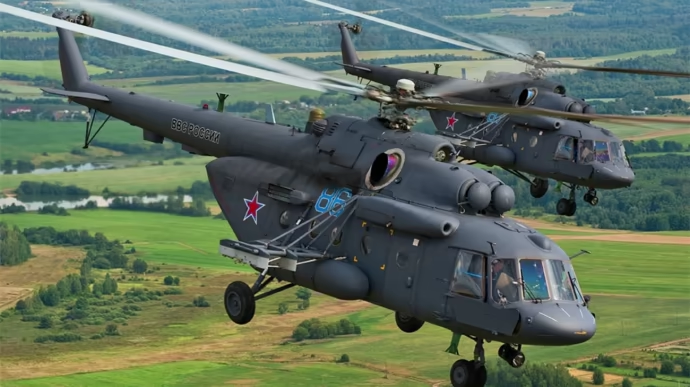
Post-flight inspection found "numerous damages to the right side, a 20×30 cm through-hole in the tail boom, severed cable runs and the HF radio antenna cable; in the cargo cabin, a flat fragment measuring 21×25 cm was found, which had punched through the sliding door on the right, the SLG-300 mounting, and struck the armored plate of the cockpit door."
Other incidents
The document also records a Su-35S that, while taxiing out of a hardened aircraft shelter on 5 January 2026, clipped the shelter gate with its right wingtip, damaging the fairing of its Khibiny (L-265) electronic warfare system transmitter. A MiG-31BM on 5 January blew its right main landing gear tire during braking after its drag chute failed to deploy.
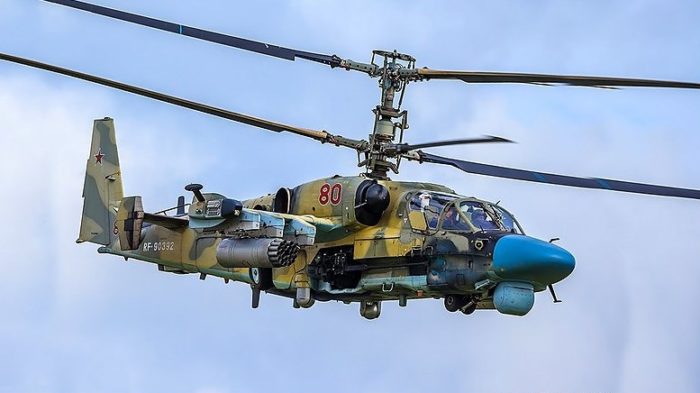
An Su-34 on 1 January overran the runway by 70 m after the crew aborted takeoff due to a loss of airspeed indication. A Tu-134A cracked its commander's windscreen on the 13th minute of flight. A Ка-52M suffered a full hydraulic system failure during a night "special flight" and made a field landing.


