


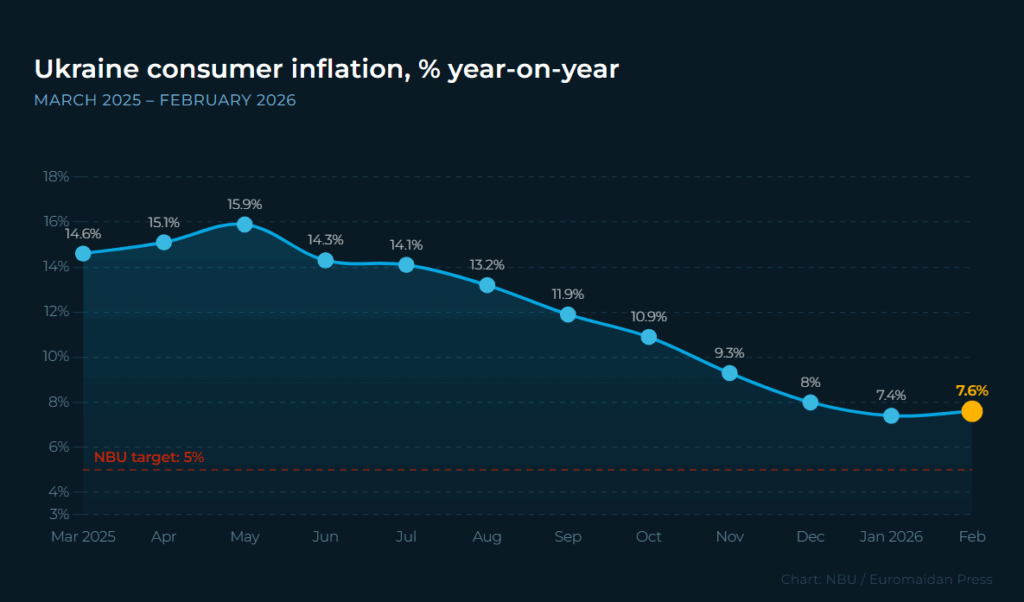
Ukraine’s consumer prices rose 7.6% year-on-year in February 2026, slightly above the National Bank of Ukraine’s forecast trajectory, as fuel costs surged on rising European energy benchmarks and a weaker hryvnia.
The NBU pointed directly to rising geopolitical tensions in global energy markets as the driver of February’s fuel price surge.
The overshoot was narrow—core inflation held exactly on the NBU’s target at 7.0%—but it ends a streak in which Ukraine had met or beaten its own projections for several months running.
The new variable isn’t domestic. The NBU pointed directly to rising geopolitical tensions in global energy markets as the driver of February’s fuel price surge—pressure that Ukrainian monetary policy can contain at home but cannot control abroad. For a central bank that just began easing rates, that distinction matters.
What pushed prices higher in February
According to the State Statistics Service of Ukraine’s express release published on 10 March, consumer prices rose 1.0% month-on-month in February, with the year-on-year reading coming in at 7.6%. In its February inflation comment, the NBU attributed the above-forecast reading to three drivers: fuel, services, and raw food.
The central bank cited rising European price benchmarks driven by increased geopolitical tensions.
Fuel inflation jumped to 8.0% year-on-year—its sharpest acceleration in months. The central bank cited rising European price benchmarks driven by increased geopolitical tensions, compounded by exchange rate effects from a weaker hryvnia. Liquefied petroleum gas (LPG) remained relatively stable due to low demand and a market surplus, but petrol and diesel led costs higher.
Raw food prices rose 9.6% year-on-year for the second consecutive month.
Services inflation accelerated to 12.3% year-on-year, with mobile communications costs the primary driver. The NBU linked the increase to Ukraine’s difficult energy situation, which raises operating costs for telecoms infrastructure.
Raw food prices rose 9.6% year-on-year for the second consecutive month, driven by cucumbers and tomatoes—where import costs are rising—alongside accelerating price growth for fruit, including bananas and citrus. Pork and chicken price growth slowed, providing a partial offset.
Where discipline is holding
Processed food inflation continued to slow, reaching 9.9% year-on-year, as dairy prices stabilized amid increased import competition, while sunflower oil and confectionery recorded slower price growth. Non-food goods prices continued to fall, down 0.4% year-on-year—underpinned by exchange rate stability.
What domestic monetary discipline can control, it is controlling.
Administrative prices—regulated tariffs—slowed to 8.8% year-on-year, as tobacco and pharmaceutical price growth eased.
Core inflation, which strips out volatile food and energy components, came in at exactly 7.0%—precisely in line with the NBU’s January forecast. What domestic monetary discipline can control, it is controlling.
Trending Now
What the central bank is watching next
The NBU described February’s result as “moderate and close to forecast” but flagged that proinflationary risks had intensified over the past month.
It cited rising global geopolitical tensions and increased energy price volatility as factors that could push inflation off its projected path, noting both would be incorporated into the next monetary policy decision.
Ukraine brought inflation down from a 15.9% peak in May 2025 to 7.6% by February.
In January 2026, the central bank cut its key policy rate from 15.5% to 15%—its first easing since March 2025. February’s data does not rule out further cuts, but it narrows the margin of comfort.
Ukraine brought inflation down from a 15.9% peak in May 2025 to 7.6% by February—a nine-month run that shows what the institution can do when the pressure is domestic.

For now, that pressure is not domestic. The NBU’s forward-looking language is unusually direct for a central bank: external shocks are now explicitly on the table alongside rate decisions.
A central bank that just began cutting rates is publicly flagging that the world outside Ukraine’s borders may force it to stop. That is the global story inside a domestic data release—and it remains open.


