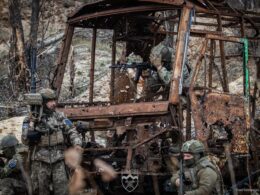

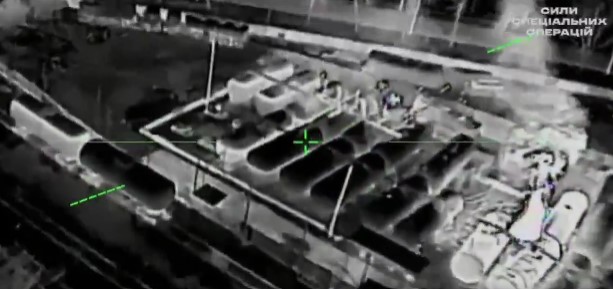
The Ukrainian Special Operations Forces have reported they have carried out a series of precision strikes on Russian military facilities in the temporarily occupied cities of Makiivka and Donetsk.
The strikes targeted fuel infrastructure and electronic warfare systems, which directly affect the enemy’s ability to supply its troops and counter Ukrainian drones.
Resistance movement helps identify targets
Representatives of the Ukrainian Resistance Movement, operating in the occupied territory of Donetsk Oblast, played a key role in the operation by helping identify the targets.
After receiving intelligence data, Ukrainian Front-strike units attacked a fuel storage base and a distribution and supply point for fuel and lubricants in Makiivka.
The destruction of such facilities complicates the supply of fuel and logistics for Russian forces.
“Volna-3” disabled: Ukraine's drones destroy Russian EW system in Donetsk
In nearby Donetsk, Ukrainian drones struck a Volna-3 electronic warfare station. Russia used this system to jam the control channels of Ukrainian UAVs, creating interference on communication frequencies.
This often caused drones to lose control or miss their targets.
Destroying such a system weakens the protection of Russian units from Ukrainian drones and opens more opportunities for strikes on the enemy's rear infrastructure.
“Asymmetric war of attrition”: Ukrainians continue targeting critical enemy nodes
Ukrainian defense officials say such operations are part of an asymmetric strategy aimed at gradually exhausting Russia’s military capabilities.
The destruction of fuel infrastructure, logistics hubs, and electronic warfare systems in the rear reduces the combat effectiveness of frontline units.
Battle for Pokrovsk and the Kremlin’s plans
The capture of Donetsk Oblast remains a Russian priority. It will continue efforts to seize it entirely during the spring-summer offensive campaign. One of the key directions remains Pokrovsk, where Ukrainian forces maintain positions in the northern part of the city.
Russian troops are attempting to bypass Ukrainian defenses from Rodynske (on the eastern flank) and Hryshyne (on the western flank). If they manage to create an encirclement, the next stage could be an advance toward Dobropillia.
Final objective: the Sloviansk–Kramatorsk agglomeration
After Pokrovsk, Russian forces may attempt to push toward Kostiantynivka, while pressure is also expected on Lyman, Sloviansk, and Kramatorsk.
The Sloviansk–Kramatorsk agglomeration remains the key defensive hub. Capturing it would require Russia to claim full control over Donetsk Oblast.
“Deadline – 1 April”: Kremlin’s plan appears unrealistic
According to available information, the Russian command has tasked its forces with completing the capture of Donetsk Oblast by 1 April, writes Denys Popovych for Slovo i Delo.
However, given the current battlefield situation, achieving this objective within the set timeframe appears highly unlikely. At the same time, similar deadlines have previously been postponed multiple times, suggesting that Russia is unlikely to abandon its offensive plans in Donbas.