

Ukraine's Ministry of Foreign Affairs (MFA) released a detailed account on 9 March of how Hungary treated seven Oschadbank employees detained four days earlier, calling Hungary's actions "unacceptable" and equating them with "hostage-taking and theft of property." The couriers returned to Ukraine — the bank's $82 million in cash and gold did not.
Hungary sent an APC against unarmed bank workers
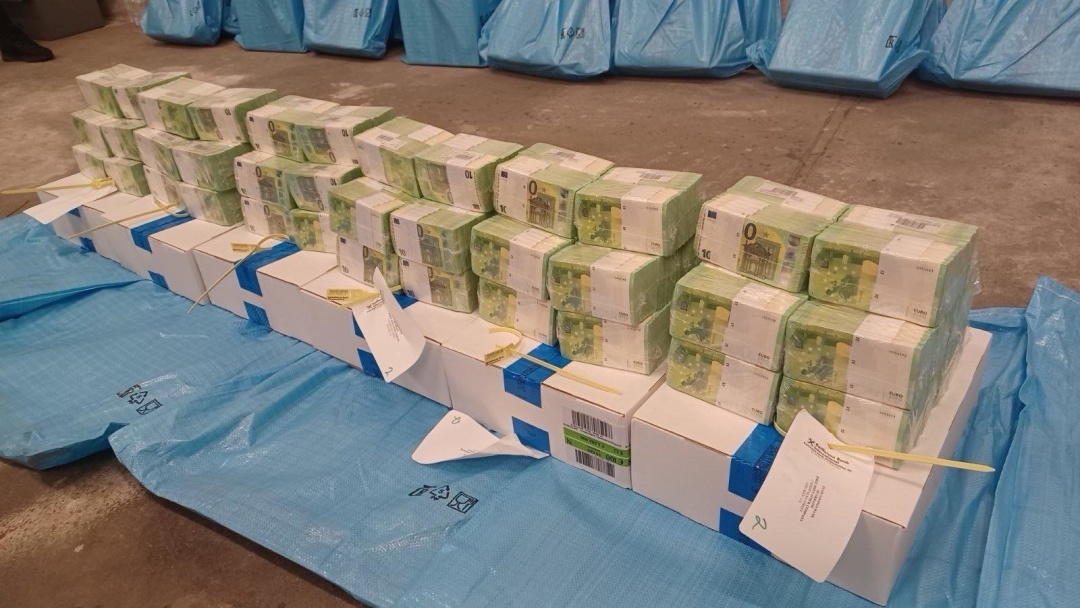
On 5 March, Hungary's Counter-Terrorism Centre (TEK) intercepted two Oschadbank armored vehicles on the Budapest ring road. The convoy was transporting valuables from Vienna to Ukraine under an international contract between Raiffeisen Bank International AG (Austria) and Oschadbank, fully documented under European customs procedures. Hungary knew the couriers were unarmed, the MFA said. TEK deployed an armored personnel carrier (APC) for the interception. Its officers carried machine guns and grenade launchers.

28 hours blindfolded, interrogated in Russian
According to the MFA, Hungary held the seven employees as witnesses throughout — it never charged them with a crime. Despite that status, TEK kept them handcuffed for 28 hours and transported them blindfolded the entire time.
Hungarian forces confiscated personal belongings, including mobile phones. The couriers could not contact their families, the Ukrainian Embassy, or their employer. The MFA says most items were never returned.

Orbán’s Hungary robbed Ukraine’s state bank of $82 million — Oschadbank launches international legal fight to recover it
Hungary also denied the detainees legal counsel — ignoring both their requests and appeals from a lawyer they had hired. Consular access was blocked too. Hungary's National Tax and Customs Service investigative unit initially told the Ukrainian Embassy that a consul could attend proceedings with the detainees; after that, the MFA said, Hungarian officials either avoided contact with Embassy staff entirely or gave false information about the detainees' whereabouts.
Hungarian law enforcement denied the couriers the right to testify in their own language. Instead, they addressed them in Russian.
A diabetic courier received no care until he passed out
Trending Now
One detainee has a disability, requires a special diet, and takes regular medication. Hungary provided no medical assistance until he lost consciousness, the MFA said. After he passed out, Hungarian personnel forcibly injected him with a substance that caused his blood sugar to spike sharply and triggered hypertension. He required hospitalization.

Fico: “Slovakia is ready to take over the baton from Hungary, if necessary” — on blocking EU’s Ukraine loan and Russia sanctions
Deported as witnesses, banned from Europe for three years
Hungary held all seven couriers as witnesses — never as suspects. On 6 March, at the submission of Hungary's Constitution Protection Office, Hungary deported all seven and imposed a three-year Schengen area entry ban. The MFA said the ban appears to be punishment for their refusal to provide the testimony Hungary sought.
Since Hungary could not charge them, it used immigration proceedings to expel them — and kept the convoy's two armored vehicles, $40 million, €35 million, and 9 kg of banking gold as evidence in a money-laundering investigation targeting an unnamed perpetrator, per Oschadbank's lawyers cited by Euronews.
Ukraine demands assets back and a European-level response
The MFA called Hungary's actions a cynical violation of the European Convention on Human Rights (ECHR), the Vienna Convention on Consular Relations, and the Ukrainian-Hungarian consular convention. It demands the immediate return of the bank's vehicles and all seized assets, and accountability for every official responsible for the detention, mistreatment, and theft of property. Ukraine will pursue justice through all available national and international legal means, the MFA stated, and reserves the right to take appropriate response measures.
Oschadbank is pursuing two parallel legal tracks: challenging the entry bans Hungary imposed on its staff and taking formal steps to recover the assets, the bank announced. It has also commissioned an independent audit by an international firm covering all contractual relations in the transfer. The bank's lawyers told Euronews that the three-year EU entry ban could form the basis of a case before the European Court of Human Rights (ECHR).
Read also
-
Hackers attack Ukraine’s Oschadbank after Hungary robbed it of $82 million, and opposition says Russian agents already in Budapest
-
Putin sends election fixers to Budapest to keep Orbán’s Kremlin veto alive
-
Hungary abducts Ukrainian state bank employees along with cash-in-transit vehicles amid pressure over Russian oil


