

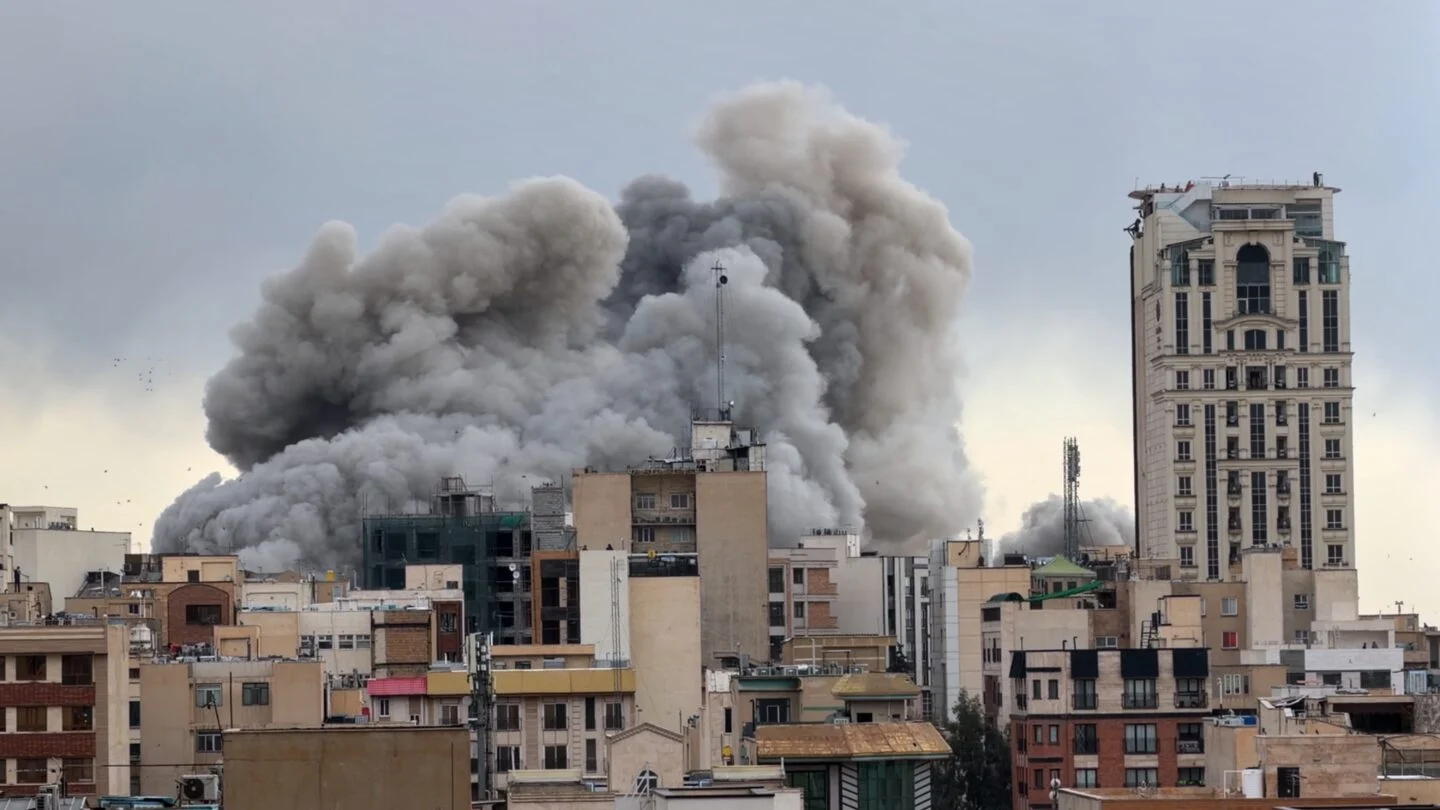
The sudden escalation of war between the United States, Israel and Iran has reshaped the global strategic landscape almost overnight. While the immediate consequences are unfolding across the Middle East, the shockwaves are already reaching the battlefields of Ukraine.
The front lines have moved slowly, measured in kilometers rather than breakthroughs, while diplomacy has hovered uneasily in the background.
The most immediate effect may be one that few anticipated: a strategic pause in Europe’s largest war.
For more than three years, the conflict between Russia and Ukraine has been characterized by relentless military pressure. The front lines have moved slowly, measured in kilometers rather than breakthroughs, while diplomacy has hovered uneasily in the background. Yet the sudden emergence of a major Middle Eastern war forces both Kyiv and Moscow to reassess the environment in which that war is being fought.
The windfall Moscow didn’t plan for
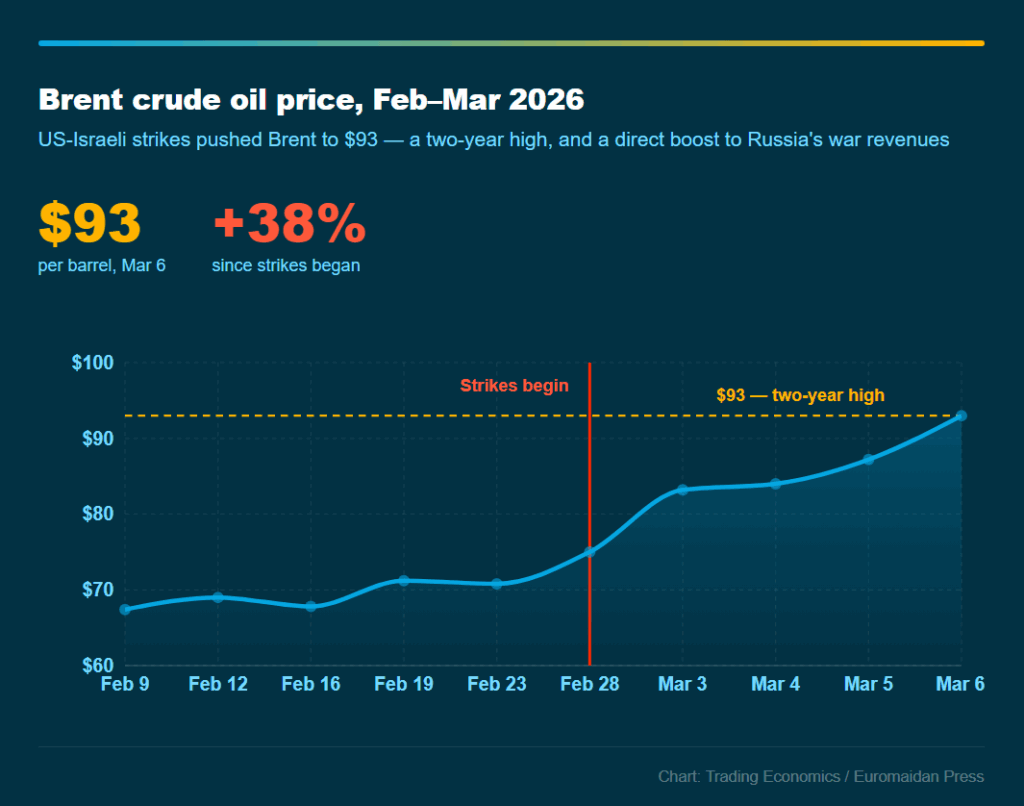
Financial markets reacted instantly. Within days of the first strikes on Iranian infrastructure, Brent crude rose above $93 per barrel for the first time since 2023. Maritime insurers increased risk premiums for vessels passing through the Persian Gulf and Strait of Hormuz, while energy analysts warned that even limited disruption could remove several million barrels per day from global markets.
For Russia, whose war economy remains heavily dependent on hydrocarbon revenues, rising oil prices are not merely an economic development but a strategic windfall.
The Middle Eastern crisis arrives at a convenient moment for Moscow, offsetting some of the pressure imposed by Western sanctions.
As several analysts have already noted, higher energy prices directly strengthen Moscow’s fiscal position. Russia’s federal budget still depends heavily on oil and gas receipts; every sustained increase in global prices expands the Kremlin’s capacity to finance its war effort. In that sense the Middle Eastern crisis arrives at a convenient moment for Moscow, offsetting some of the pressure imposed by Western sanctions.
But the implications run deeper than energy markets.
The new war introduces a profound level of uncertainty into global politics. Neither Kyiv nor Moscow anticipated that Washington would initiate a military campaign capable of destabilizing one of the world’s most critical energy regions. For both sides, the sheer scale of the geopolitical shock requires a reassessment of strategy.
How much attention, money, and military capacity will the West still devote to Ukraine if a large regional war unfolds simultaneously in the Middle East?
That reassessment may already be visible in the tempo of events. Ukrainian officials have emphasized the importance of maintaining Western attention on their war even as global headlines shift toward Iran. Russian state media, meanwhile, has rapidly pivoted to coverage of the Middle East, portraying the crisis as evidence of American recklessness and Western instability.
Behind the rhetoric, both sides are likely watching the same question: how much attention, money and military capacity will the West still devote to Ukraine if a large regional war unfolds simultaneously in the Middle East?
Washington the unreliable mediator
This is where the most uncomfortable implication of the Iran crisis emerges. For Kyiv, the United States is not only the principal supplier of advanced weapons and financial assistance. It is also the central diplomatic actor in any future negotiations over the war.
Yet Washington has just demonstrated something that inevitably complicates that role. A state capable of launching major military operations against Iran on short notice is a mediator whose strategic priorities can shift abruptly—and whose security guarantees may be worth less when it is already engaged in a conflict elsewhere.
Kyiv’s diplomatic strategy since 2022 has relied on the assumption of sustained American leadership in the Western coalition.
For Ukrainian policymakers, this introduces an element of unpredictability that did not previously exist. Kyiv’s diplomatic strategy since 2022 has relied on the assumption of sustained American leadership in the Western coalition—including the provision of security guarantees in any eventual peace agreement. Whether those guarantees retain their value while Washington is managing a second major conflict is now a live question Zelenskyy’s team cannot ignore.
President Volodymyr Zelenskyy therefore faces a delicate balancing act. On one hand, Ukraine cannot afford to criticize Washington’s actions or undermine the alliance upon which its survival depends. On the other hand, Kyiv must quietly adapt to the possibility that American resources, political capital and diplomatic attention may be partially redirected toward the Middle East.
If American attention becomes less reliable, Europe must become more capable.
That adaptation may already be underway. Ukrainian officials have increasingly emphasized direct cooperation with European governments, particularly on air defense systems, ammunition production and financial assistance for sustaining the Ukrainian state budget. The logic is straightforward: if American attention becomes less reliable, Europe must become more capable.
Europe’s moment—and its weakness
Yet Europe’s role in this evolving situation remains dangerously underdeveloped.
If the United States becomes absorbed by a prolonged confrontation with Iran, the burden of sustaining Ukraine will inevitably fall more heavily on European states. That means not only political declarations of support but concrete commitments: accelerated ammunition production, expanded air defense deliveries and financial bridging mechanisms capable of sustaining the Ukrainian government through extended periods of uncertainty.
Ammunition production initiatives have expanded, but not yet at the level required to sustain a prolonged high-intensity war without substantial American support.
Europe has taken steps in this direction—the EU’s rearmament push and bilateral defense agreements with Kyiv are real—but the pace remains far below what a scenario of reduced American engagement would actually require.
The challenge is that Europe has struggled for three years to move from declarations to industrial scale. Ammunition production initiatives have expanded, but not yet at the level required to sustain a prolonged high-intensity war without substantial American support. Air defense systems remain limited and expensive. Financial assistance continues to depend on complex negotiations within European Union institutions.
The danger created by the Iran war is therefore not simply distraction. It is the exposure of Europe’s continuing dependence on American leadership.
Why Moscow may also want to wait
For Moscow, the calculus is different but equally complex. Rising energy prices strengthen Russia’s fiscal position, and the diversion of Western attention potentially eases political pressure. Yet the Kremlin also faces uncertainty.
A prolonged war involving the United States, Israel and Iran could destabilize regions where Russia has its own interests—from Syria to the South Caucasus to the Persian Gulf. It could also introduce new volatility into global markets upon which Russia’s war economy depends.
Rather than seeking dramatic escalation in Ukraine while global attention is elsewhere, the Kremlin may find it advantageous to consolidate existing territorial gains.
For that reason Moscow may also prefer a period of strategic patience. Rather than seeking dramatic escalation in Ukraine while global attention is elsewhere, the Kremlin may find it advantageous to consolidate existing territorial gains and allow geopolitical developments to unfold.
The result could be a temporary slowing of strategic decision-making on both sides.
Not a ceasefire, not a negotiated settlement, but a quiet recalibration of expectations while the world waits to see how the Middle Eastern war develops.
Yet global politics does not always respect regional priorities.
If that happens, the war in Ukraine risks entering a dangerous new phase: not escalation, but gradual marginalization.
For Ukrainians, the stakes remain existential. For Europeans, the war remains the central security crisis on their continent. Yet global politics does not always respect regional priorities. If the confrontation with Iran evolves into a prolonged conflict involving maritime security, energy infrastructure and multiple regional actors, the gravitational pull of that crisis will inevitably reshape international attention.
What has to happen now
This is precisely why Europe must act now rather than later.
If Kyiv is to retain leverage in any future negotiations, it must demonstrate that the war cannot simply be placed on the geopolitical back burner. Sustained military pressure on Russian forces remains essential. Continued progress in domestic arms production is equally critical.
Once the world stops watching, wars rarely end quickly.
Most importantly, European states must ensure that Ukraine’s financial and military lifelines remain secure regardless of shifts in American policy—and must begin planning now for the possibility that those shifts are already underway.
A frozen conflict created by diplomatic negotiation is one thing. A frozen conflict created by global distraction is something far more dangerous. Because once the world stops watching, wars rarely end quickly. They simply harden into the landscape.

Editor's note. The opinions expressed in our Opinion section belong to their authors. Euromaidan Press' editorial team may or may not share them.
Submit an opinion to Euromaidan Press


