
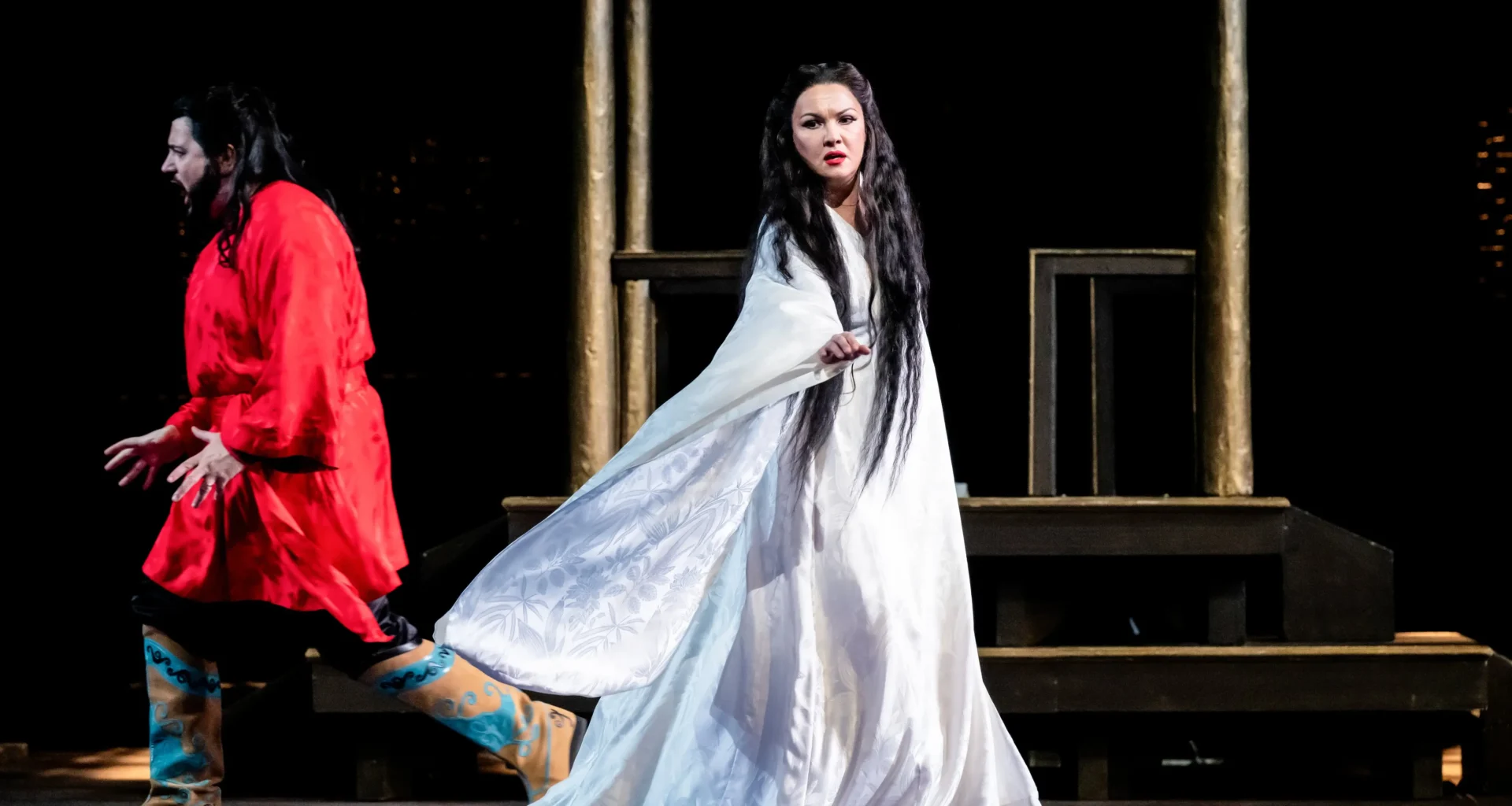

When Ukraine's ambassador to the United Kingdom formally objected to a Kremlin-linked soprano performing at London's Royal Opera House, the UK Foreign Office had a choice. It could take the objection at face value—a formal diplomatic intervention from an allied nation at war. Or it could reframe it.
It reframed it.
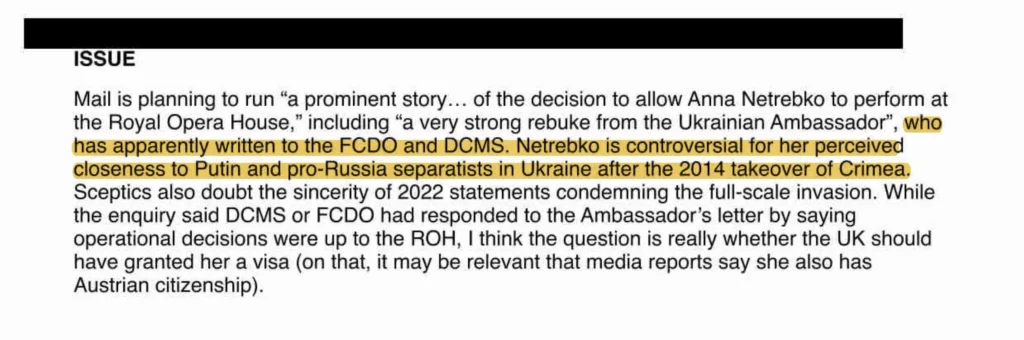
An internal email obtained through Freedom of Information shows the Foreign, Commonwealth and Development Office (FCDO) summarized Ambassador Valerii Zaluzhnyi's objections as concerning Anna Netrebko's "perceived closeness to Putin and pro-Russia separatists in Ukraine."
Four years into Russia's full-scale war against Ukraine, FOI documents from five UK government bodies and the Charity Commission reveal that no department, funding body, or regulator has built any process for determining whether public money underwrites performers sanctioned by an allied nation—or for recognizing how Russia uses cultural prestige to launder its wars of aggression.
The UK, despite positioning itself as Ukraine's foremost ally, has no government capacity to process the cultural dimension of a hybrid war it claims to be helping fight.
This is the paper trail of what that looks like in practice.
What Zaluzhnyi actually raised
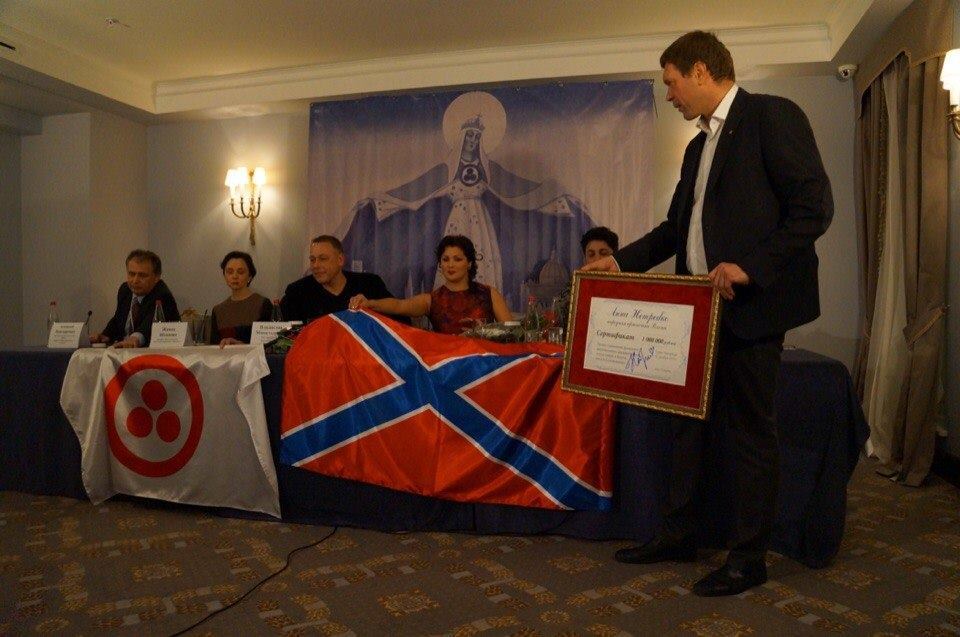
Netrebko served as a trusted representative for Putin's 2012 presidential campaign. She has received numerous Russian state honors. In 2014, she was photographed holding the flag of the "Novorossiya" movement—the Kremlin's project for seizing southern Ukraine—and donated one million rubles to a theater in Russian-occupied Donetsk.
She posed with Oleg Tsarev, the insurgent leader Russia tasked with disintegrating eastern Ukraine, who was subsequently placed on EU and US sanctions lists.
On the basis of this record—the campaign role, the state honors, the Novorossiya flag, the Donetsk donation—Ukraine's National Security and Defence Council placed Netrebko under sanction in January 2023, alongside 118 other Russian cultural and public figures. The sanctions freeze any assets in Ukraine and ban entry for ten years.
Ukraine's ambassador to the UK raised all of these points. The FCDO assessed this as "perceived closeness to Putin and pro-Russia separatists."

The FCDO email, dated 5 September and sent across the FCDO, the Department for Culture, Media and Sport (DCMS), and the Home Office, was seeking clearance for a response to a Daily Mail correspondent. The story in progress was Zaluzhnyi's own op-ed, published on 7 September, titled: How Russian soprano's voice will drown out the real cries of Ukrainians as the Royal Opera House 'betrays' millions.
The internal email notes that Zaluzhnyi "has apparently written to FCDO and DCMS" raising objections to Netrebko's engagement. His formal diplomatic intervention through proper channels became, in the FCDO's internal framing, something he "apparently" did.
The email also states that "sceptics also doubt the sincerity of 2022 statements condemning the full-scale invasion"—referring to Netrebko's Facebook post in late March 2022, five weeks into Russia's full-scale invasion, in which she wrote that she "expressly condemns the war against Ukraine." That statement came only after the Metropolitan Opera in New York, La Scala, the Bavarian State Opera, and other major venues had already dropped her.
Among the "sceptics" doubting its sincerity: the National Security and Defence Council of Ukraine, which sanctioned her ten months later.
"Angry discourse" and "Ukraine-linked groups"
The pattern of dismissal extends beyond the FCDO.
Arts Council England (ACE) is Europe's largest arts funding body. It distributes over £23 million (₴1.35 billion) of public and National Lottery money annually to the Royal Opera House—making the venue ACE's single largest funding recipient in the country.
Heavily redacted documents disclosed through FOI show correspondence between ACE and the Royal Opera House demonstrating clear awareness of concerns about Netrebko—including links to articles detailing her ties to the Russian state, to Putin personally, and to her donation to separatist-linked causes in occupied Donetsk.
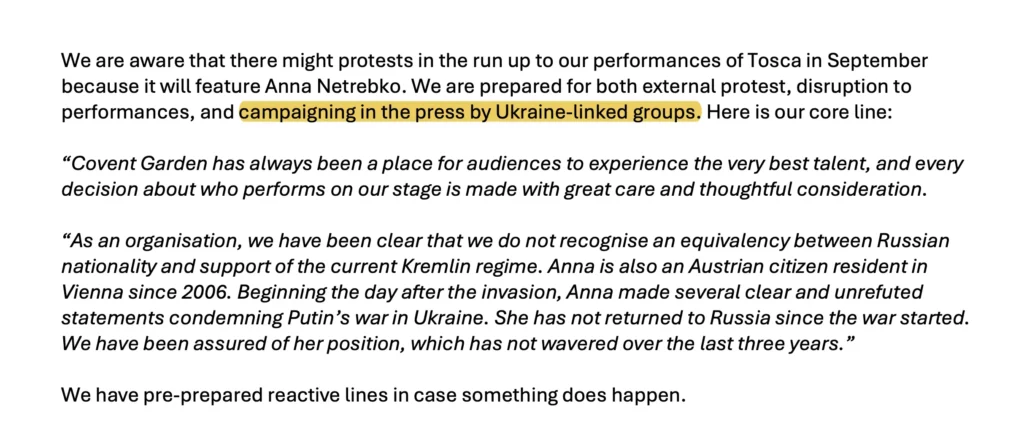
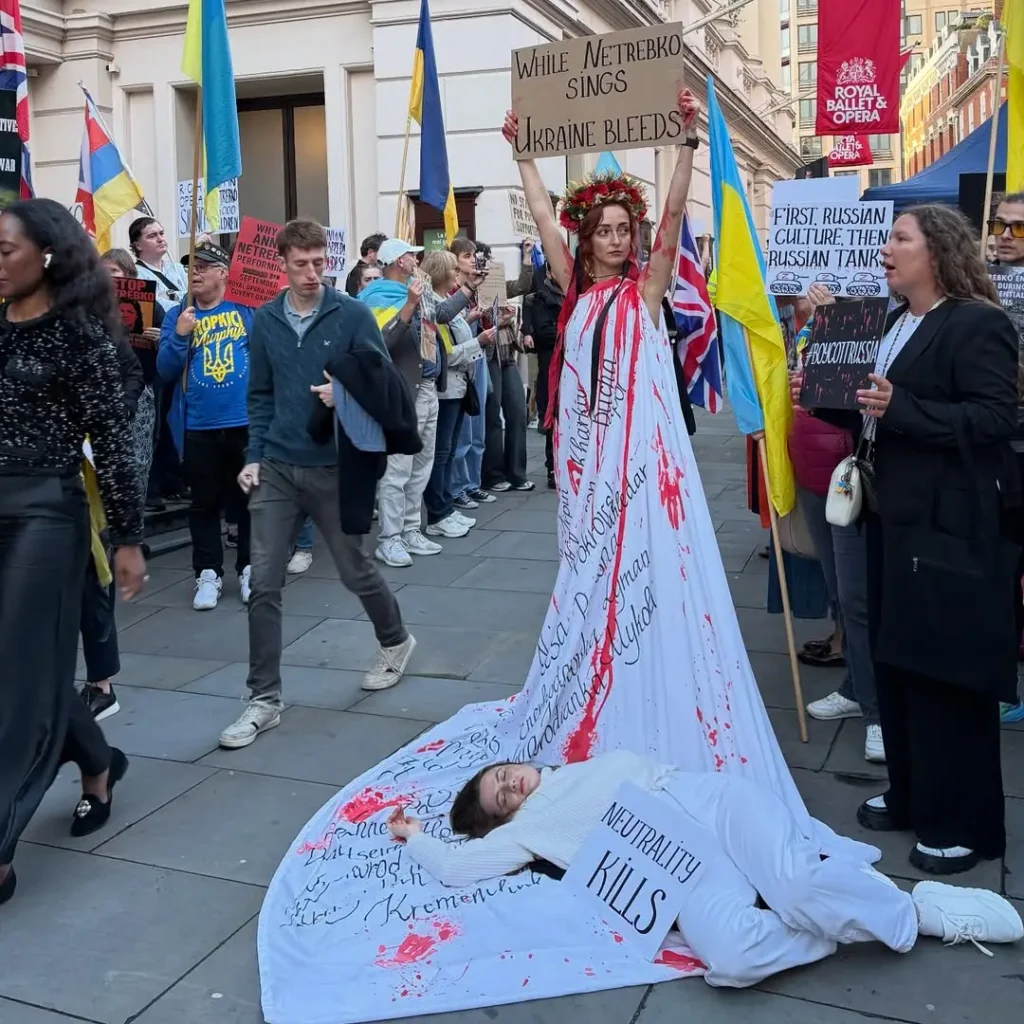
Arts Council England's internal emails asked whether they should give Netrebko a heads up about protests against her performance in London
The Royal Opera House's chief executive, Alex Beard, had already attracted attention for recasting the organization's former support for Ukraine as "aligned with the global consensus at the time"—a remark widely interpreted as signaling that the consensus had shifted.
ACE's disclosure goes further.

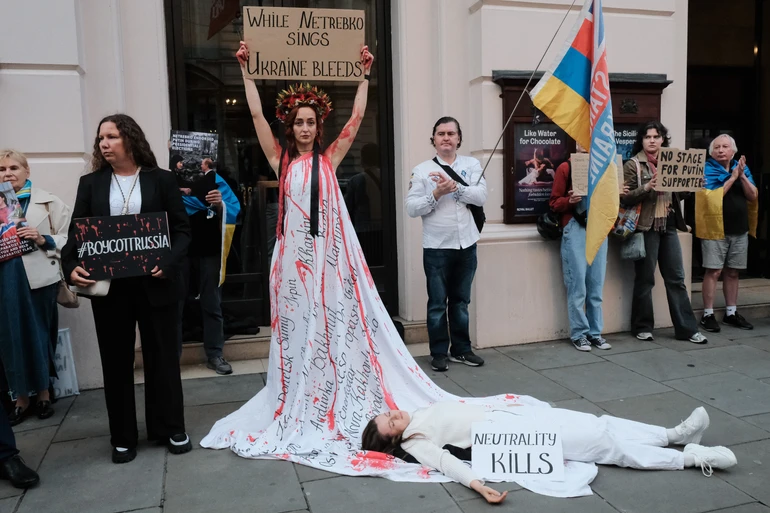
Internal emails ask whether "we should give her [Netrebko] a heads up?"—appearing to prioritize the singer's comfort—and describe those objecting as "angry discourse" and "campaigning in the press by Ukraine-linked groups," from whom disruption to performances was anticipated.
Those dismissed as "angry discourse" and "Ukraine-linked groups" include:
- A cross-party group of seven UK Members of Parliament, among them former culture secretary John Whittingdale;
- Sergiy Kyslytsya, former Ukrainian Permanent Representative to the UN and current First Deputy Foreign Minister of Ukraine;
- Dr Daria Mattingly, a Cambridge academic specializing in the Holodomor;
- Leaders and founders of major institutes and NGOs;
- Two dozen creative professionals;
- And former New Zealand Prime Minister, UNDP Administrator, and 2016 candidate for UN Secretary-General Helen Clark.
These individuals signed an open letter published by The Guardian on 14 August calling on the Royal Opera House to reconsider.
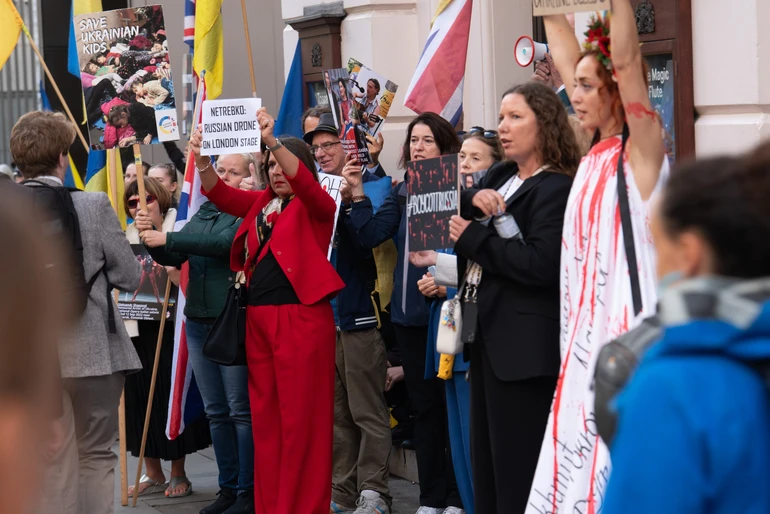
It received no public response from the venue. Disclosed emails suggest it received no internal consideration either, despite repeated street protests.
Also absent from ACE's disclosure: policy documents referenced in the emails, a "risk mitigation plan," and an attachment titled "Protest Social Media Report PDF.pdf"—all of which should have fallen within the scope of the FOI request.

So did UK taxpayers pay?
The UK government's standard defense—that "operational and artistic decisions are taken by individual organisations independently of the government"—runs into a problem on page two of the Royal Opera House's latest public accounts.
Those accounts record £22.3 million in unrestricted grant funding from ACE and a further £673,000 in restricted funding. The venue also continues to repay a 20-year, £21.7 million Culture Recovery Fund loan at an interest rate far below any commercial equivalent. This is taxpayer money, flowing through a publicly funded arm's-length body, to an institution that invited a performer sanctioned by an allied nation.
The government's claim that it plays no role in such decisions is directly contradicted by the paper trail showing its bodies discussing and acting on those very decisions.

When I asked DCMS in November whether "any public funds, grants, or other financial support provided directly or indirectly by HM Government (including through Arts Council England) have been used to support, underwrite, or pay fees associated with any engagement or performance by Netrebko," the response was that DCMS "does not have information within scope of your request."
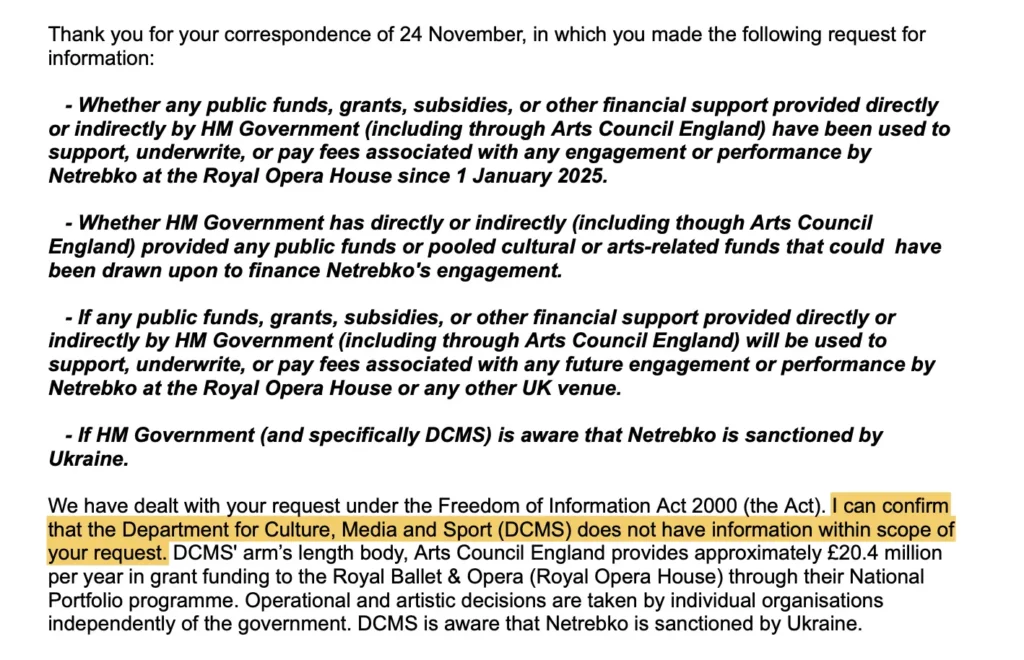
This is the department that sponsors and oversees Arts Council England and holds direct responsibility for public spending in the cultural sector.
ACE's position was that its National Portfolio Organisation award "is not restricted funds so they can apply it against any activity they wish. Decisions on which artists NPOs hire rest entirely with NPO leadership and boards."
HM Treasury—responsible for the UK's sanctions regime and national budget allocation—also returned "no information held."
No department or body has confirmed that public money was not used to fund Netrebko. None can. The question has no mechanism to be answered—because in four years of full-scale war, no one built one.
The CEO who knew but didn't know
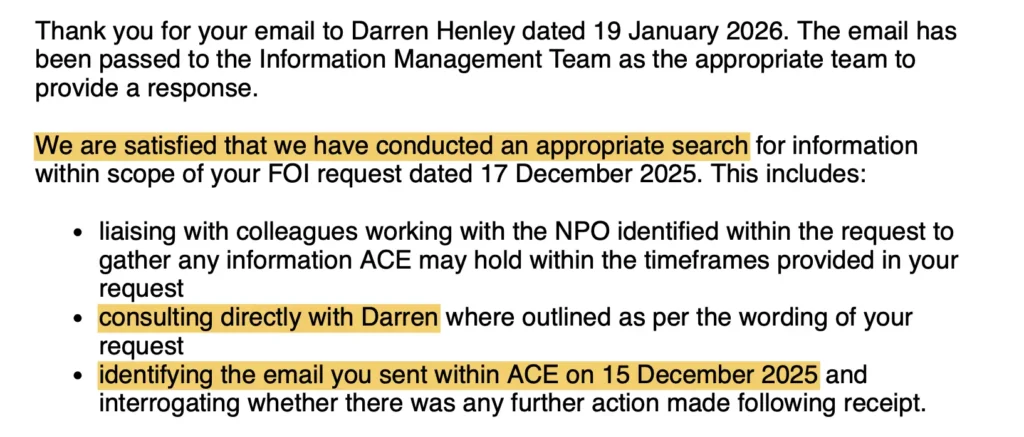
ACE's chief executive, Darren Henley, was made personally aware of Netrebko's sanctioned status on 3 October, 15 December, and 17 December during this investigation. Yet an FOI response as recent as last month continued to state that ACE holds no information on whether she is sanctioned by Ukraine.
When I asked Henley directly whether, as CEO, he would warrant the accuracy of that response, an unnamed reply arrived a week later stating that ACE was "satisfied we have conducted an appropriate search," including "consulting directly with Darren" and "identifying the email you sent within ACE on 15 December."
Trending Now
That email—the one ACE confirmed finding—explicitly referenced Netrebko's sanctioned status. The same response confirmed that ACE holds no records of whether Henley has undertaken any sanctions training.
The department that forgot what it knew
DCMS initially appeared unaware of the issues surrounding Netrebko. An internal email dated 1 April—sent shortly before the Royal Opera House announced her inclusion in its season—described her simply as "a Russian soprano who has publicly voiced her opposition to the war in Ukraine."
By mid-August, both ACE and DCMS were aware of Netrebko's links to the Russian state and separatist causes.
By October, both were aware of her sanctioned status. She was granted leave to enter the UK again for December performances regardless.
Neither body checked whether public money was funding her appearances, nor formally recorded a decision not to act.

A Freedom of Information response from DCMS dated 22 December confirmed the department was aware Netrebko was sanctioned by Ukraine. A later response dated 22 January—addressing the same question—stated that the department holds no information.

The January response, directly contradicting the December one, was accompanied by internal correspondence referencing my communications with the department and her status as a sanctioned person. It also confirmed that DCMS's Permanent Secretary, Susannah Storey, has not received any training related to sanctions.

Separate correspondence from DCMS about Netrebko's December engagement reiterated that the invitation was the Royal Opera House's decision, before adding: "We cannot let aggressors like Vladimir Putin succeed."
That framing—naming Putin as the aggressor while distancing the singer who served as his campaign representative—sits uncomfortably alongside the department's documented inaction.
"The Ukraine"
HM Treasury initially applied exemptions to withhold much of the information I requested—including material already disclosed by other departments—before stating: "HM Treasury does not maintain a list of sanctions in other countries."

The Treasury then referred to Ukraine as "the Ukraine" in an official response that required internal clearance and sign-off. This formulation, associated with the denial of Ukrainian sovereignty, is commonly used by Russia and its proxies.
When the department's most senior official was asked whether this would be corrected, no response came. An updated document was issued ten days later, without comment or acknowledgment.
The Charity Commission doesn't bat an eye
The Royal Opera House itself is not subject to Freedom of Information laws. As a registered charity, it is regulated by the Charity Commission. I submitted a complaint on the grounds that Netrebko's engagement was damaging to the charity's reputation and contrary to good governance. The Commission dismissed it, citing its role as a "risk-led regulator" and concluding the issue did not pose sufficient harm to public trust. When I later presented detailed evidence, the Commission provided no further response.
A subsequent request produced written confirmation that the Commission was aware Netrebko was sanctioned—and had been since 20 September 2025. It would not confirm whether its chief executive was personally aware, nor whether her status had been discussed with the Royal Opera House, ACE, DCMS, or the FCDO. The chief executive was made personally aware during this investigation on 4 October and again on 15 December.
The Commission confirmed it had taken no regulatory action.
The Cabinet Office—responsible for government standards and answerable to the Prime Minister—did not respond to my FOI request. It did not respond to a follow-up two months later.
The pattern
From the Foreign, Commonwealth and Development Office: documented evidence that a formal diplomatic objection by Ukraine's ambassador—grounded in publicly verifiable conduct and an active sanctions designation—was internally reframed as concern about "perceived closeness."
From the Department for Culture, Media and Sport: contradictory positions on whether it knew Netrebko was sanctioned, set out in formal FOI responses issued one month apart. The only thing the department appears certain of is that it does not know whether public money funded her performances—because it has no mechanism to find out.
From Arts Council England: distancing language about responsibility, contradicted on page two of the Royal Opera House's own public accounts. Formal responses that are as demonstrably false as they are confidently asserted. A CEO personally informed three times, with no record that he acted.
From HM Treasury: confirmation that Ukrainian sanctions are irrelevant to UK considerations, and official correspondence referring to Ukraine as "the Ukraine"—corrected only after challenge and without explanation.
From the Charity Commission: confirmed knowledge of Netrebko's sanctioned status, evidence of awareness at senior level, and confirmed regulatory inaction—alongside refusal to confirm whether discussions took place.
And from the Prime Minister's office: nothing.
At no point during this investigation has any party stated that it stands with Ukraine and the Ukrainian people—even when asked directly. That position appeared only once, in a single DCMS response, and only after I drew attention to its absence.
Russia has long used cultural prestige as a tool of soft power—lending its artists to the world's most celebrated stages to project an image of civilization while waging war.
Artists like Netrebko are not incidental to this strategy. They are the strategy.
As Zaluzhnyi himself wrote, her voice "was supposed to show that Russia is civilized, modern, and worthy of applause." Four years into a full-scale invasion, the UK has not built a single process, across any department, to recognize this mechanism—let alone counter it.
The country that calls itself Ukraine's strongest ally has no organ for understanding how hybrid warfare operates on a cultural stage.
The UK has positioned itself as Ukraine's strongest ally. But being an ally is not a statement—it is what you do when Ukrainians raise an objection and nobody is watching. The documents show what that looks like behind closed doors: dismiss, mischaracterize, forget.
Objections were raised before Netrebko's September performances. They proceeded.
Further objections were raised before her December performances. They proceeded.
She is scheduled for a solo recital at the Royal Opera House on 24 June. This time, there is no basis to claim ignorance. Netrebko's performances must be cancelled.
The central question is when the Ukrainian people can expect an apology—and when the United Kingdom will treat its obligations as an ally as substantive rather than performative.
The full FOI correspondence underlying this investigation is available here.


