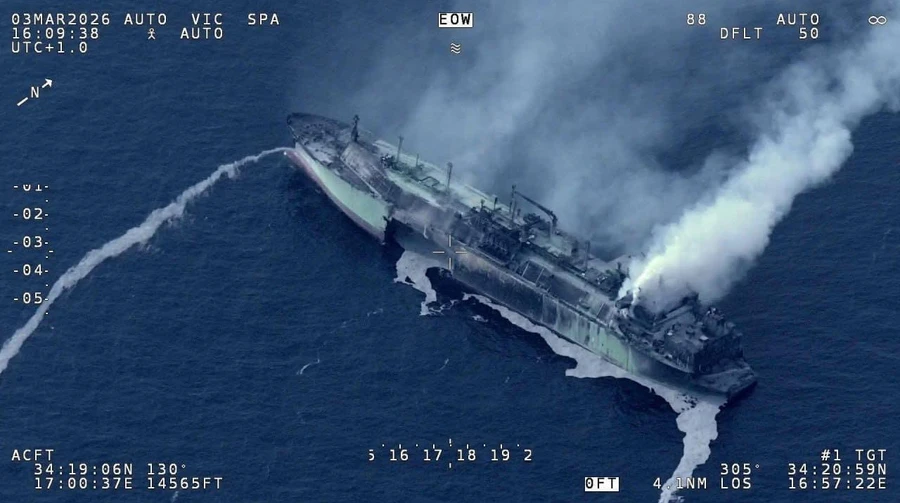
A Russian-flagged liquefied natural gas tanker under international sanctions caught fire and sank in the central Mediterranean on 3 March, with Moscow blaming Ukrainian naval drones launched from the Libyan coast. Ukraine has not commented.
Russia's Ministry of Transport said the vessel was struck near EU waters, according to BBC. "An attack was carried out on a Russian vessel, gas tanker Arctic Metagaz, in the immediate vicinity of the territorial waters of an EU member state — the Republic of Malta," the ministry said. According to Moscow, the strike was launched by Ukrainian unmanned surface vessels from the Libyan coast. Ukraine has not commented on the accusations.
Libyan port authorities confirmed the sequence of events, saying the tanker "experienced sudden explosions followed by a severe fire, which ultimately led to its complete sinking." The wreckage lies, according to their statement, "in the maritime zone between Libya and Malta, within the Libyan search-and-rescue zone approximately 240 kilometres north of the port of Sirte."
The Arctic Metagaz, a 277-metre LNG carrier built in 2003 and operating under a Russian flag, ignited in waters near Malta on the morning of 3 March, according to maritime security sources cited by Reuters. Video of the fire circulated on Telegram and X; maritime OSINT analyst H. I. Sutton assessed the footage as authentic. Explosions reportedly preceded the blaze. The vessel later sank. Arctic Metagaz YouTube channels released video of the reportedly damaged Russian-flagged LNG tanker.
All 30 crew members — Russian nationals — survived. Malta's Armed Forces said they received a distress message, launched a search operation, and located the sailors in a lifeboat inside Libya's search-and-rescue region. "Survivors were subsequently located within the Libyan SRR in a lifeboat during the search effort. All crew were reported safely onboard the lifeboat," the Armed Forces of Malta said in a Facebook statement. Moscow credited the joint response of Maltese and Russian rescue services for the evacuation.
Russia's Transport Ministry, in a statement also carried by Interfax, characterised the incident as "an act of international terrorism and maritime piracy." Reuters, citing sources, reported the tanker may have been attacked by a Ukrainian naval drone, but noted the source provided no evidence for the claim. Ukraine's Security Service did not respond to requests for comment. Ukrainian authorities have not publicly addressed the incident.
The Arctic Metagaz last transmitted its location on 2 March near the Maltese coast, according to MarineTraffic data. According to Starboard Maritime Intelligence, as cited by The Insider, the vessel switched off its AIS transponder that evening as it exited Malta's exclusive economic zone — a practice Ukrainian intelligence says is common among vessels transporting sanctioned Russian LNG, and one that violates international maritime law. Images of the burning vessel circulated on social media, though their authenticity was not officially confirmed.
The vessel had departed Murmansk on 24 February. On 18 February, it loaded LNG at the Saam FSU, a floating storage unit belonging to Novatek drifting under a Russian flag roughly 50 kilometres northwest of Murmansk, The Insider reported. It then transited around the United Kingdom and Spain before entering the Mediterranean, with Port Said, Egypt listed as its declared destination.
According to Ukrainian military intelligence, the Arctic Metagaz was part of the logistics chain for the Arctic LNG 2 project, carrying sanctioned LNG to the Chinese terminal at Beihai. The vessel is listed in the War & Sanctions database maintained by Ukraine's Defence Intelligence. It has been under EU, Swiss, Canadian, and New Zealand sanctions since 2024; the Arctic LNG 2 project itself is subject to US and UK sanctions.
Greek maritime security firm Diaplous Group confirmed the fire. "We can confirm that the incident took place, but at this point we have no details," a company representative told gCaptain.
The Greek outlet Naftemporiki reported that Ukrainian special forces operatives are active in Libya and suggested the drones were launched from Libyan territory, though it provided no supporting evidence. Multiple other outlets have circulated similar accounts, all citing unnamed sources rather than official statements.
This is not the first time a vessel linked to Russia's shadow fleet has been struck in the Mediterranean. In December 2025, the Kendil — an Oman-flagged shadow fleet ship — was hit in waters between Crete and Malta, according to Ukrainian media and maritime security companies, as reported by Euronews.
Israel-US military operation against Iran
The Mediterranean was already under heightened military attention when the tanker sank. On 28 February, Israel struck Tehran, after which US President Donald Trump announced that American forces had launched what he called "a large-scale combat operation" against Iran, aimed at eliminating what he described as "imminent threats from the Iranian regime." Trump accused Iranian authorities of "financing and training" militants across Syria, Lebanon, Iraq, and Hamas in Palestine, and stated the operation's goals included "destroying Iran's missile industry and fleet."
Iran's Islamic Revolutionary Guard Corps said it launched missiles and drones toward Israel and struck US military bases in Qatar, Saudi Arabia, and the United Arab Emirates.
Trump announced on 28 February 28 that Supreme Leader Ali Khamenei was dead — a claim subsequently confirmed by Iran's Islamic Republic News Agency. By 1 March, the IRGC declared it was launching what it called "the most destructive offensive operation in the history of the Islamic Republic" against Israel and US military targets. On 3 March — the same day the Arctic Metagaz sank — US Secretary of State Marco Rubio stated that the next phase of American military operations against Iran would be even more destructive. That same day, according to sources cited by Iran International, Iran's Assembly of Experts elected a new supreme leader: Mojtaba Khamenei, son of the deceased ayatollah.
France called for an emergency UN Security Council session. The EU reaffirmed what it described as its "unwavering commitment to ensuring regional security and stability" in the Middle East. Ukrainian President Volodymyr Zelenskyy said it was fair to give Iranians "a chance to get rid of the terrorist regime and guarantee security for all peoples who have suffered from attacks from Iran."