
Something has shifted in Tbilisi. The Georgian Dream is no longer bothering to keep up appearances.
Instead, the regime is striking preemptively—dismantling every unit of social mobilization and pushing the country toward managed poverty and emigration. What's unfolding is a systematic dismantling of Georgia's social and economic fabric. But the process is rushed and brittle.
From late January to mid-February 2026, the regime launched a crackdown targeting democratic leaders and university faculties, neighbourhood pharmacies, and imported cars—all at once, with a speed and scope that defy the usual autocratic playbook.
Regimes typically tighten the screws gradually, saving the harshest measures for after dissent is crushed. In Georgia, it is all happening while political parties, civil society, and independent media are still functioning—and while people have been protesting daily for more than a year and a half. So why the rush?
Because the Georgian Dream knows it is structurally fragile—and is gambling against time.
Criminalizing dissent
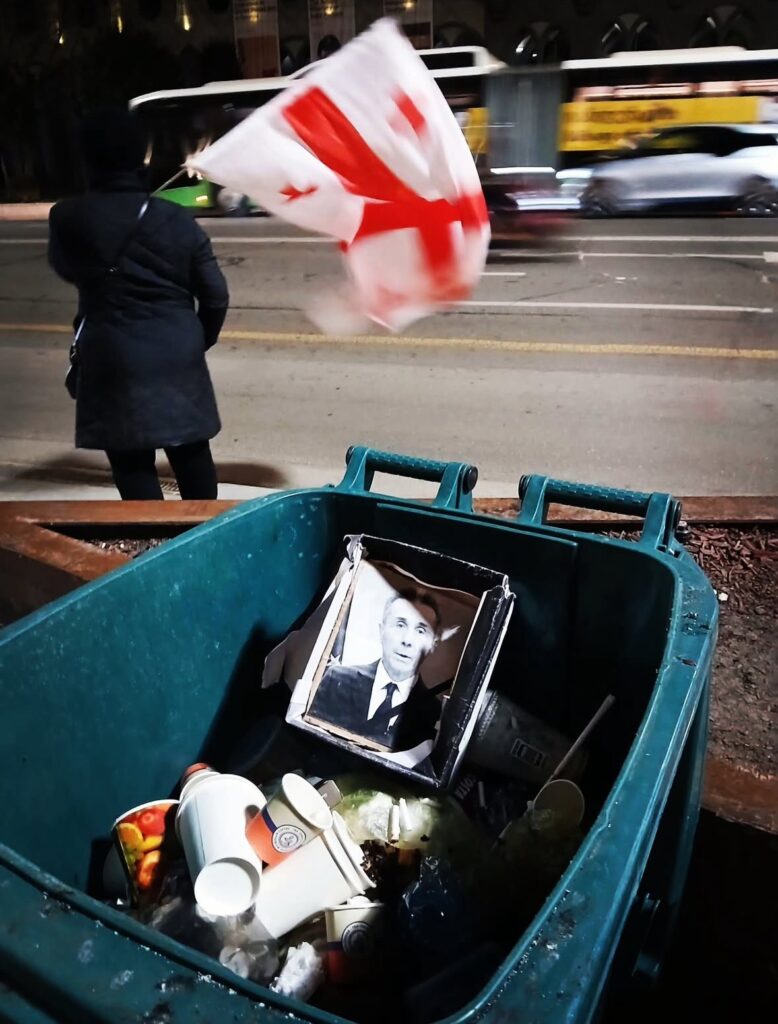
Shadow autocrat and Russian-made oligarch Bidzina Ivanishvili in a garbage bin.
Picture by X account @True_Georgian
The centrepiece is a sweeping "Grants Law" being fast-tracked through parliament. In theory, it could target not just opposition politicians and civil society organizations but remittances from the Georgian diaspora and even basic person-to-person transactions.
The law also criminalizes "external lobbying"—essentially any activity abroad promoting democracy in Georgia or advocating for EU integration.
To understand the stakes, consider what foreign-funded civil society actually does in Georgia. Georgian NGOs receive over 90% of their funding from abroad—and they do work the government won't: monitoring elections, investigating corruption, providing legal aid, running shelters, supporting investigative journalism.
As scholar Julie George wrote, "what many CSOs in Georgia do is governance that the government does not."
The Georgian Dream has been working to destroy this infrastructure since 2024, when it passed a Russian-style foreign agents law requiring organizations receiving more than 20% of their funding from abroad to register as "pursuing the interests of a foreign power"—with debilitating fines for noncompliance.
The vast majority of Georgia's roughly 26,000 NGOs refused to register.
The Grants Law escalates from fines to prison. It blurs the lines between legal and illegal so thoroughly that the public is left wondering what lawful conduct even looks like anymore.
Numerous legal experts in Georgia have said as much, including Tamar Oniani, the Chairperson of Georgian Young Lawyers' Association (GYLA). With criminal penalties of up to 6 years—and in some cases up to 12—the broad scope and vague wording do not inherently exclude remittances (11.9% of Georgian GDP in 2024). The exemption has been confirmed only verbally by some Georgian Dream MPs.

Georgia’s Foreign Agents law: Russia’s new frontline in its war against freedom in the world
Meanwhile, while all Western funding is being criminalized, China continues to fund a program popularizing China on Georgia's pro-Kremlin media outlet Obiektivi.
The law could also criminalize basic transactions within Georgia itself: Michael O'Flaherty, Commissioner for Human Rights of the Council of Europe, underlined in his 2 February statement that the new law "would encompass any cash or in-kind transfer from one person to another person that may be used to carry out activities with the belief or intention of exerting any influence on the government, state institutions or any part of society."
In practice, the law will most likely be applied selectively. But its vast scope and deliberate vagueness mean it could criminalize almost anyone—and under a regime this reckless, that is the point. As constitutionalist Davit Zedelashvili notes, the regime has given critics a choice: prison or exile.
Even before the Grants Law, Human Rights Watch assessed the 2025 draconian laws to be "decimating the country's vibrant civil society."
Prosecuting the opposition
Those on trial are Mikheil Saakashvili, Giorgi Vashadze, Nika Gvaramia, Nika Melia, Zurab Japaridze, Elene Khoshtaria, Mamuka Khazaradze, and Badri Japaridze. Different parties.
— Terje Helland (@terjehelland) February 10, 2026
Different political roles.
One courtroom. One message: opposition itself is the crime.
3/10 pic.twitter.com/XbQuw8zKLy
The regime is also considering a ban—and jail time—for refusing to recognize the "legitimacy of constitutional bodies" (read: the legitimacy of the Georgian Dream). Three opposition party chairpersons, Zurab Girchi Japaridze, Giorgi Vashadze, and Nika Gvaramia, have just left jail, but their passports and ID cards have been confiscated to ban them from exiting the country, and they face further prosecution.
Others, chiefly Elene Khoshtaria, Nika Melia, and Mikheil Saakashvili, remain imprisoned, although Saakashvili's case is older and stems from a somewhat different context.
Yet the regime is pressing ahead with prosecuting almost all democratic leaders over "state sabotage" and related "crimes." The harshest charge—"assistance to a foreign country, foreign organisation or an organization controlled by a foreign state in hostile activities," which the Georgian Dream interprets as advocating for targeted sanctions over Russia sanctions evasion and human rights violations—carries 7 to 15 years in prison.
Three leaders are being prosecuted specifically for sanctions advocacy: Elene Khoshtaria of Droa, Zurab Girchi Japaridze of Girchi–More Freedom, and Giorgi Vashadze of Strategy Aghmashenebeli. Japaridze and Vashadze have been banned from leaving Georgia, their passports and IDs confiscated.
The absurdity deserves spelling out. Russia still occupies 20% of Georgian territory since the 2008 invasion. After Russia's full-scale invasion of Ukraine in 2022, the Georgian Dream refused to join Western sanctions against Moscow and began echoing Russian propaganda narratives—earning the regime the nickname "Russian Dream."
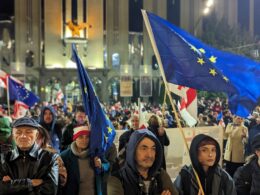
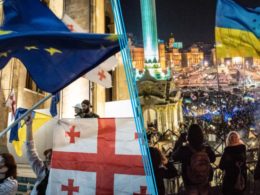
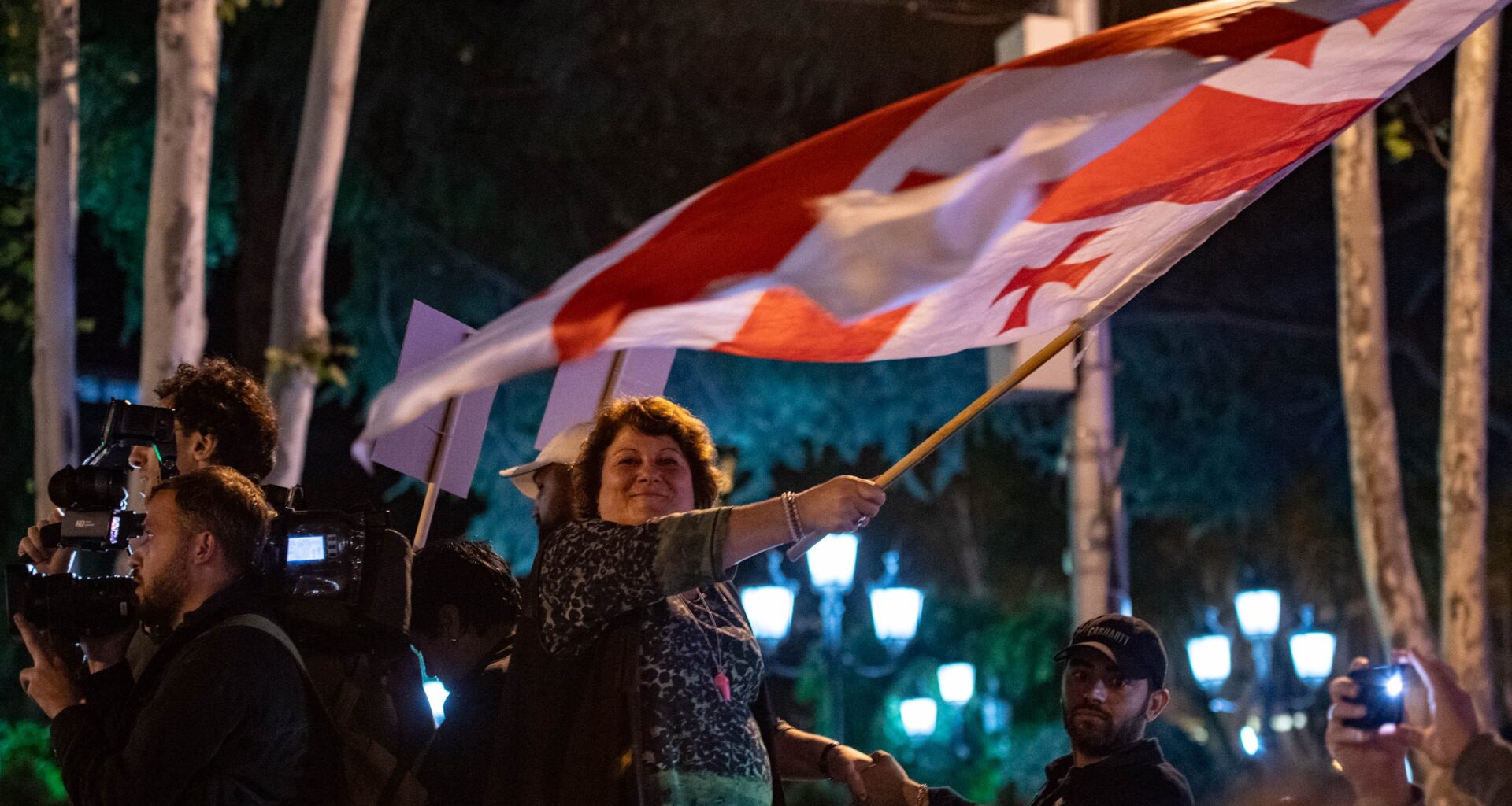
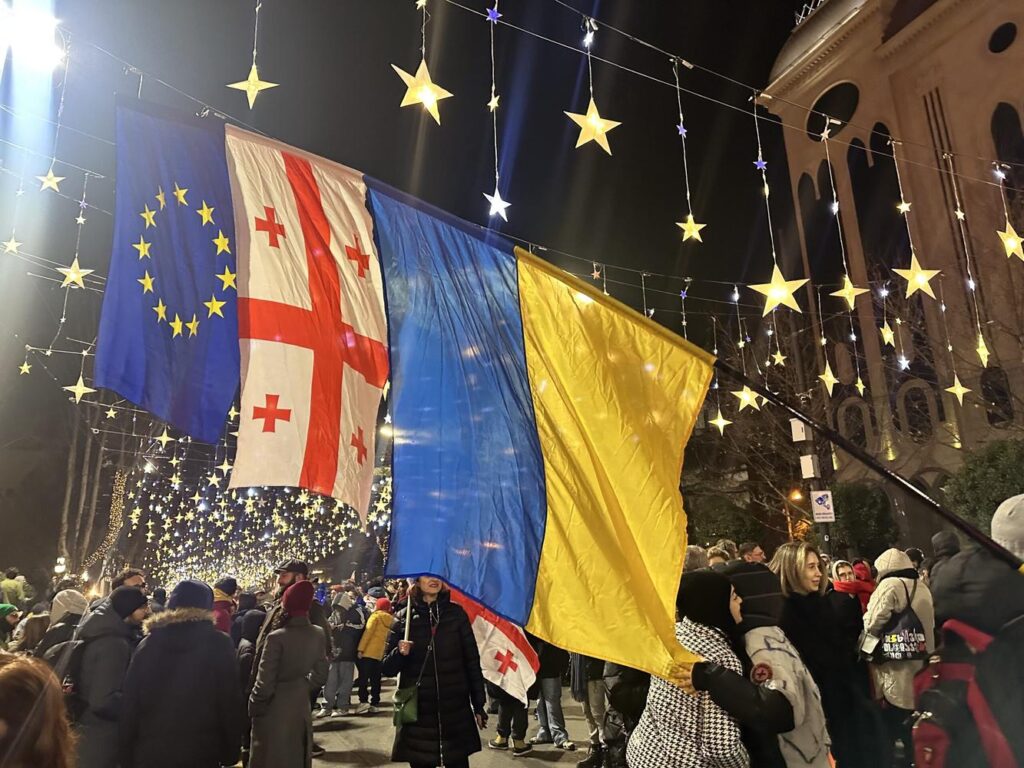
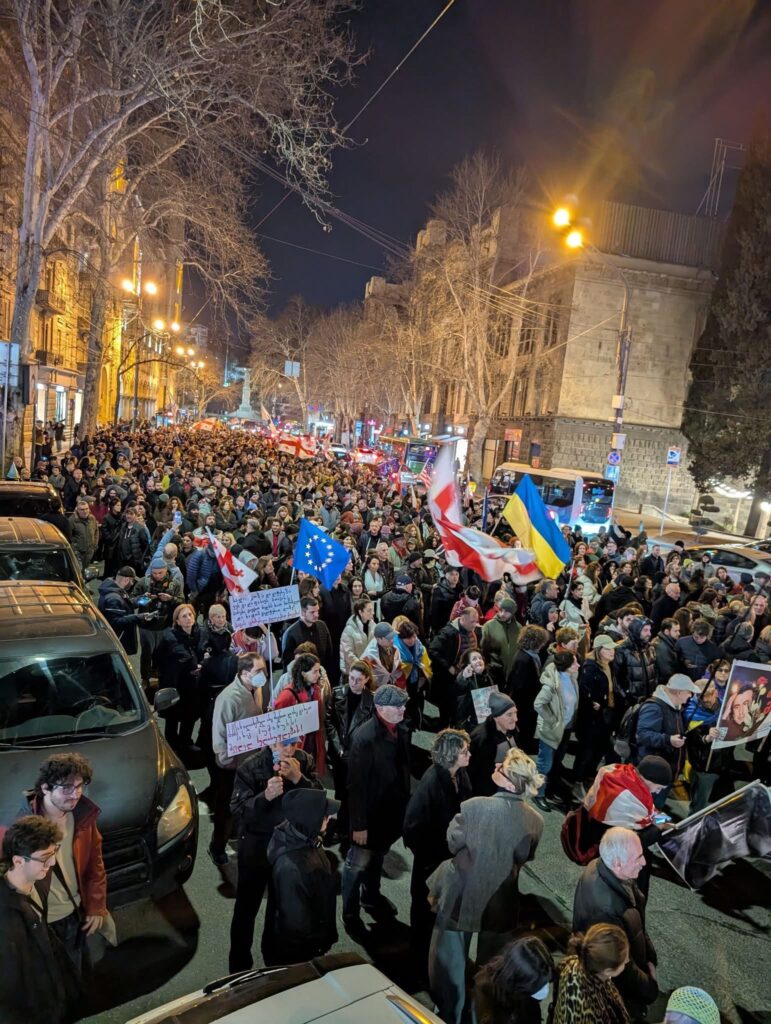
Ordinary Georgians see it differently: Ukrainian flags fly alongside Georgian and EU flags at the daily protests against falsified elections, and Georgians openly view Ukraine's fight as their own. The regime's response is to jail the people calling for sanctions against Georgia's occupier.
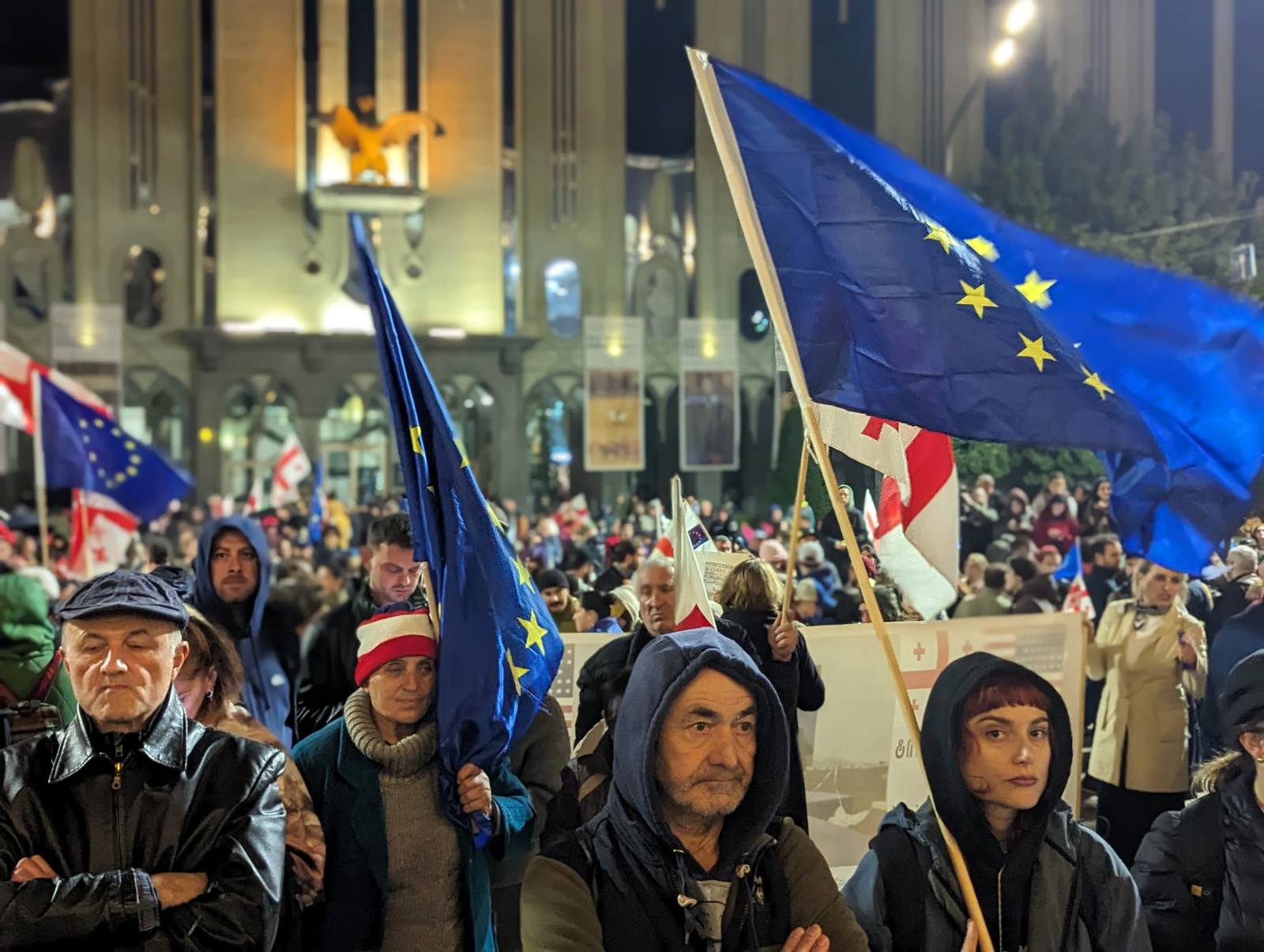
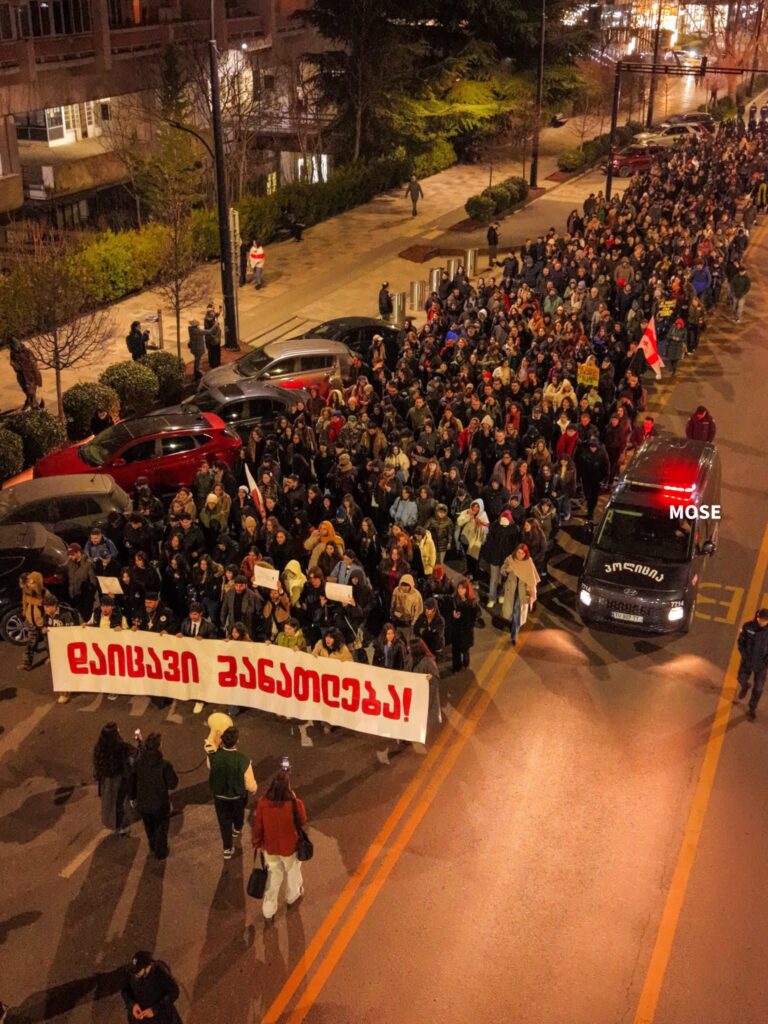
Several peaceful protesters are currently detained for protesting on a sidewalk outside the Parliament of Georgia—the daily location of protests for almost 450 days. Protesting on that sidewalk more than once is now a criminal offense punishable by up to a year in prison.
Crackdown on universities
In a long-anticipated but sudden "one city–one faculty" decision, the regime effectively gutted the majority of state universities.
Ilia State University, the most prominent government-critical university, is only allowed to keep 2 faculties and just 8% of its previous admissions—essentially a closure.
Education Minister Givi Mikanadze stated that all affected universities learned about the changes from his briefing. Bachelor's programs are shortening from 4 years to 3; master's programs from 2 years to 1.
This is not an educational reform. By liquidating faculties and shortening degrees, the regime is de-Europeanizing its youth.
Prime Minister Irakli Kobakhidze does not hide that an aggressive cut in student numbers is meant to fill understaffed sectors—often underpaid jobs in a country where the median monthly salary is the equivalent of EUR 420 in 2025, while prices rival Western Europe (in Kobakhidze's own admittance).
The real goal is to turn students into cheap, exhausted workers as fast as possible—reducing the time and intellectual space young people have to organize.
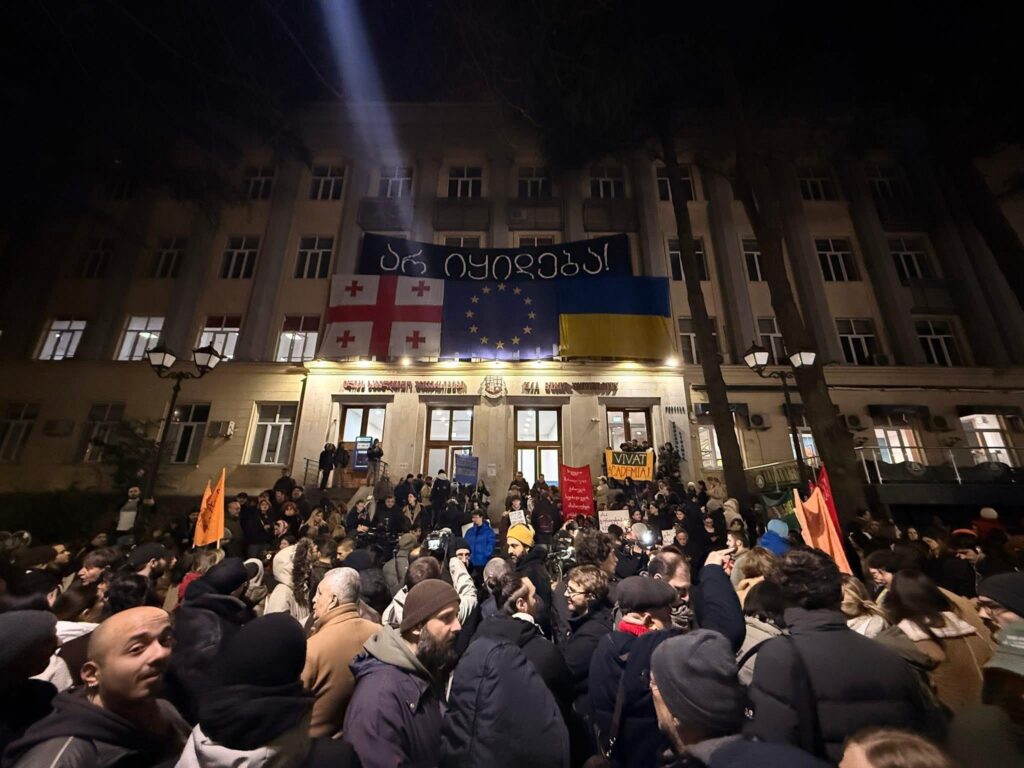
The crackdown on academia is not popular. Georgians already call it a "deform."
Meanwhile, the Georgian Dream launched TV "debates" with its own proxies on the "necessity" of EU integration. In Georgia, where EU and NATO integration are constitutionally enshrined and seen by the overwhelming majority as non-negotiable, staging debates with proxies who openly advocate "neutrality" serves one purpose: normalizing the idea of abandoning Europe.
There have long been suggestions that the Georgian Dream would aim for a constitutional majority in the next elections and erase EU and NATO membership from the Constitution entirely.
Since the Georgian Dream controls all institutions, has incomparable financial resources, a security apparatus trained in population manipulation and intimidation from previous cycles, soon-to-be-banned democratic parties, and a shrinking independent media space, any elections held under the current legislative framework, as well as power disposition, would inherently be rigged.
Moreover, when the Georgian Dream announced in late October 2025 a list of parties to be banned, they openly stated that several parties would be banned in the future if they grew strong enough to cross the electoral threshold of 5%.
Reshaping the economy from the top down
Trending Now
The State Security Service is now auditing supermarkets, and a parliamentary commission has been set up to study high prices on food, fuel, and medicines. 3 out of 8 MPs on the commission are millionaires according to a 2024 RFE/RL research, while a total of 7 are informally believed to be millionaires.
State-mandated price caps are a populist move, but they risk alienating the business sector—which has long tended to go along with the regime.
Critics point out that the real drivers of high prices are monopolies, oligopolies, and cartel arrangements that have taken shape in recent years and are deeply intertwined with the ruling class. Without breaking up the crony power structure, the Georgian Dream is more likely to antagonize businesses than actually lower prices.
Kobakhidze has also floated bans on how many pharmacies and supermarkets can operate in close proximity—a move that would reshape the retail economy and daily life across the country. The Georgian Pharmacists Association warns that reducing the number of pharmacies will raise prices, not lower them.
Georgia will also ban the import of cars older than 6 years, an unpopular, seemingly unnecessary decision that a government concerned with a mass projection of smoothness would most likely shy away from, especially in a condition of already contested legitimacy.
It is not fully clear how exactly a step against neighbourhood pharmacies and supermarkets would benefit the regime. However, the Georgian Dream's incentives towards monopolizing financial resources in the country are clear from the broader context.
Limiting options for shops and pharmacies restructures the economy and risks further inflows towards regime-affiliated businesses at the expense of economic plurality and economic independence of the grassroots, especially since Georgia is full of small, family-run neighbourhood supermarkets. Economic independence is, of course, one of the main backbones of dissent in political theory.
While these are not facts that have already taken place, it is important to analyze the trajectory and rhetoric of the Georgian Dream to anticipate what's next—and, given their rushed speed, no tools of readiness to analyze and respond to the unfolding patterns in Georgia are premature.
Gutting universities, going after corner pharmacies—this is no longer just a political crisis. The regime is taking apart the fabric of Georgian daily life.
International isolation becomes institutional
As the domestic crackdown accelerates, the Georgian Dream's international isolation is hardening—not just in reputation, but in institutional exclusion. The regime has been shut out more thoroughly than any hybrid regime on the European continent, and far more than Azerbaijan, which the West views as geopolitically indispensable.
For example, the government of Serbia is criticized but still cooperates with, and is treated as legitimate. The EU and democratic actors denounce democratic backsliding but continue engagement, meeting with Serbian government members in person. This has repeatedly caused significant frustration among Serbian protesters. President Vucic also continues accession negotiations with the EU and portrays himself as a rational, transactional power playing a multi-vector game.
The Georgian Dream had assumed that Europe would eventually accept Georgia as it was—yet another autocracy in the neighbourhood. The improving relations between Armenia and Azerbaijan must have been a cold shower, and particularly TRIPP, the new connectivity and transit project between, as well as through, the two states, pushed for by President Trump.
The regime is openly frustrated by its inability to build a functional relationship with the Trump administration, demonstrated all too well by Vice President Vance's early February 2026 visit to Armenia and Azerbaijan—but not Georgia.
On 24 February 2026, the United Kingdom imposed Russia sanctions regime on the Georgian Dream's key propaganda media outlets, Imedi TV and POSTV, for spreading disinformation about Ukraine and aiding Russia in its informational war effort.
Possibly the heaviest long-term institutional blow so far came on 29 January 2026: 24 OSCE states invoked the OSCE Moscow Mechanism.
Despite the unfortunate name, the Moscow Mechanism is a tool for investigating gross human rights violations on the ground—and it does not require the authorities' consent. The fact-finding mission began operating in Georgia on 11 February.
The very invocation places Georgia in the company of Russia, Belarus, and Turkmenistan. The mechanism has previously been used for Chechnya, the Yugoslav wars, and Russia's invasion of Ukraine, including the treatment of Ukrainian prisoners of war in July 2025.
The OSCE Moscow Mechanism does not automatically trigger further targeted sanctions. But it is a formal institutional alarm—and targeted sanctions now become a matter of Western governments' credibility.
On 11 February, EU states (sans Hungary and Slovakia) voted to suspend visa-free travel for Georgian diplomatic and service passport holders. The decision takes effect in early March.
The structural weakness of autocracy in Georgia
The Georgian Dream is autocratizing at lightning speed and all-encompassing scope. But it has no robust security apparatus, no rallying ideology, or any positive vision of the national future. Policy researcher Hans Gutbrod calls the combination of desired total control and lack of any positive promise to the populace a "nihilistic totalitarianism."
There is no economic backbone of its own, and no stable international patron to ensure the regime's longevity—Russia is burning through its resources in Ukraine.
Autocratic political culture in Georgia is not the norm. The public is increasingly searching for a viable alternative, and Georgians consider the West their civilizational home.
"Chinese investment, Russian capital, and Arab construction projects are far less manageable and stable than oil and gas revenues, for example," says Bashir Kitachaev for Carnegie Politika.
To quote Kitachaev further: "The government in Tbilisi may jail opposition figures, disperse rallies, and ban opposition parties, but until it can eliminate the potential for new waves of public protest, it will be unable to establish a truly stable authoritarian regime." I only disagree with calling the Georgian Dream a "government."
For all its recklessness, the regime still clings to some trappings of hybrid governance. It is anxious to avoid further international pressure—more targeted sanctions, loan freezes from international financial institutions. It still tries to convince the domestic public that it has international legitimacy, hence the obsession with literal handshakes with European and American officials, quickly broadcast by regime media.
Legitimacy is still a currency for the Georgian Dream, and losing it still hurts.
Given all this, the Georgian Dream's rational move would be to keep up the pretense of normalcy—contain repression to active opponents, let ordinary people think life goes on as usual, and avoid provoking the broader public.
And yet the regime is doing the opposite—going after universities, pharmacies, car imports, the daily fabric of ordinary life. So why abandon a strategy that serves its survival?
Why the rush
Oligarch Bidzina Ivanishvili and his regime know that time—and any misstep along the way—could mobilize a youth and a population that is already largely against them. The regime's long-term bet is to dismantle every space where people can organize and push the country into poverty and emigration.
The crackdown touches everything. But the apparatus enforcing it is thin, the ideology is absent, and the population already knows the West—and considers it home.
Whether the gamble pays off is yet to be seen. But there are all too many places to stumble along the way.
Those on trial are Mikheil Saakashvili, Giorgi Vashadze, Nika Gvaramia, Nika Melia, Zurab Japaridze, Elene Khoshtaria, Mamuka Khazaradze, and Badri Japaridze. Different parties.
— Terje Helland (@terjehelland) February 10, 2026
Different political roles.
One courtroom. One message: opposition itself is the crime.
3/10 pic.twitter.com/XbQuw8zKLy