

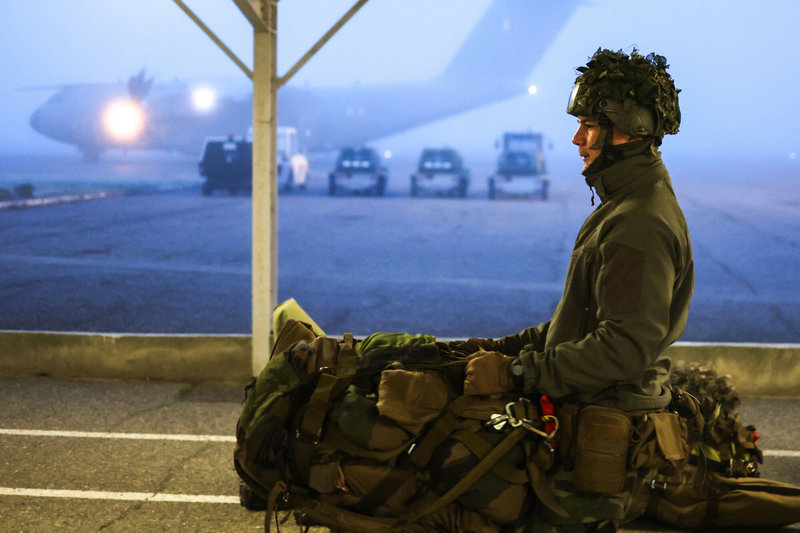
British and French paratroopers are drilling in Brittany for a possible peacekeeping deployment to Ukraine—but the Coalition of the Willing that would send them is struggling to agree on whether it even can.
Over 600 soldiers from Britain's 16 Air Assault Brigade jumped alongside France's 11e Brigade Parachutiste and an Italian platoon during Exercise Orion, a major French-led drill involving 24 partner nations. The nine-day exercise, which began on the fourth anniversary of Russia's full-scale invasion and runs through 3 March, tested drone integration, hybrid communications, and the ability to hold a position for 48 to 72 hours without resupply, the Telegraph reported.
The paratroopers are among Britain's highest-readiness forces and could form the backbone of the 10,000-strong contingent that London and Paris have pledged to Ukraine if a ceasefire is reached. The question is no longer whether these soldiers can deploy. It's whether their governments will let them.
"These guys are the tip of the spear of the conventional army. They are the most ready people to go and do anything." — UK defense source, via the Telegraph
A force that needs the enemy's permission
Two days before the exercise began, the Telegraph reported that a growing number of Coalition members had privately conceded their troop contributions depended on Moscow's approval—effectively handing Putin a veto over the force designed to deter him.
The mechanism is structural. Security guarantee negotiations have merged with the US-mediated ceasefire talks, meaning Russia now has a say over who keeps the peace. One senior diplomatic source told the Telegraph: "If Russia says we don't agree to it and consider those troops a target, then you need to send a different kind of force."
After the Paris Declaration in January, Moscow warned it would target any Western troops deployed to Ukraine. That threat appears to be driving the consent demand from inside the Coalition itself.
A pattern of shrinking ambition
The Coalition's trajectory has been one of steady retreat. In April 2025, Britain's defense chief proposed a 64,000-strong force. European ministers said they could barely muster 25,000. That same month, only six of 30 countries committed to sending troops at all.
Britain's own capacity is under strain. The Army has shrunk to about 70,000 troops—its smallest size in over 200 years. To send 5,000 to Ukraine, the UK would likely have to pull soldiers from Estonia and Cyprus, the Telegraph reported. Armed forces minister Al Carns warned this week that Britain is three to five years away from a significant confrontation with a major state and that its military "hasn't changed from the 1990s."
President Zelenskyy, meanwhile, said last week that 10,000 Western soldiers parked in Lviv, far from the front, would do nothing to stop Russia. He wants partner forces closer to the line of contact—a demand that makes the Russian-consent problem even harder to solve.
Paratroopers train to secure Ukraine while diplomats negotiate whether Russia will let them try. Until that contradiction resolves, the Coalition of the Willing remains a coalition of the preparing.n remains a rehearsal for a mission that exists on paper but not yet in political will.
Read also
-
Telegraph: Coalition of the Willing will only send troops to Ukraine with Putin’s consent
-
10,000 troops in Lviv won’t stop Russia — Western soldiers need to be deployed where real threat is, says Zelenskyy
-
Former UK PM says West should deploy troops to Ukraine before a ceasefire, not after
-
Only 6 of 30 “coalition of willing” countries ready to send peacekeepers to Ukraine
-
The Times: “Coalition of the willing” for Ukraine struggles to materialize amid Europe hesitation


