

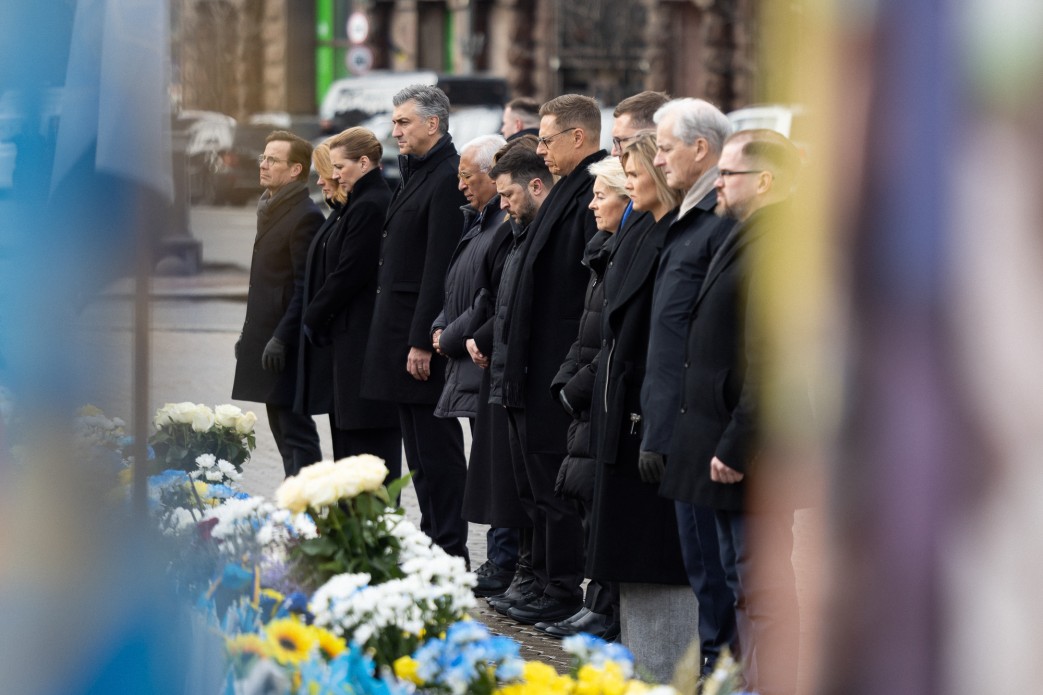
As European leaders gathered in Kyiv on 24 February to mark four years since Russia’s full-scale invasion, two EU member states were working to undermine the very support they came to reaffirm—with Hungary blocking a €90 billion ($106 billion) loan and the 20th sanctions package against Russia, and Slovakia ordering a halt to emergency electricity supplies to Ukraine.
“This is a real financial guarantee for our security and our resilience,” Ukrainian President Volodymyr Zelenskyy told European Parliament members in a live address from Kyiv.
European Commission President Ursula von der Leyen, European Council President António Costa, and leaders from Denmark, Estonia, Finland, Latvia, Lithuania, Croatia, Norway, Sweden, and Iceland arrived in Kyiv in a show of solidarity.
But from Budapest and Bratislava, Hungarian Prime Minister Viktor Orbán and Slovak Prime Minister Robert Fico were dismantling that solidarity from the inside.
“This is a real financial guarantee for our security and our resilience,” Ukrainian President Volodymyr Zelenskyy told European Parliament members in a live address from Kyiv, referring to the frozen loan. “It must be implemented.”
Four weeks from Russian strike to EU sabotage
The veto and electricity threat didn’t come out of nowhere. They capped a month-long escalation that began when Russia struck the Druzhba pipeline at Brody, Lviv Oblast, on 27 January—and escalated through a diesel cutoff, ultimatums, and finally the loan veto and electricity halt, as Budapest and Bratislava retaliated against Kyiv rather than Moscow.
Russian drone hits pipeline infrastructure at Brody, Lviv Oblast. Oil transit to Hungary and Slovakia stops.
Budapest and Bratislava cut diesel exports, blaming Kyiv for not repairing the pipeline Russia bombed.
Slovak PM issues 48-hour ultimatum: resume oil by Monday or lose emergency power supplies.
Hungary blocks both the 20th sanctions package and €90 billion loan to Ukraine, breaking a December pledge.
Slovakia announces end of emergency grid assistance. Ukrenergo says actual impact is a price change, not a cutoff.
Ten EU leaders visit Kyiv on invasion anniversary. UK unveils largest sanctions package since 2022.
A pledge broken, consequences mounting
The financial stakes are severe. An IMF program worth $8.2 billion, currently under negotiation, is conditional on Kyiv receiving the EU loan. If the loan stays frozen, so does the IMF money. Ukraine faces a budget gap as early as April—the country spends all its tax revenue on defense and depends entirely on foreign financing for pensions, hospitals, and schools.
“Ukraine can import emergency energy, but at a different price.”
Fico’s electricity threat, meanwhile, appears largely performative. Ukrenergo CEO Vitaliy Zaichenko told The Kyiv Independent that Slovakia had changed pricing terms rather than genuinely cut supply. “Ukraine can import emergency energy, but at a different price,” he said. “It’s nothing serious.”
Energy experts have noted that EU law and ENTSO-E rules prohibit unilateral suspension of cross-border electricity flows—making a full cutoff legally unenforceable regardless of what Fico announces.

Slovakia can’t legally cut power to Ukraine under EU rules—any blackout move would break ENTSO-E deal
Allies act while vetoes hold
While Orbán and Fico blocked EU-level action, other allies moved forward. The UK unveiled its largest sanctions package since 2022—nearly 300 new designations targeting PJSC Transneft, the pipeline company responsible for transporting over 80% of Russian oil exports and operator of the Russian section of the Druzhba pipeline.
The package also hit 175 companies in the 2Rivers shadow fleet network, nine Russian banks, and three Rosatom subsidiaries.
France and Britain convened the 15th meeting of the Coalition of the Willing, the grouping of some 35 nations—including many European countries, Australia, Japan, and New Zealand—working on post-ceasefire security guarantees for Ukraine. No US representative attended.

UK and Australia impose largest sanctions packages against Russia since 2022, targeting oil giant Transneft and shadow fleet
European Parliament fires back
European People’s Party MEP Michael Gahler said the attitude of both Orbán and Fico would go down in European history books as “quislings even without occupation.” Greens co-leader Terry Reintke was blunter: “He has become Putin’s cheap servant. He has not only betrayed Ukraine, he has betrayed all of us.”
The sole dissenting voice came from the far-right Europe of Sovereign Nations.
Even the center-right European Conservatives and Reformists took a veiled shot. Co-leader Nicola Procaccini said history would provide “contempt to whoever is turning their backs to Ukraine, to the freedom, the sense of honour.”
The sole dissenting voice came from the far-right Europe of Sovereign Nations. Slovak MEP Milan Uhrík said his group opposes continued support for Ukraine and doesn’t want “to send any more money, any more weapons there.” His speech was met with boos.
Read also
-
“We will not back down”: EU leaders arrive in Kyiv on fourth anniversary of Russia’s full-scale invasion
-
How Ukraine’s economy survived four years of war—and what it cost
-
“Present for Putin”: Slovakia cuts electricity flows for millions of Ukrainians amid Russia’s winter terror and war’s fourth anniversary
Russian drone hits pipeline infrastructure at Brody, Lviv Oblast. Oil transit to Hungary and Slovakia stops.
Budapest and Bratislava cut diesel exports, blaming Kyiv for not repairing the pipeline Russia bombed.
Slovak PM issues 48-hour ultimatum: resume oil by Monday or lose emergency power supplies.
Hungary blocks both the 20th sanctions package and €90 billion loan to Ukraine, breaking a December pledge.
Slovakia announces end of emergency grid assistance. Ukrenergo says actual impact is a price change, not a cutoff.
Ten EU leaders visit Kyiv on invasion anniversary. UK unveils largest sanctions package since 2022.


