


Russia will not accept any Ukrainian government that rejects Kremlin control, and Putin is pushing for Ukraine's capitulation now — before economic pressures force difficult choices in late 2026 — while dangling bilateral business deals to distract Washington from the war negotiations, according to the Institute for the Study of War (ISW).
European spy chiefs call Geneva talks "negotiation theater"
ISW reports that the heads of five European spy agencies told Reuters that Russia does not want a quick end to the war. One intelligence chief said the Kremlin's strategic goals have not changed and still include the removal of President Volodymyr Zelenskyy and forced Ukrainian neutrality. Another called the latest Geneva talks "negotiation theater." A third warned that even if Ukraine ceded the rest of Donetsk Oblast, Russia would simply make new demands. Territorial concessions, the intelligence chiefs assessed, would mark the beginning of negotiations rather than the end.
Their assessment clashes sharply with the White House, which Ukraine says wants a deal by June ahead of the US congressional midterm elections in November. US President Donald Trump has said he believes Putin wants to make a deal.
Lavrov repeats maximalist demands in Al-Arabiya interview
Russian Foreign Minister Sergei Lavrov gave an interview to Saudi state-owned Al-Arabiya on 18 February. Lavrov claimed the US and Russian delegations discussed their alleged "Alaska understanding" in Geneva, referring to supposed agreements from the August 2025 Alaska summit. He said these "understandings" address what Moscow calls the "root causes" of the war: Ukraine's NATO aspirations, the Ukrainian government's alleged discrimination of ethnic Russians, and restrictions on the Kremlin-backed Ukrainian Orthodox Church-Moscow Patriarchate.

EU wants Russia to hold free elections and withdraw troops from Belarus, Georgia, Armenia, and Transnistria— as part of a Ukraine peace deal, leaked paper shows
Lavrov called for recognition of Russia's illegal 2022 annexation of Luhansk, Donetsk, Zaporizhzhia, and Kherson oblasts. He blamed Ukraine for the war since 2014 and accused the EU of wrecking the Minsk agreements, deflecting Russia's own role in violating them. Lavrov also denounced Western security guarantees for Ukraine as threatening to Russia.
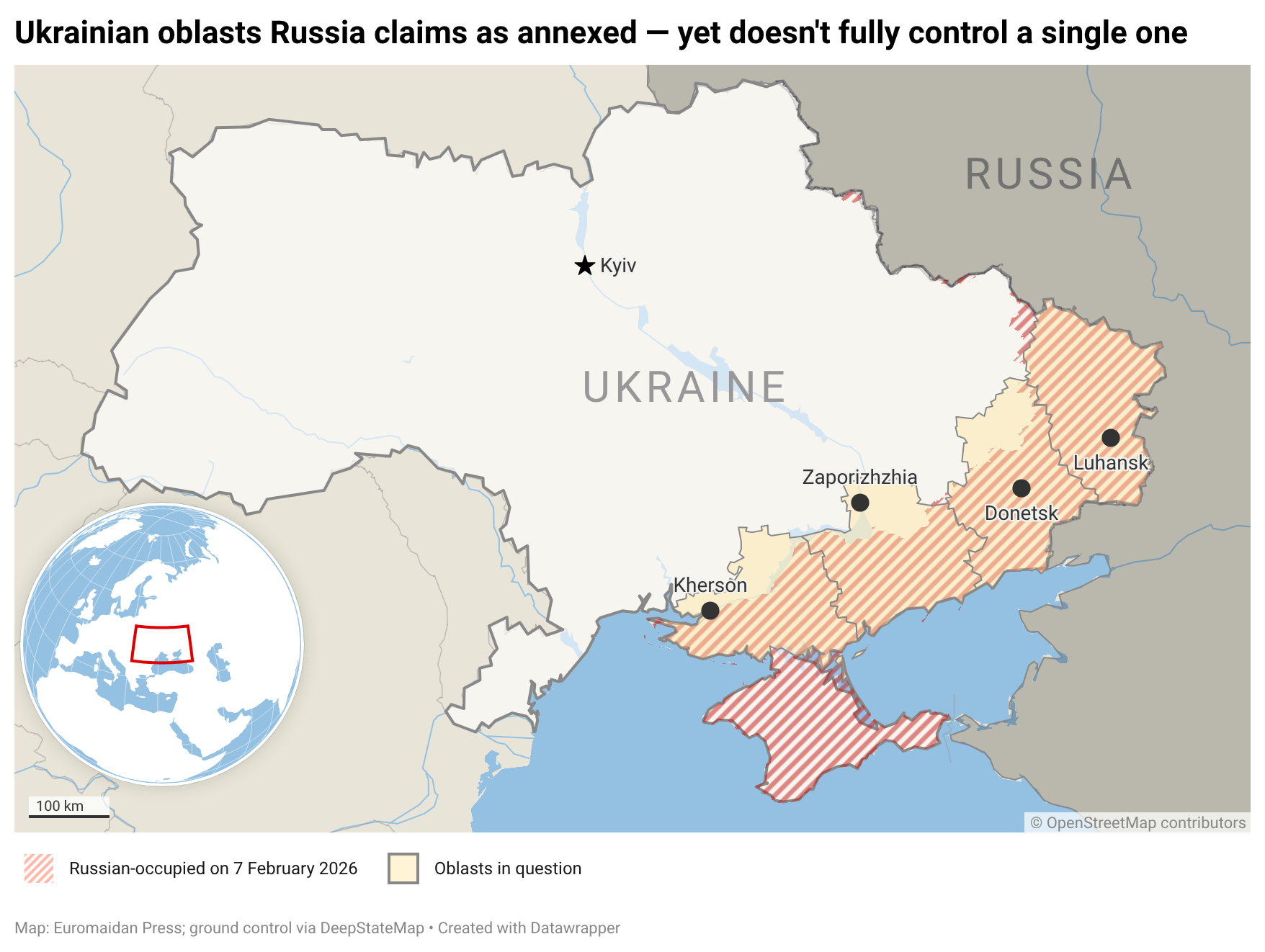
ISW noted that Lavrov's statements reveal the Kremlin's goals extend beyond removing Zelenskyy. By blaming both Zelenskyy and former President Petro Poroshenko for allegedly discriminating against ethnic Russians, Moscow showed it objects to any Ukrainian leader who refuses Kremlin control. Lavrov recently demanded that any future Ukrainian government be "friendly" toward Russia and "benevolent" — a clear signal that a new democratically elected government would not satisfy Moscow either.
Putin bets he can outlast the West economically — the data says otherwise
One intelligence chief told Reuters the "main issue" is that Putin neither wants nor needs a quick peace because Russia's economy is "not on the verge of collapse." But another source warned Russia faces "very high" financial risks in the second half of 2026 as sanctions and high borrowing costs limit Moscow's access to capital markets.
Trending Now

Trump extends all US sanctions against Russia for another year, calling it an “extraordinary threat”
The numbers suggest the clock is ticking. Bloomberg reported on 18 February that Russian oil producers drilled 3.4% fewer production wells in 2025 compared to 2024. Drilling activity slumped 16% in December alone.
Russian oil and gas revenues dropped to a five-year low in 2025, and Finance Minister Anton Siluanov acknowledged in September 2025 that Russia expects the share of budget revenue from oil and gas to fall by roughly 30% in 2026. ISW assessed that Putin's ability to manage these economic friction points is not indefinite.
Russia dangles business deals to distract the US
Four intelligence chiefs assessed that Moscow has spent the past year using talks with the US to push for sanctions relief and bilateral business deals. Two sources said Russia is trying to split negotiations into two tracks: one on the war, another on US-Russian economic cooperation.

Ukraine in exchange for money: US-Russia deal revenues could reach only $340 billion, far short of claimed $12 trillion
Kirill Dmitriev, Kremlin economic negotiator, claimed US sanctions are costly for American businesses and offered Trump an unrealistic $14 trillion deal if they were rolled back.
Kremlin spokesperson Dmitry Peskov called the sanctions "illegal" and said they hinder trade cooperation. Lavrov confirmed in the Al-Arabiya interview that Russia and the US have agreed to establish a bilateral economic working group alongside the trilateral Geneva talks.


